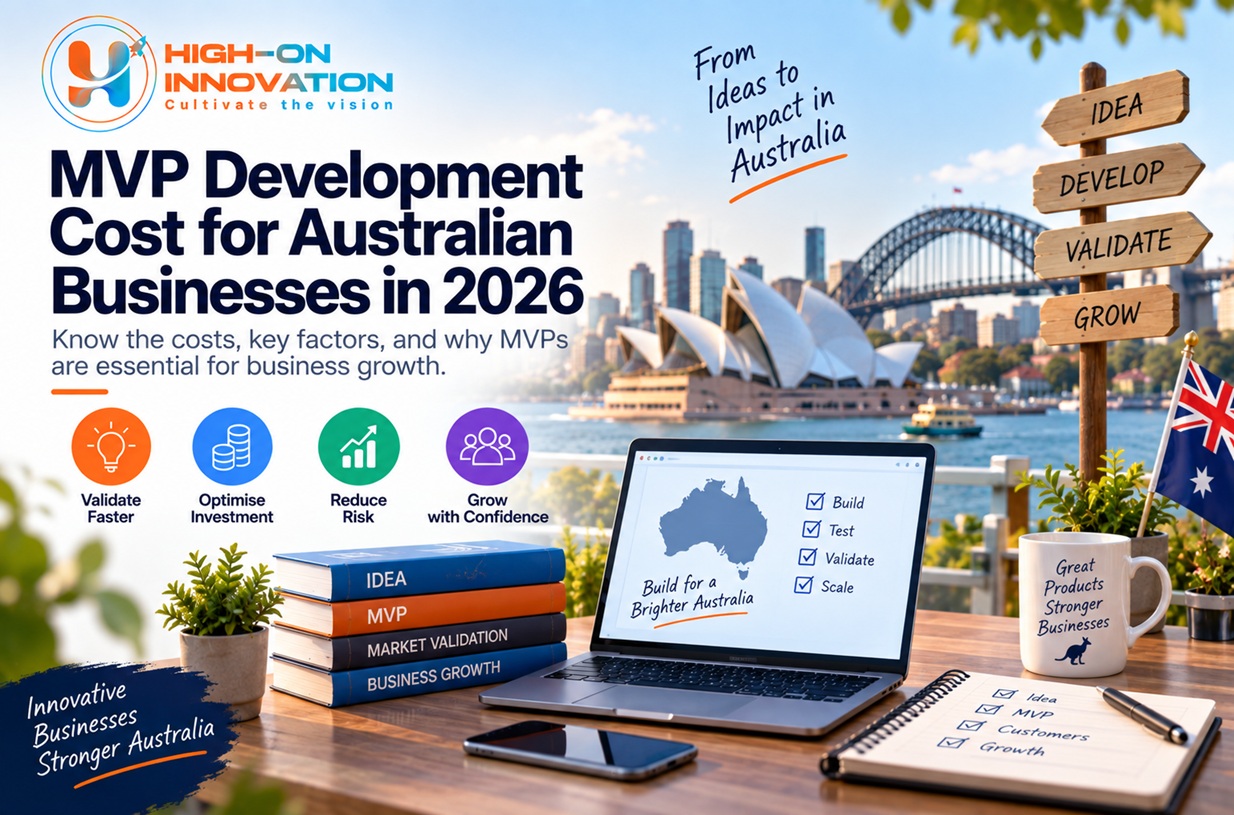
MVP Development Cost for Australian Businesses in 2026
Introduction
Building a new digital product is exciting, but for an Australian startup or established business, the first major question is usually financial:
How much will it cost to build an MVP in Australia?
The answer depends on what you are actually building.
A simple customer portal, booking application, SaaS dashboard, marketplace, AI-powered platform, fintech product, healthcare application, or enterprise workflow system can all be described as an "MVP", but their development requirements can be dramatically different.
Current Australian market estimates for 2026 vary widely. Some published estimates place MVP development around AUD $15,000–$150,000+, while more focused startup MVPs commonly fall within the tens of thousands of dollars. Other Australian development providers quote considerably higher ranges for sophisticated, production-ready MVPs.
The important point is that there is no universal MVP price.
A business should not choose an MVP development partner simply because it offers the lowest quotation. A lower quote may exclude product discovery, UX/UI design, QA, security, deployment, documentation, or post-launch support.
For an Australian business, the more useful question is:
What should we build first, how much should we invest, and what will the MVP help us prove?
That is where a strategic approach to MVP development becomes important.
This guide explains MVP development cost Australia in 2026, why MVPs matter, what affects the budget, what an MVP should include, how Australian privacy requirements can influence product development, what to ask a development company, and how HOI can help Australian startups and businesses turn product ideas into scalable digital products.
What Is an MVP?
A Minimum Viable Product is the first usable version of a digital product that contains enough functionality to solve a core customer problem and test the business proposition with real users.
The important word is viable.
An MVP shouldn't be a broken or incomplete product released simply to save money.
It should be good enough for the intended users to:
Understand the product
Complete the primary task
Receive meaningful value
Provide feedback
Potentially pay for the solution
For example, imagine an Australian startup wants to build an online marketplace for local service providers.
The long-term product might include:
Customer accounts
Provider accounts
Profiles
Search
Reviews
Messaging
Payments
Booking
Promotions
Loyalty programs
Mobile apps
AI recommendations
Analytics
Building everything at once could require a substantial investment.
The MVP might instead focus on:
Customer registration
Provider registration
Service listings
Search
Booking
Basic payment functionality
Admin management
Once real users begin using the platform, the company can determine which additional features deserve investment.
Why Are MVPs Important for Australian Businesses?
MVP development is not only a startup strategy.
Established Australian businesses can also use MVPs to test new digital products, internal systems, customer portals, automation solutions, and new revenue streams.
Validate Demand Before Major Investment
A business may have a strong idea but still be uncertain about customer demand.
An MVP provides a way to test the idea with real users before investing in the complete product.
This changes the decision-making process from:
"We think customers will want this."
to:
"We have evidence showing how customers respond to this."
Reduce Product Risk
Software development can become expensive when requirements are uncertain.
An MVP limits the amount of functionality that must be developed before customer feedback becomes available.
If the initial hypothesis proves incorrect, the business can change direction without having invested the full budget into an unnecessarily large product.
Get to Market Faster
Speed can be strategically important.
Launching a focused product allows a business to begin learning while competitors are still developing.
The company can improve the product through multiple iterations rather than waiting until every planned feature is finished.
Understand Real Customer Behaviour
What customers say they want and what they actually use can be different.
An MVP can reveal:
Which features users prefer
Where users abandon the journey
Which workflows create value
What customers are willing to pay for
Which customer segment is most engaged
Support Fundraising
For startups seeking investment, a functioning MVP can provide evidence that the team can execute.
Depending on the startup, investors may want to see:
Working technology
Early users
Customer feedback
Revenue
Engagement
Retention
Product roadmap
An MVP doesn't guarantee funding, but it can help move conversations from an idea toward measurable traction.
How Much Does MVP Development Cost in Australia in 2026?
There is no single Australian MVP price.
Based on current 2026 Australian market references, a practical planning framework is:
MVP Type Indicative Cost in AUD Typical Characteristics
Lean MVP $15,000–$30,000 One core workflow, limited screens, one platform
Standard MVP $30,000–$80,000 Multiple workflows, authentication, dashboard, integrations
Complex MVP $80,000–$150,000+ Multiple roles, complex workflows, advanced integrations
Advanced / AI MVP $100,000+ AI, real-time features, complex data, multiple platforms
These ranges are indicative rather than fixed market prices. Current Australian providers publish substantially different ranges because their definitions of an MVP, team models, quality requirements, and included deliverables differ.
One recent Australian estimate, for example, puts simple MVPs at approximately AUD $15,000–$35,000, standard MVPs at $35,000–$80,000, and complex or regulated MVPs at $80,000–$150,000+.
Another 2026 Australian development guide estimates MVP development at approximately $15,000–$150,000+, reinforcing the importance of scope rather than relying on a single "average" number.
Why Is the Startup MVP Cost in Australia So Different From Project to Project?
The phrase "MVP" does not describe a specific amount of work.
Two startups can approach an MVP development company Australia with completely different requirements.
One might need:
Login
Dashboard
One database
One workflow
Another might need:
Two or more user types
Payments
Real-time communication
AI
Multiple APIs
Complex permissions
Mobile applications
Administrative systems
Analytics
Both may call their projects "MVPs."
Their budgets obviously won't be the same.
The Biggest Factors Affecting MVP Development Cost Australia
Product Complexity
Complexity is one of the strongest cost drivers.
A straightforward CRUD-based application can be relatively simple.
A product involving:
Real-time data
Complex business rules
AI
Advanced analytics
Financial transactions
Multiple user roles
Third-party integrations
requires considerably more engineering and testing.
Number of Features
Every feature introduces additional work.
A feature isn't just one screen.
It may require:
UX → UI → Frontend → Backend → Database → API → Testing → Security → Documentation
Therefore, adding ten "small" features can significantly increase project scope.
Number of User Roles
A product supporting customers only is relatively straightforward.
A platform supporting:
Customers
Administrators
Managers
Vendors
Employees
Partners
requires more sophisticated permissions and workflows.
Platforms
A responsive web application is different from:
Web + iOS + Android
Each additional platform increases:
Development
Testing
Deployment
Maintenance
Compatibility requirements
For many startups, starting with one platform can be an effective way to control the initial startup MVP cost Australia.
Integrations
Third-party integrations can significantly affect development.
Examples include:
Stripe
Xero
Salesforce
HubSpot
Google services
Microsoft services
Accounting platforms
SMS providers
Email platforms
Mapping services
AI APIs
The cost depends on the integration complexity, authentication, data synchronization, error handling, and testing requirements.
AI Features
AI can create substantial product value, but it also introduces additional technical considerations.
AI-powered MVPs may require:
AI API integration
Prompt design
Data preparation
Retrieval mechanisms
Model evaluation
Usage monitoring
Cost controls
Guardrails
Human review
The question should not be:
"Can we add AI?"
It should be:
"Does AI help prove our core product hypothesis?"
What Does an MVP Development Budget Actually Pay For?
A professional MVP project is much more than development hours.
Product Discovery
This stage establishes:
Business goals
Target users
Customer problems
Product proposition
User journeys
MVP scope
Feature priorities
This work helps prevent expensive assumptions from entering development.
UX/UI Design
Design may include:
User journeys
Wireframes
Interactive prototypes
UI design
Responsive layouts
Design systems
A prototype can also be tested before development begins.
Frontend Development
Frontend developers build the interfaces users interact with.
This includes:
Screens
Forms
Dashboards
Navigation
Responsive layouts
Interactive components
Backend Development
Backend engineering can involve:
APIs
Database architecture
Authentication
Business logic
User management
Permissions
Notifications
Integrations
Quality Assurance
QA ensures that the product doesn't simply work under ideal circumstances.
Testing may include:
Functional testing
Regression testing
Browser testing
Mobile testing
API testing
Performance testing
Security testing
Deployment and DevOps
Production deployment may require:
Cloud infrastructure
Database configuration
CI/CD
SSL
Monitoring
Backups
Logging
Environment management
These activities should be discussed when comparing quotations.
Why Product Discovery Can Reduce MVP Cost
It may seem strange to spend money before development to save development money.
But consider what happens when requirements aren't clear.
The development team begins coding.
The founder sees the first version.
The founder says:
"That's not what I meant."
The team changes it.
Then another requirement changes.
Then the database needs modification.
Then the API needs modification.
Then QA needs to test the revised workflow.
The cost increases.
Product discovery reduces this type of uncertainty.
It doesn't eliminate changes, but it allows the team to resolve more important decisions before development becomes expensive.
What Should Be Included in an Australian MVP?
A strong MVP should include the minimum functionality necessary to deliver the core customer outcome.
User Registration and Authentication
Where required, users should be able to securely create accounts and access the product.
Core Product Workflow
This is the most important component.
It is the workflow that proves whether the product solves the problem.
Basic User Management
Depending on the product, this could include:
Profile
Account settings
Password management
Basic permissions
Administrative Controls
An admin interface can be essential for managing:
Users
Content
Transactions
Settings
Reports
Product activity
Notifications
Notifications should be included when they are necessary to complete the core workflow.
Analytics
Basic product analytics can help answer:
Who is using the product?
What are they doing?
Where are they dropping off?
Which features are being used?
Feedback Mechanism
The MVP should make it easy for users to report:
Problems
Suggestions
Feature requests
Questions
What Should Not Be Included in an MVP?
The hardest MVP decision is often deciding what not to build.
Features commonly better suited to later releases may include:
Advanced analytics
Complex loyalty programs
Social features
Extensive customization
Multiple payment methods
Dozens of integrations
Advanced AI capabilities
Complex automation
Internationalization
Multiple native applications
This isn't a universal rule.
If one of these features is central to the product hypothesis, it belongs in the MVP.
The point is to distinguish essential functionality from attractive functionality.
How Much Does an MVP App Cost in Australia?
For mobile MVP development, the cost depends heavily on whether you build:
iOS only
Android only
Cross-platform
iOS + Android + backend
Mobile + web admin
Recent Australian 2026 estimates put simple MVP applications around AUD $15,000–$40,000, standard applications around $40,000–$90,000, and complex or AI-heavy products at $90,000–$150,000+.
A mobile MVP may become more expensive when it requires:
GPS
Maps
Camera
Push notifications
Offline functionality
Bluetooth
Real-time tracking
Payments
Complex device integrations
Should an Australian Startup Build Web or Mobile First?
The answer depends on how users receive value.
A responsive web MVP may be the better first choice when:
The product is workflow-oriented.
Users primarily use desktop devices.
The product is B2B.
Mobile-specific hardware isn't required.
Mobile may be the better starting point when the product relies on:
GPS
Camera
Push notifications
Mobile-first behaviour
On-the-go usage
Device capabilities
The right platform decision can have a meaningful effect on MVP development cost Australia.
Australian Privacy Should Be Considered During MVP Planning
Privacy isn't something Australian businesses should simply "add later."
The Office of the Australian Information Commissioner recommends a privacy-by-design approach for startups because retrofitting privacy management later can create additional costs and delays.
Depending on the business and data involved, the Australian Privacy Principles and Privacy Act may affect how personal information is:
Collected
Stored
Used
Disclosed
Secured
Accessed
Deleted
The OAIC's guidance also highlights data minimisation and collecting personal information only when reasonably necessary for an organisation's functions or activities.
This is especially relevant for MVPs handling:
Customer data
Employee information
Health information
Financial data
Identity information
Behavioural data
The exact legal obligations depend on the organisation and circumstances, so businesses should obtain appropriate legal/privacy advice.
AI and Australian Privacy Requirements
AI introduces another layer of consideration.
If an application uses personal information to make automated decisions, Australian privacy requirements may become particularly relevant.
The OAIC states that from 10 December 2026, additional APP 1 privacy-policy obligations will apply to certain automated decisions involving personal information where the decision could reasonably be expected to significantly affect an individual's rights or interests.
For an AI-powered Australian MVP, this means founders should discuss:
What data AI receives
Where that data goes
Whether third-party AI providers process it
Whether personal information is used
How decisions are made
Whether humans review important decisions
How data is retained
AI architecture should therefore be considered alongside privacy and product design.
What About Australian Data Hosting?
Australian businesses may have specific data residency, contractual, security, or customer requirements.
Some customers may prefer or require Australian-hosted infrastructure.
This can affect:
Cloud architecture
Database location
Backup strategy
Third-party services
Disaster recovery
Compliance planning
The requirement should be identified during discovery rather than after architecture has already been selected.
How Long Does It Take to Build an MVP in Australia?
A focused MVP can potentially be developed within a few months, while more sophisticated products require longer.
Current Australian 2026 estimates commonly place focused MVP projects around approximately 6–20 weeks, depending on scope and delivery model.
A typical development journey could look like:
Discovery → UX/UI → Architecture → Development → QA → Beta → Launch
For example:
Discovery: 1–3 weeks
UX/UI: 2–5 weeks
Development: 6–14+ weeks
Testing: 2–4 weeks
Some stages can overlap.
The timeline should be based on the product's actual scope rather than an arbitrary promise such as "we can build anything in four weeks."
Choosing an MVP Development Company in Australia
Selecting an MVP development company Australia is one of the most important decisions a startup makes.
The company you choose can influence:
Product quality
Development cost
Speed
Technical architecture
Security
Scalability
Future maintenance
Investor confidence
Look Beyond the Portfolio
A portfolio can tell you what a company has built.
It doesn't necessarily tell you:
How the product was planned
How requirements were managed
How many developers worked on it
What challenges occurred
Whether the client still owns the code
What happened after launch
Ask for relevant case studies.
Evaluate Product Thinking
A strong MVP partner should be willing to challenge your assumptions.
If you give them 50 features, ask:
"Which five would you recommend for version one?"
Their answer can tell you a lot about how they think.
Check Technical Expertise
Evaluate whether the company has experience with:
Web applications
Mobile apps
SaaS
APIs
Cloud
AI
Security
Databases
DevOps
Third-party integrations
Understand Their Communication Model
For Australian businesses working with an international development partner, communication becomes especially important.
Ask:
Who is the account manager?
Who is the technical lead?
What are the meeting hours?
How often will you receive updates?
What project management tool is used?
How are decisions documented?
Who handles urgent issues?
Should You Choose a Local Australian Company or Offshore Partner?
There isn't one correct answer.
A fully local Australian team can provide:
Local timezone alignment
Face-to-face communication
Australian market familiarity
Local accountability
But it may come with higher development rates.
Hybrid and offshore models can provide access to broader engineering talent and potentially lower development costs.
The important comparison is total project value, not simply hourly rates.
One current Australian 2026 market analysis, for example, estimates fully local agency rates substantially higher than offshore rates and identifies hybrid models as a middle-ground option. These figures vary by provider and should not be treated as universal market rates.
HOI's Australian Presence
High-On Innovation (HOI) supports businesses and startups looking to turn ideas into practical digital products.
HOI has an Australian presence through its office in Peakhurst, Sydney, giving Australian businesses the option to work with a technology partner that combines local presence with broader product engineering capabilities.
This local presence is particularly valuable for businesses that want:
Australian business communication
Easier collaboration
Local relationship management
Product discussions aligned with Australian requirements
Access to broader engineering expertise
For businesses in Sydney and across Australia, this creates an opportunity to work with a product development team without limiting the engagement to a purely local or purely offshore model.
What HOI Has Expertise in Building
HOI's capabilities extend beyond traditional software development.
Our product engineering experience includes:
SaaS Products
HOI can build SaaS applications involving:
User management
Subscription systems
Dashboards
Role-based access
Admin panels
Analytics
APIs
Cloud infrastructure
Mobile Applications
HOI can develop mobile products around specific business and customer requirements, including applications requiring:
Push notifications
Location services
Camera functionality
Payments
Real-time features
User accounts
AI-Powered Applications
HOI can help businesses incorporate AI into products where it delivers meaningful value.
Potential applications include:
AI assistants
Intelligent search
Document processing
Recommendations
Workflow automation
Data analysis
Predictive functionality
Generative AI
Custom Business Software
HOI can develop software for businesses that need solutions tailored to their operational requirements.
Examples include:
CRM systems
Customer portals
Operations platforms
Workflow management
Internal business applications
Industry-specific systems
Digital Transformation
For established Australian businesses, an MVP isn't always about launching a startup.
A business may want to test:
A new digital service
A customer portal
A new revenue stream
An automation platform
A digital marketplace
An AI-powered service
An MVP can provide a controlled way to test the concept.
How HOI Can Help Australian Startups
HOI can support the complete journey from product idea to initial launch.
Product Discovery
We help clarify:
Business objectives
Target customers
Customer pain points
Product proposition
Core workflows
MVP requirements
MVP Strategy
We help determine:
What needs to be built now?
and:
What can wait until after validation?
This can help founders avoid unnecessary development expenditure.
UX/UI Design
The team can translate product concepts into:
User flows
Wireframes
Prototypes
UI designs
Responsive experiences
Custom MVP Development
HOI can build:
Web MVPs
Mobile MVPs
SaaS MVPs
AI-powered MVPs
Business applications
Customer platforms
Marketplace products
API and Integration Development
Where the MVP depends on external systems, HOI can work with appropriate APIs and integrations.
Quality Assurance
Testing can be incorporated throughout the development lifecycle rather than left until the end.
Cloud and DevOps
HOI can help establish the cloud and deployment foundation required for launching and evolving the product.
Post-Launch Development
The first release should generate learning.
HOI can continue supporting the product through:
Feature enhancements
UX improvements
Performance optimization
New integrations
AI enhancements
Scalability
New product versions
What Can HOI Build for an Australian Startup?
The answer depends on the startup's product idea.
For example, HOI could help an Australian founder turn a SaaS concept into:
Idea → Discovery → Prototype → MVP → Beta → Production → Scale
A marketplace startup could begin with buyers, sellers, listings, search, and transactions.
A B2B SaaS company could start with authentication, its core workflow, a dashboard, and billing.
An AI startup could focus its MVP around one high-value AI workflow instead of trying to build an entire AI ecosystem.
An established Australian company could use an MVP to test a new digital service without committing its entire transformation budget to the first release.
HOI's Approach to Controlling MVP Development Cost
Cost control shouldn't mean cutting corners.
It should mean removing unnecessary work.
HOI can help control MVP budgets through:
Focused Scope
Build the functionality required to validate the product.
Feature Prioritization
Separate must-have features from future functionality.
Appropriate Technology
Choose technology based on requirements instead of unnecessarily complex architecture.
Reusable Components
Where appropriate, use established technologies and services instead of rebuilding commoditized functionality.
Iterative Development
Develop in stages so that the business can review progress and make informed decisions.
Scalable Foundations
Build the MVP so it can evolve without unnecessarily overengineering version one.
How Australian Businesses Should Compare MVP Quotes
Never compare quotations based only on the final number.
Instead, create a comparison like this:
Evaluation Area
What to Check
Product Discovery
Is discovery included?
UX/UI
Are wireframes and UI included?
Development
What functionality is included?
Platforms
Web, iOS, Android or cross-platform?
Integrations
Which APIs are included?
QA
Who tests the product?
Security
What security practices are included?
Privacy
How is personal data handled?
Deployment
Is production deployment included?
Documentation
Is technical documentation provided?
Source Code
Will the business receive full access?
IP Ownership
Who owns the product?
Project Management
Who manages delivery?
Support
What happens after launch?
Change Requests
How are scope changes priced?
Infrastructure
Who controls hosting accounts?
This approach makes vendor comparison considerably more meaningful.
Questions to Ask an MVP Development Company Australia
What exactly is included in the quoted price?
Ask for a detailed deliverables list.
What isn't included?
This can be just as important as what is included.
Who will work on my product?
Understand the actual team.
Do you provide product discovery?
A development company should be able to help clarify requirements.
How do you prioritize features?
The answer can reveal whether the company understands MVP strategy.
How do you handle scope changes?
Get the process in writing.
Who owns the source code?
Make sure intellectual property terms are clear.
Will I have repository access?
The startup should understand how it maintains control of its product.
Who controls the cloud account?
This matters for long-term independence.
How is security handled?
Ask about authentication, permissions, encryption, backups, infrastructure, and testing.
How do you approach Australian privacy requirements?
The development partner should understand that privacy needs to be considered during architecture and product design, while recognising that legal advice may be required for the specific business.
What happens after launch?
Understand warranty, maintenance, monitoring, and future development options.
Fixed Price vs Time and Materials for Australian MVPs
Fixed Price
Fixed-price development can work well when the MVP scope is clearly defined.
The main advantage is budget predictability.
The risk is that changing requirements can create change requests and renegotiation.
Time and Materials
This model offers more flexibility.
It can work well when:
Product requirements are evolving.
Customer feedback will influence development.
The startup expects iterative releases.
However, budget management becomes particularly important.
Hybrid Approach
A strong option for many startups is:
Fixed-price discovery → Defined MVP scope → Iterative development → Controlled change management
This creates greater clarity before significant development investment begins.
Common Mistakes That Increase MVP Cost
Starting Development Without Defining the Product
Developers shouldn't be expected to guess what the product needs to accomplish.
Building Too Many Features
Every additional feature increases design, development, testing, and maintenance requirements.
Building Multiple Platforms Immediately
Web + iOS + Android can significantly increase initial costs.
Adding AI Without a Clear Use Case
AI can increase technical and operational complexity.
Ignoring UX
Poor UX creates rework and can make a good product appear unsuccessful.
Treating QA as Optional
Bugs discovered by customers are more expensive than problems identified during development.
Ignoring Privacy Until Launch
Retrofitting privacy controls can create additional development work and delays. The OAIC specifically encourages startups to adopt privacy by design.
Choosing a Vendor Only Because It Is Cheap
A cheap quote can become expensive if it leads to:
Rework
Poor architecture
Missed deadlines
Communication problems
Security issues
Vendor dependency
How to Reduce MVP Development Cost in Australia
Build One Core Workflow
Identify the single workflow that must work for the product to create value.
Start With One Platform
Use web first or mobile first depending on customer behavior.
Use Third-Party Services Where Appropriate
Don't build commodity functionality unnecessarily.
Validate Before Scaling
Use early users to determine what deserves additional investment.
Design Before Development
Resolve important UX decisions before coding.
Use Agile Delivery
Short development cycles allow the business to review progress and correct direction.
Measure the Right Metrics
Track the metrics that actually determine whether the product is working.
What Metrics Should an MVP Track?
The metrics depend on the business model.
Acquisition
How many potential users are entering the funnel?
Activation
How many users reach the first meaningful value?
Engagement
How frequently do users interact with the product?
Retention
Do users come back?
Conversion
Do users complete the intended commercial action?
Revenue
Are customers willing to pay?
Customer Feedback
Why are users staying, leaving, or requesting changes?
The purpose of these metrics isn't to create impressive dashboards.
It is to help the business make better product decisions.
MVP Development Should Create a Feedback Loop
The most valuable MVP process is:
Build → Launch → Measure → Learn → Improve
The first release isn't supposed to answer every question.
It should answer the most important questions first.
For example:
A startup may discover that customers love the core feature but hate the onboarding process.
The solution isn't necessarily to add more features.
The startup might instead simplify onboarding.
Another startup may discover that customers use one feature far more than everything else.
That could become the center of version two.
This is how an MVP becomes a strategic learning tool.
A Practical MVP Development Roadmap for Australian Businesses
Stage 1: Business Discovery
Understand the business problem and desired outcome.
Stage 2: Customer Definition
Identify the initial target customer.
Stage 3: Market Research
Study competitors, alternatives, pricing, and customer expectations.
Stage 4: MVP Scope
Determine the smallest product that can validate the business hypothesis.
Stage 5: UX/UI
Design the primary customer experience.
Stage 6: Technical Architecture
Select the technology, integrations, infrastructure, and security approach.
Stage 7: Development
Build the prioritized MVP functionality.
Stage 8: Testing
Perform appropriate functional, usability, performance, compatibility, and security testing.
Stage 9: Beta Launch
Release to a controlled group of relevant users.
Stage 10: Measurement
Track behaviour and business outcomes.
Stage 11: Product Iteration
Use the evidence to determine the next development priorities.
MVP Readiness Checklist
Before launching, Australian businesses should be able to answer:
Is the customer problem clearly defined?
Is the target customer identified?
Is the value proposition clear?
Is the primary workflow documented?
Are MVP features prioritized?
Have unnecessary features been removed?
Has the UX been reviewed?
Is the technology appropriate?
Have privacy requirements been considered?
Is security appropriate for the product?
Has the application been tested?
Is analytics configured?
Is customer feedback available?
Are early users identified?
Are success metrics defined?
Is there a post-launch roadmap?
If these questions have clear answers, the business is in a much stronger position to launch.
Frequently Asked Questions About MVP Development Cost Australia
How much does an MVP cost in Australia in 2026?
Indicative 2026 Australian market estimates range from around AUD $15,000 for very focused MVPs to $150,000+ for complex products, with many standard startup MVPs falling within the broader tens-of-thousands range. The final cost depends on features, platforms, integrations, UX, security, AI, and development model.
What is the startup MVP cost Australia?
There is no fixed startup MVP price. A focused startup MVP may begin around AUD $15,000–$30,000, while a more standard product can reach AUD $30,000–$80,000 and complex products can exceed AUD $100,000.
Is MVP development cheaper in Australia than full product development?
Generally, an MVP should require less initial investment because it deliberately limits functionality. However, a complex MVP can still be expensive if the core functionality requires advanced technology, integrations, security, or multiple platforms.
How much does an MVP app cost in Australia?
Simple mobile MVPs can fall around AUD $15,000–$40,000, while standard and complex mobile products can move into the AUD $40,000–$150,000+ range depending on functionality and platforms.
How long does it take to build an MVP in Australia?
A focused MVP may take approximately 6–12 weeks, while more sophisticated products can take several months. Current Australian estimates vary according to complexity, team structure, and scope.
Should I hire an Australian MVP development company?
Not necessarily.
You should select a partner based on product expertise, communication, technical capability, relevant experience, security, ownership, delivery model, and total project value.
For Australian businesses, local presence can nevertheless be valuable when the project requires close collaboration or Australian market knowledge.
Can HOI build an MVP for an Australian startup?
Yes. HOI can support Australian startups and businesses across product discovery, MVP strategy, UX/UI, web development, mobile development, AI integration, custom software, APIs, QA, cloud deployment, and post-launch product development.
HOI also has an Australian presence through its Peakhurst, Sydney office.
Does HOI only work with startups?
No. MVP methodology can also be used by established businesses testing new digital products, services, automation systems, customer portals, and revenue opportunities.
Can HOI build AI-powered MVPs?
Yes. HOI can integrate AI into MVPs where AI is central to the product's value proposition, including assistants, document processing, intelligent search, recommendations, automation, and other AI-driven workflows.
What should I give HOI before asking for an MVP estimate?
Ideally, provide:
Product concept
Target audience
Core problem
Desired outcome
Known features
Platform preference
Integrations
Target market
Business model
Expected timeline
Approximate budget
If you don't have all of this, product discovery can help establish the missing requirements.
Is the cheapest MVP development company the best option?
No.
The cheapest quotation may not include everything your business requires.
Evaluate:
Scope + Quality + Experience + Security + Communication + Ownership + Support + Total Cost
rather than price alone.
Why Choose HOI for MVP Development in Australia?
For Australian businesses, HOI combines local presence with broader product engineering capabilities.
Our Peakhurst, Sydney presence gives Australian clients a local point of contact while our wider technical capabilities allow us to support products requiring software engineering, mobile development, AI, automation, cloud, and digital transformation.
More importantly, HOI approaches MVP development as a product-building exercise rather than simply a coding project.
We help businesses ask:
What does the product need to prove?
Who needs to use it?
What is the core workflow?
Which features are essential?
What technology is appropriate?
How can we build the MVP without unnecessarily building the entire final product?
That approach can help Australian startups and businesses make more disciplined technology investments.
Conclusion
Understanding MVP development cost Australia in 2026 requires more than looking for an average price.
An MVP can cost tens of thousands of dollars or significantly more depending on product complexity, platforms, integrations, AI, security, privacy, user roles, design, infrastructure, and development methodology.
For startups, the objective should not be to build the cheapest possible product.
It should be to build the smallest reliable product capable of proving the most important business assumption.
For established Australian businesses, MVP development can provide a structured way to test new digital services, automation opportunities, customer experiences, and revenue models without committing the entire transformation budget upfront.
The right process is:
Problem → Product Strategy → MVP Scope → Design → Development → Testing → Launch → Feedback → Improvement
Choosing the right MVP development company Australia is equally important.
Businesses should evaluate product thinking, technical expertise, relevant experience, privacy and security practices, communication, source-code ownership, infrastructure access, pricing transparency, and post-launch support.
At HOI, our goal is to help Australian businesses turn ideas into practical digital products through a combination of product strategy, UX/UI, custom software development, mobile applications, AI automation, cloud, and ongoing product engineering.
With our Peakhurst, Sydney presence, HOI can support Australian businesses that want local accessibility combined with broader technology capabilities.
The goal isn't simply to build an MVP.
The goal is to build the right first version, learn from the market, and create a foundation worth scaling.
Harsit Gupta is the Founder of High-On Innovation and is responsible for shaping the company's vision, business model, growth strategy, and market expansion initiatives. He specializes in identifying emerging opportunities, driving innovation, and helping businesses navigate digital transformation in a rapidly evolving technology landscape. His expertise includes business strategy, digital innovation, startup growth, market positioning, and future-focused technology adoption.
Comments
Loading comments…
Latest Market Trends

Sep 3, 2026
How to Choose an MVP Development Company for Your Startup
Choosing the right MVP development company can have a major impact on your startup's first product launch. The right development partner does more than write code. They help translate your business idea into a focused product, identify technical risks, prioritize features, and create an MVP that can be tested with real users.

Sep 8, 2026
MVP Development Cost for Canadian Businesses in 2026: Complete Guide to Pricing, Features and Process
Discover MVP development cost Canada in 2026, including startup MVP cost, development factors, timelines, features, technology, compliance, and how to choose the right MVP development company.
Sep 8, 2026
MVP Development Cost for USA Startups in 2026
An MVP, or Minimum Viable Product, gives founders a way to turn an idea into a usable product, launch it with real users, collect feedback, and understand whether the market actually wants the solution.
Popular Post
How to Choose an MVP Development Company for Your Startup
Choosing the right MVP development company can have a major impact on your startup's first product launch. The right development partner does more than write code. They help translate your business idea into a focused product, identify technical risks, prioritize features, and create an MVP that can be tested with real users.
MVP Development Cost for Canadian Businesses in 2026: Complete Guide to Pricing, Features and Process
Discover MVP development cost Canada in 2026, including startup MVP cost, development factors, timelines, features, technology, compliance, and how to choose the right MVP development company.
MVP Development Cost for USA Startups in 2026
An MVP, or Minimum Viable Product, gives founders a way to turn an idea into a usable product, launch it with real users, collect feedback, and understand whether the market actually wants the solution.
How Much Does It Cost to Build an MVP for a Startup?
An MVP, or Minimum Viable Product, is the first usable version of a product that contains enough functionality to solve a specific customer problem. The final product might eventually include loyalty programs, AI recommendations, advanced analytics, delivery optimization, multiple payment methods, promotional tools, and dedicated mobile applications.