AI Automation for Healthcare: Complete Guide for Hospitals, Clinics & Medical Businesses
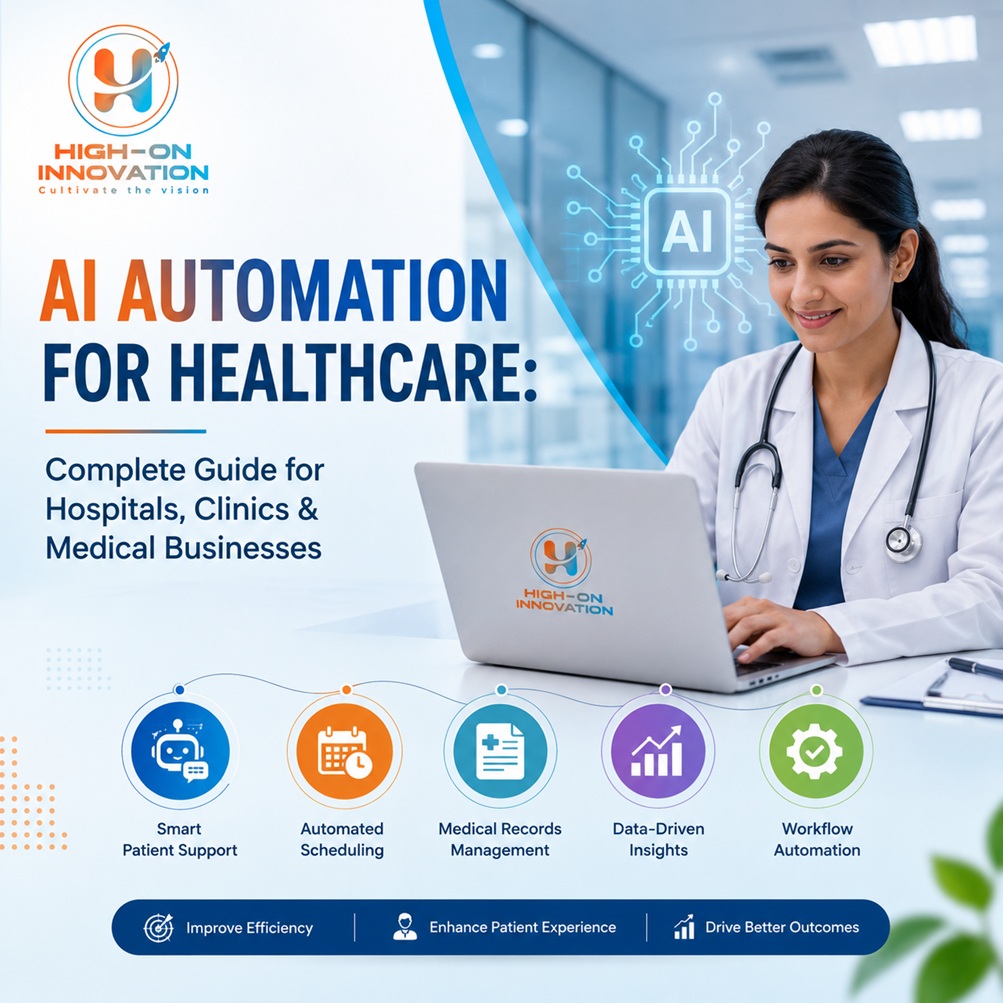
AI Automation for Healthcare: Complete Guide for Hospitals, Clinics & Medical Businesses
Healthcare is evolving faster than ever. Rising patient expectations, increasing operational costs, staff shortages, regulatory pressures, and growing administrative workloads are forcing healthcare organizations to rethink how they operate. Whether you're managing a single-specialty clinic, a multi-specialty hospital, a diagnostic laboratory, or a medical equipment company, the challenge is the same: deliver better care while operating more efficiently.
Traditional approaches—hiring more staff, expanding administrative teams, or relying on manual processes—are no longer sustainable. Healthcare providers need smarter systems that reduce repetitive work, improve communication, eliminate delays, and enable clinical teams to focus on what matters most: patient care.
This is where AI automation for healthcare is making a measurable impact.
Artificial intelligence is no longer limited to advanced diagnostics or medical research. Today, AI is transforming everyday healthcare operations by automating appointment scheduling, streamlining insurance verification, improving patient communication, optimizing workflows, accelerating claims processing, enhancing CRM systems, and providing data-driven insights for better decision-making.
From small clinics to large hospitals, healthcare organizations are adopting AI-powered automation to reduce costs, improve patient satisfaction, minimize administrative burdens, and create scalable operational models.
In this comprehensive guide, you'll learn:
What AI automation means in healthcare
Why healthcare organizations need AI now more than ever
The biggest operational challenges AI solves
Key benefits of healthcare AI automation
Real-world applications across hospitals, clinics, diagnostic centers, and medical businesses
A practical roadmap for implementing AI automation successfully
How HOI helps healthcare organizations automate processes and accelerate digital transformation
Whether you're a hospital administrator, clinic owner, operations manager, healthcare entrepreneur, or medical equipment supplier, this guide will help you understand how AI automation can transform your organization.
Table of Contents
What is AI Automation in Healthcare?
Why Healthcare Needs AI More Than Ever
Benefits of AI Automation
AI Use Cases Across Healthcare
AI for Different Healthcare Businesses
Healthcare AI Implementation Roadmap
Why Healthcare Organizations Choose HOI
Frequently Asked Questions
Chapter 1: What is AI Automation in Healthcare?
AI automation in healthcare refers to the use of Artificial Intelligence (AI), Machine Learning (ML), intelligent workflows, and automation technologies to perform repetitive, time-consuming, and data-intensive tasks with minimal human intervention.
Instead of replacing healthcare professionals, AI automation enhances their capabilities by reducing administrative work, improving decision-making, and accelerating operational processes.
Healthcare organizations generate enormous amounts of data every day—from patient records and appointment schedules to insurance claims and billing information. Managing this information manually leads to delays, errors, inefficiencies, and staff burnout.
AI automation helps healthcare providers manage these processes more efficiently while maintaining accuracy, compliance, and consistency.
Think of AI automation as a digital workforce that operates 24/7, handling repetitive tasks while enabling doctors, nurses, and administrative teams to focus on higher-value activities.
The Five Building Blocks of Healthcare AI Automation
1. Artificial Intelligence (AI)
Artificial Intelligence enables computer systems to simulate human intelligence by analyzing data, recognizing patterns, making predictions, and assisting in decision-making.
In healthcare, AI supports a wide range of operational and clinical functions, including:
Patient triage
Appointment scheduling
Medical imaging analysis
Clinical documentation
Insurance verification
Fraud detection
Revenue cycle optimization
Predictive analytics
Virtual assistants
Patient engagement
Rather than replacing clinical expertise, AI augments it by providing faster insights and automating repetitive processes.
2. Machine Learning (ML)
Machine Learning is a subset of AI that enables systems to learn from historical data and improve their performance over time without being explicitly programmed.
Healthcare organizations generate valuable operational data that ML algorithms can use to identify trends and predict future outcomes.
Examples include:
Predicting appointment no-shows
Forecasting patient admissions
Identifying patients at risk of chronic diseases
Optimizing staff schedules
Improving inventory management
Detecting fraudulent insurance claims
Forecasting revenue cycles
As more data becomes available, machine learning models continuously improve their accuracy and recommendations.
3. Workflow Automation
Healthcare workflows involve multiple departments, approvals, forms, and communications.
Manual workflows often result in:
Delayed approvals
Duplicate work
Missed follow-ups
Communication gaps
Compliance issues
Workflow automation digitizes and standardizes these processes, ensuring that every task follows predefined rules and reaches the right stakeholder at the right time.
Examples include:
Automated patient onboarding
Digital consent forms
Referral management
Lab report notifications
Follow-up reminders
Internal approval workflows
Escalation management
4. Process Automation
Process automation focuses on eliminating repetitive administrative tasks across the organization.
Instead of manually entering data across multiple systems, automation synchronizes information and performs routine actions automatically.
Common healthcare automation processes include:
Insurance verification
Claims submission
Billing reconciliation
Data entry
Medical record updates
Appointment confirmations
Prescription refill requests
Vendor management
Purchase order processing
By reducing manual intervention, organizations improve speed, accuracy, and operational consistency.
5. Intelligent Automation
Intelligent automation combines AI, machine learning, workflow automation, and robotic process automation (RPA) to create systems capable of handling complex business processes.
Unlike basic automation, intelligent automation can:
Interpret unstructured documents
Make recommendations
Learn from previous outcomes
Trigger workflows based on context
Identify anomalies
Route cases dynamically
For example, an intelligent automation system can:
Receive an insurance claim.
Extract patient details automatically.
Verify policy eligibility.
Identify missing documents.
Notify the patient.
Submit the completed claim.
Track approval status.
Update the CRM.
Inform the billing department.
All without manual coordination.
How AI Automation Differs from Traditional Healthcare Software
Many healthcare organizations already use Hospital Information Systems (HIS), Electronic Health Records (EHR), or practice management software. However, these systems often function as data repositories rather than intelligent assistants.
AI automation builds on these existing systems by adding intelligence and automation layers that:
Eliminate repetitive tasks
Connect disconnected systems
Automate decision-making
Trigger workflows automatically
Improve communication
Generate predictive insights
Rather than replacing your existing technology stack, AI automation enhances it.
Chapter 2: Why Healthcare Needs AI More Than Ever
Healthcare organizations worldwide face unprecedented operational challenges. While medical technology has advanced significantly, many administrative and operational processes remain manual, fragmented, and inefficient.
The result is increased costs, overwhelmed staff, delayed patient care, and reduced operational efficiency.
Let's explore the key pain points driving the adoption of AI automation.
1. Rising Administrative Burden
Administrative work consumes a significant portion of healthcare professionals' time.
Tasks such as:
Scheduling appointments
Updating patient records
Processing insurance claims
Coordinating referrals
Managing billing
Responding to patient inquiries
Following up on appointments
often require manual effort, leaving less time for direct patient care.
AI automation reduces this burden by handling repetitive tasks, allowing healthcare professionals to focus on clinical responsibilities.
2. Staff Shortages and Burnout
Healthcare providers across the globe are experiencing workforce shortages. Recruiting and retaining qualified staff has become increasingly difficult, while existing employees face mounting workloads.
Administrative overload contributes significantly to burnout among doctors, nurses, and support staff.
AI automation helps by:
Reducing repetitive tasks
Automating documentation
Streamlining workflows
Improving task allocation
Minimizing manual coordination
This enables healthcare teams to work more efficiently without increasing headcount.
3. Inefficient Insurance Processing
Insurance verification, pre-authorizations, claims submission, and reimbursement tracking are often time-consuming and error-prone.
Manual processes can lead to:
Delayed approvals
Claim rejections
Revenue leakage
Increased administrative costs
AI-powered automation accelerates insurance workflows by verifying eligibility, identifying missing information, and tracking claim statuses in real time.
4. Missed Appointments and Revenue Loss
Patient no-shows continue to impact healthcare organizations, leading to underutilized resources and lost revenue.
AI automation addresses this challenge through:
Automated appointment reminders
Intelligent rescheduling
Personalized notifications
Multi-channel communication via SMS, email, and messaging platforms
These proactive engagement strategies help reduce missed appointments and improve patient satisfaction.
5. Fragmented Patient Communication
Patients today expect timely, convenient, and personalized communication. However, many healthcare providers still rely on disconnected systems and manual follow-ups.
AI automation enables consistent communication across the patient journey—from appointment booking and reminders to post-treatment follow-ups and feedback collection—creating a more seamless and engaging experience.
6. Pressure to Improve Efficiency Without Increasing Costs
Healthcare organizations are expected to deliver high-quality care while managing tighter budgets and increasing demand.
AI automation supports this objective by:
Optimizing resource utilization
Reducing manual effort
Accelerating workflows
Improving data accuracy
Enhancing decision-making
Lowering operational costs
Instead of simply adding more staff, organizations can scale operations through intelligent automation.
Chapter 3: Benefits of AI Automation for Healthcare
Healthcare organizations invest in technology for one reason—to improve patient care while operating more efficiently. AI automation delivers measurable improvements across clinical, operational, and financial processes, making it a strategic investment rather than just another software implementation.
Whether you're running a private clinic, a multi-specialty hospital, a diagnostic laboratory, or a medical equipment company, AI automation helps streamline routine operations so your team can focus on delivering better healthcare.
1. Reduce Operational Costs
Administrative operations account for a significant portion of healthcare expenditure. Tasks such as appointment scheduling, insurance verification, billing, patient follow-ups, and documentation often require extensive manual effort.
AI automation minimizes these repetitive tasks by handling them digitally and consistently.
Organizations can reduce costs by:
Eliminating repetitive administrative work
Reducing paperwork
Minimizing manual data entry
Lowering claim processing costs
Optimizing workforce utilization
Decreasing overtime requirements
Instead of hiring additional administrative staff to manage increasing workloads, healthcare providers can scale operations using intelligent automation.
Business Impact
✔ Lower operational expenditure (OPEX)
✔ Faster administrative processing
✔ Improved resource allocation
2. Improve Patient Experience
Today's patients expect healthcare experiences similar to those offered by modern digital services—fast responses, online booking, timely updates, and personalized communication.
AI automation enhances the patient journey through:
Instant appointment scheduling
Automated appointment reminders
Real-time notifications
Digital registration
Personalized follow-ups
Faster response to patient queries
AI-powered chat assistance
Simplified insurance updates
Patients spend less time waiting and more time receiving care.
Benefits for Patients
Reduced waiting times
Improved communication
Better accessibility
Greater convenience
Higher satisfaction
Happy patients are more likely to return for future care and recommend your organization to others.
3. Accelerate Healthcare Workflows
Healthcare operations involve multiple stakeholders, including physicians, nurses, laboratories, billing teams, insurance providers, administrators, and patients.
Without automation, delays often occur because tasks depend on manual coordination.
AI-powered workflow automation ensures that:
Tasks are assigned automatically
Documents move instantly between departments
Approvals happen faster
Notifications are triggered automatically
Cases are escalated when necessary
Instead of waiting hours—or even days—for manual updates, workflows continue seamlessly in real time.
Example
A patient books an appointment online.
↓
The system automatically:
Confirms the appointment
Updates the calendar
Sends reminders
Verifies insurance
Creates a patient profile
Notifies the physician
Updates the CRM
No manual intervention required.
4. Reduce Human Errors
Manual processes increase the likelihood of:
Data entry mistakes
Duplicate records
Missed appointments
Billing inaccuracies
Insurance claim errors
Documentation inconsistencies
AI automation standardizes processes and validates information before actions are taken.
Examples include:
Automatic validation of insurance details
Duplicate patient detection
Intelligent form validation
Automated billing calculations
Claims verification before submission
Reducing errors improves operational efficiency while minimizing revenue leakage and compliance risks.
5. Increase Staff Productivity
Healthcare professionals should spend more time caring for patients—not completing repetitive paperwork.
AI automation reduces administrative workloads by handling tasks such as:
Appointment confirmations
Patient reminders
Insurance verification
CRM updates
Medical documentation
Internal notifications
Report generation
Doctors, nurses, and administrators gain more time for patient care, improving both productivity and job satisfaction.
Productivity Gains
Healthcare organizations often report improvements in:
Faster patient onboarding
Reduced administrative workload
Increased appointment capacity
Shorter processing times
Improved staff collaboration
6. Strengthen Compliance and Data Accuracy
Healthcare organizations operate in a highly regulated environment where maintaining accurate records and protecting patient information are critical.
AI automation supports compliance by:
Maintaining audit trails
Standardizing documentation
Enforcing approval workflows
Restricting unauthorized access
Monitoring process compliance
Reducing documentation errors
Automated systems also ensure that required information is captured consistently across departments, reducing the risk of missing or incomplete records.
7. Improve Financial Performance
Operational inefficiencies often lead to:
Delayed billing
Claim denials
Revenue leakage
Missed follow-ups
Poor patient retention
AI automation addresses these challenges by streamlining the revenue cycle and improving financial visibility.
Benefits include:
Faster invoice generation
Automated payment reminders
Reduced claim rejection rates
Improved cash flow
Better revenue forecasting
For healthcare organizations operating on tight margins, even small efficiency improvements can translate into substantial financial gains.
8. Enable Better Decision-Making
AI systems continuously analyze operational data to identify patterns and provide actionable insights.
Healthcare leaders can make informed decisions using dashboards that track:
Patient volumes
Appointment trends
No-show rates
Insurance claim performance
Staff productivity
Revenue metrics
Patient satisfaction
Operational bottlenecks
Instead of relying solely on historical reports, organizations can use predictive analytics to anticipate future demand and optimize resources proactively.
Chapter 4: Top AI Automation Use Cases in Healthcare
AI automation can be applied across nearly every administrative and operational function within a healthcare organization. The following use cases represent some of the highest-impact opportunities for improving efficiency and patient care.
Each of these topics will be explored in greater depth in dedicated cluster articles linked from this pillar page.
1. AI-Powered Appointment Scheduling
Appointment scheduling is often the first interaction a patient has with a healthcare provider. Manual scheduling processes can result in long wait times, booking errors, and inefficient calendar management.
AI-powered scheduling systems automate:
Online appointment booking
Calendar synchronization
Physician availability management
Appointment confirmations
Rescheduling
Waitlist management
Reminder notifications
Benefits
Reduced no-shows
Better calendar utilization
Improved patient convenience
Lower administrative workload
Related Cluster Blog: AI Appointment Scheduling for Healthcare: Reduce No-Shows and Improve Efficiency
2. Patient Communication Automation
Patients expect timely updates throughout their healthcare journey. AI automation enables personalized communication across multiple channels.
Common automated communications include:
Appointment reminders
Test result notifications
Prescription refill reminders
Preventive care reminders
Post-treatment follow-ups
Feedback surveys
Health education campaigns
Communication channels may include:
SMS
Email
WhatsApp
Voice calls
Mobile applications
Patient portals
Benefits
Higher patient engagement
Improved treatment adherence
Increased patient satisfaction
Better retention rates
Related Cluster Blog: Patient Communication Automation: The Complete Guide for Hospitals and Clinics
3. Healthcare CRM Automation
A Customer Relationship Management (CRM) system centralizes patient interactions and automates relationship management throughout the patient lifecycle.
AI-powered CRM capabilities include:
Lead management
Patient onboarding
Referral tracking
Automated follow-ups
Campaign management
Patient segmentation
Personalized communication
Healthcare CRM automation strengthens patient relationships while reducing administrative effort.
Related Cluster Blog: Healthcare CRM Automation: Improve Patient Relationships with AI
4. Insurance Verification Automation
Insurance verification remains one of the most time-consuming administrative processes in healthcare.
AI automation can:
Verify eligibility instantly
Validate policy details
Identify missing documentation
Flag inconsistencies
Notify patients automatically
Reduce manual verification calls
Benefits
Faster approvals
Reduced claim denials
Improved patient experience
Lower administrative costs
Related Cluster Blog: Insurance Verification Automation for Healthcare Providers
5. Claims Processing Automation
Manual claims processing often leads to delays, rejected claims, and revenue loss.
AI automation streamlines the entire claims lifecycle by:
Capturing claim data
Validating documentation
Detecting missing information
Submitting claims electronically
Tracking claim status
Identifying denial risks
Automating follow-ups
Business Impact
Faster reimbursements
Reduced rejection rates
Improved revenue cycle management
Lower processing costs
Related Cluster Blog: AI Claims Processing Automation for Hospitals and Clinics
6. Medical Records Automation
Managing patient records manually increases the risk of duplication, errors, and delays.
AI automation helps:
Digitize patient records
Organize clinical documentation
Retrieve records quickly
Extract data from scanned documents
Update patient histories automatically
Healthcare professionals gain faster access to accurate information, supporting better clinical decision-making.
Related Cluster Blog: AI Automation for Medical Records Management
7. Workflow Automation
Every healthcare organization operates through interconnected workflows involving multiple departments.
AI-powered workflow automation simplifies:
Patient admissions
Referral management
Laboratory workflows
Discharge processes
Internal approvals
Staff coordination
Equipment maintenance requests
Automated workflows reduce bottlenecks and improve operational consistency.
Related Cluster Blog: Healthcare Workflow Automation: Streamline Operations with AI
8. Billing Automation
Healthcare billing involves multiple stakeholders, complex coding requirements, and strict compliance standards.
AI automation supports:
Invoice generation
Coding validation
Payment reminders
Revenue reconciliation
Outstanding balance tracking
Financial reporting
The result is improved cash flow and fewer billing errors.
Related Cluster Blog: Healthcare Billing Automation: Improve Revenue Cycle Efficiency
9. Predictive Analytics
Predictive analytics enables healthcare organizations to anticipate future trends using historical and real-time data.
Applications include:
Forecasting patient demand
Predicting appointment no-shows
Identifying high-risk patients
Optimizing staffing levels
Managing inventory
Planning capacity
Healthcare leaders can make proactive decisions that improve efficiency and patient outcomes.
Related Cluster Blog: Predictive Analytics in Healthcare: Smarter Decisions with AI
10. AI Chatbots and Virtual Assistants
AI-powered chatbots provide instant support to patients and administrative teams around the clock.
Common use cases include:
Answering frequently asked questions
Appointment booking
Insurance inquiries
Prescription refill requests
Clinic information
Symptom guidance
Patient onboarding
By handling routine inquiries, chatbots reduce call volumes and free staff to address more complex patient needs.
Related Cluster Blog: AI Chatbots for Healthcare: Enhancing Patient Support and Operational Efficiency
Chapter 5: AI Automation Across Different Healthcare Businesses
Healthcare is not a one-size-fits-all industry. Every healthcare organization has unique operational challenges, patient engagement models, regulatory requirements, and business goals. While the underlying technology remains the same, the way AI automation is implemented varies significantly across different healthcare segments.
Whether you're running a single-doctor clinic or managing a multi-location hospital network, AI automation can be customized to streamline operations, improve patient experiences, and reduce administrative overhead.
Let's explore how different healthcare organizations can benefit from AI automation.
AI Automation for Small Clinics & Private Practices
Small clinics often operate with limited administrative staff. Doctors and front-desk teams frequently juggle appointment scheduling, patient communication, billing, follow-ups, and insurance coordination alongside clinical responsibilities.
As patient volumes increase, manual processes become difficult to manage, leading to missed appointments, delayed responses, and administrative inefficiencies.
Common Challenges
Manual appointment scheduling
Missed patient follow-ups
Frequent appointment no-shows
Insurance verification delays
Limited staff resources
Manual billing
Paper-based documentation
Difficulty managing patient relationships
How AI Automation Helps
AI automation simplifies everyday operations by handling repetitive administrative tasks, allowing clinic staff to focus on patient care.
Key automation opportunities include:
Online appointment scheduling
Automated reminders via SMS, WhatsApp, and email
Digital patient registration
AI-powered patient communication
Insurance verification
Automated billing workflows
Patient feedback collection
CRM-driven follow-up campaigns
Business Outcomes
Reduced administrative workload
Higher patient retention
Fewer appointment no-shows
Faster patient onboarding
Improved operational efficiency
Better patient experience
Small clinics can compete with larger healthcare providers by delivering a seamless digital experience without significantly increasing operational costs.
AI Automation for Hospitals
Hospitals manage complex ecosystems involving multiple departments, thousands of patient interactions, clinical workflows, administrative processes, billing operations, and insurance coordination.
Without automation, information often becomes siloed across systems, leading to delays and inefficiencies.
Operational Challenges
Complex patient journeys
Departmental coordination
Long administrative processes
High patient volumes
Delayed insurance approvals
Manual reporting
Staff shortages
Communication gaps
AI Automation Solutions
Hospitals can automate:
Patient Journey Management
From admission to discharge, AI ensures every step follows a standardized workflow.
Appointment Management
AI optimizes physician schedules and reduces patient waiting times.
Clinical Workflow Automation
Departments receive automated task assignments, notifications, and approvals.
Insurance Automation
Eligibility verification and claim processing occur faster with fewer manual interventions.
Revenue Cycle Automation
Billing, invoicing, and payment tracking become more accurate and efficient.
Patient Communication
Patients receive timely updates throughout their care journey.
Benefits
Improved operational efficiency
Faster patient throughput
Reduced administrative burden
Better interdepartmental coordination
Improved financial performance
Enhanced patient satisfaction
Hospitals adopting AI automation are better equipped to manage increasing patient demand while maintaining high-quality care.
AI Automation for Multi-Specialty & Super Specialty Hospitals
Super specialty hospitals involve highly coordinated care across multiple disciplines, including cardiology, oncology, neurology, orthopedics, nephrology, and critical care.
Managing referrals, consultations, diagnostics, surgeries, and post-treatment care requires seamless communication and workflow management.
Common Challenges
Cross-department coordination
Referral management
Multi-stage treatment plans
Complex insurance workflows
Specialist scheduling
Patient communication across departments
Clinical documentation
AI Automation Opportunities
AI can coordinate complex patient journeys by:
Managing referrals automatically
Scheduling consultations across specialties
Sending treatment reminders
Tracking care plans
Automating documentation
Coordinating diagnostic workflows
Integrating CRM with patient communication
Outcomes
Better care coordination
Faster specialist access
Reduced treatment delays
Improved patient engagement
Increased operational visibility
For large healthcare organizations, AI acts as the connective layer between departments, improving collaboration and continuity of care.
AI Automation for Diagnostic Centers & Pathology Labs
Diagnostic centers rely heavily on speed, accuracy, and operational efficiency. Delays in reporting or communication can directly impact patient outcomes and referring physicians.
Operational Challenges
High sample volumes
Manual report distribution
Appointment scheduling
Patient communication
Billing management
Referral coordination
Inventory tracking
AI Automation Solutions
Automation can streamline:
Diagnostic appointment booking
Sample tracking
Report generation workflows
Automated report delivery
Physician notifications
Patient reminders
Billing processes
CRM for referring doctors
Benefits
Faster turnaround times
Improved report accuracy
Better patient communication
Enhanced referring physician relationships
Reduced administrative workload
AI enables diagnostic centers to process higher volumes without compromising quality or efficiency.
AI Automation for Dental Clinics
Modern dental practices compete not only on clinical expertise but also on patient experience.
Routine procedures such as appointment confirmations, treatment reminders, and follow-ups consume valuable administrative time.
Common Challenges
Missed appointments
Treatment follow-ups
Recall reminders
Manual scheduling
Patient education
Insurance coordination
AI Automation Opportunities
Dental clinics can automate:
Appointment scheduling
Recall campaigns
Oral hygiene reminders
Treatment plan follow-ups
Patient communication
Billing notifications
Online inquiries through AI chatbots
Benefits
Increased patient retention
Reduced no-shows
Better treatment compliance
Improved patient satisfaction
Higher operational efficiency
Automation helps dental clinics build long-term patient relationships while reducing front-desk workload.
AI Automation for IVF Centers
IVF treatment involves multiple consultations, diagnostics, medications, and emotionally sensitive patient journeys.
Patients require frequent communication and timely updates throughout the treatment process.
Challenges
Complex treatment schedules
Medication reminders
Patient anxiety
Follow-up communication
Appointment coordination
Documentation
Consultation management
AI Automation Solutions
AI supports IVF centers through:
Personalized patient communication
Treatment reminders
Automated scheduling
Digital consent workflows
CRM-driven patient engagement
AI chat assistance
Follow-up automation
Benefits
Improved patient engagement
Better treatment adherence
Reduced administrative workload
Enhanced patient experience
Stronger patient relationships
Given the high-touch nature of fertility care, consistent communication powered by AI can significantly improve the overall patient journey.
AI Automation for Eye Hospitals & Ophthalmology Clinics
Eye hospitals often manage high patient volumes for consultations, diagnostics, surgeries, and post-operative care.
Efficient scheduling and patient communication are essential to maintaining smooth operations.
Operational Challenges
Long waiting times
Follow-up scheduling
Surgery coordination
Diagnostic workflows
Insurance approvals
Patient education
AI Automation Applications
Automation can assist with:
Online appointment scheduling
Automated vision screening reminders
Cataract surgery workflows
Post-operative follow-ups
Medication reminders
Insurance coordination
CRM automation
Outcomes
Better patient experience
Reduced scheduling conflicts
Improved surgery coordination
Faster administrative processing
AI enables ophthalmology providers to deliver more organized, patient-centric care.
AI Automation for Home Healthcare Providers
Home healthcare organizations coordinate caregivers, patients, schedules, and ongoing communication across multiple locations.
Managing these operations manually can become increasingly difficult as services expand.
Challenges
Caregiver scheduling
Route planning
Patient communication
Documentation
Service coordination
Billing
Visit confirmations
AI Automation Solutions
AI can automate:
Care scheduling
Visit reminders
Patient check-ins
Care documentation
Internal workflow management
Billing
CRM integration
Benefits
Better care coordination
Improved workforce utilization
Reduced administrative effort
Enhanced patient satisfaction
Automation allows home healthcare providers to scale services while maintaining high-quality patient care.
AI Automation for Medical Equipment Manufacturers & Distributors
Healthcare automation extends beyond hospitals and clinics. Medical equipment manufacturers and distributors also manage complex sales, service, inventory, and customer support operations.
Common Challenges
Lead management
Sales follow-ups
Equipment servicing
Dealer management
Customer communication
Inventory visibility
Warranty tracking
AI Automation Opportunities
Organizations can automate:
CRM Automation
Track leads, hospitals, distributors, and customers through the entire sales lifecycle.
Service Automation
Schedule preventive maintenance and service reminders automatically.
Workflow Automation
Streamline quotations, approvals, purchase orders, and installation processes.
AI Customer Support
Deploy chatbots and AI assistants to answer product inquiries and schedule service requests.
Predictive Maintenance
Analyze equipment performance to identify maintenance needs before failures occur.
Benefits
Faster sales cycles
Improved customer relationships
Higher service efficiency
Better inventory planning
Increased customer retention
Reduced operational costs
For medical equipment companies, AI automation improves both commercial performance and customer service while creating long-term operational efficiencies.
Choosing the Right AI Automation Strategy for Your Healthcare Business
Although every healthcare organization has unique operational requirements, successful AI adoption follows the same principle:
Start with your biggest operational bottlenecks, automate high-impact repetitive processes, integrate systems, and scale gradually.
Rather than attempting to automate everything at once, organizations achieve better outcomes by focusing on processes that deliver immediate value, such as appointment scheduling, patient communication, insurance verification, CRM automation, and workflow management.
As these systems mature, AI can be extended to more advanced capabilities, including predictive analytics, intelligent decision support, and enterprise-wide automation.
The key is selecting solutions that are flexible, scalable, and tailored to your organization's size, specialty, and long-term goals.
Chapter 6: Healthcare AI Implementation Roadmap
Adopting AI automation is not about replacing existing systems or disrupting patient care. It's about creating a connected, intelligent ecosystem where technology supports healthcare professionals, improves operational efficiency, and enhances the patient experience.
Successful AI implementation requires a structured approach. Organizations that begin with a clear roadmap are more likely to achieve measurable outcomes, reduce implementation risks, and maximize their return on investment.
Below is a practical seven-step framework for implementing AI automation in healthcare.
Step 1: Assess Your Current Operations
Every successful automation journey begins with understanding how your organization currently operates.
Before introducing AI, evaluate your existing workflows, systems, and operational bottlenecks.
Questions to Ask
Which tasks consume the most administrative time?
Where do delays occur most frequently?
Which processes depend heavily on manual intervention?
What are the biggest causes of patient dissatisfaction?
Which departments experience the highest workload?
Where are errors and rework most common?
Typical Assessment Areas
Appointment scheduling
Patient registration
Insurance verification
Claims management
Billing
Medical records
Internal approvals
Staff communication
Patient engagement
CRM processes
This assessment creates a baseline for identifying automation opportunities and measuring future improvements.
Step 2: Map Existing Workflows
Many healthcare organizations discover that their processes have evolved over time without formal documentation.
Before automating, it's essential to map each workflow from start to finish.
For example, consider the patient appointment process:
Patient Inquiry
↓
Appointment Booking
↓
Confirmation
↓
Insurance Verification
↓
Consultation
↓
Billing
↓
Follow-up Communication
By visualizing the workflow, you can identify:
Redundant steps
Manual handoffs
Approval delays
Duplicate data entry
Communication gaps
Process bottlenecks
Workflow mapping ensures that automation improves the process rather than simply digitizing inefficiencies.
Step 3: Prioritize High-Impact Automation Opportunities
Not every process needs to be automated immediately.
The most successful healthcare organizations begin with repetitive, high-volume tasks that deliver quick wins.
High-Value Starting Points
Appointment scheduling
Patient reminders
Online registrations
Insurance verification
Claims processing
CRM updates
Billing workflows
Internal approvals
Report distribution
Patient follow-ups
Starting with these areas allows teams to experience immediate efficiency gains while building confidence in AI-driven processes.
Step 4: Design the Right Automation Strategy
Every healthcare organization has unique operational requirements. A small clinic has very different needs compared to a multi-specialty hospital or a medical equipment company.
Instead of implementing generic software, design an automation strategy aligned with your goals.
Considerations
Organization Size
Single-location clinic
Multi-location practice
Hospital
Enterprise healthcare network
Existing Technology
Hospital Information System (HIS)
Electronic Medical Records (EMR/EHR)
Laboratory Information Systems
Practice Management Software
Billing Software
CRM Platforms
Growth Objectives
Improve patient experience
Increase operational efficiency
Reduce costs
Scale operations
Improve compliance
Strengthen patient engagement
A customized strategy ensures that AI complements existing systems rather than replacing them unnecessarily.
Step 5: Integrate AI with Existing Systems
One of the biggest misconceptions about AI is that organizations must replace their existing software.
In reality, modern AI solutions are designed to integrate with existing technology.
Typical integrations include:
Hospital Information Systems (HIS)
Electronic Medical Records (EMR/EHR)
CRM platforms
Billing software
Insurance portals
Patient portals
Laboratory systems
Accounting software
ERP systems
Communication platforms such as WhatsApp, email, and SMS
When systems are connected, information flows automatically between departments, eliminating duplicate data entry and improving operational visibility.
Example Workflow
A patient books an appointment online.
↓
The scheduling system creates the appointment.
↓
The CRM updates the patient profile.
↓
Insurance eligibility is verified automatically.
↓
The physician receives the appointment notification.
↓
Reminder messages are sent before the visit.
↓
Billing is prepared after consultation.
↓
Follow-up communication is triggered automatically.
This seamless flow reduces administrative effort while improving the patient experience.
Step 6: Train Your Team and Manage Change
Technology alone does not guarantee success.
People remain at the center of every successful healthcare transformation.
Introducing AI often changes how employees perform daily tasks. Proper training helps staff understand how automation supports—not replaces—their work.
Effective Change Management Includes
Leadership alignment
Process documentation
Hands-on training sessions
Role-specific learning
Pilot implementations
Feedback collection
Continuous support
When employees understand the benefits of AI, adoption rates increase significantly.
Step 7: Monitor Performance and Continuously Improve
AI implementation is an ongoing journey rather than a one-time project.
Healthcare organizations should regularly evaluate automation performance using measurable Key Performance Indicators (KPIs).
Recommended KPIs
Operational Metrics
Appointment no-show rate
Patient wait time
Administrative processing time
Claims turnaround time
Insurance approval time
Financial Metrics
Revenue cycle efficiency
Billing accuracy
Claim rejection rate
Operational cost savings
Patient Metrics
Patient satisfaction
Response time
Follow-up completion
Patient retention
Staff Metrics
Administrative workload
Productivity
Employee satisfaction
Process completion time
Continuous monitoring enables organizations to identify new automation opportunities and optimize existing workflows over time.
Common Mistakes to Avoid During AI Implementation
Many healthcare organizations struggle with automation projects because they focus on technology instead of processes.
Avoid these common mistakes:
Automating Inefficient Processes
If the underlying workflow is broken, automation simply accelerates the problem.
Always optimize processes before automating them.
Trying to Automate Everything at Once
Start with high-impact areas, demonstrate measurable value, and expand gradually.
Ignoring User Adoption
Even the most advanced AI solution delivers little value if employees don't use it consistently.
Training and change management are critical.
Choosing Generic Solutions
Healthcare has unique operational and regulatory requirements.
Select automation platforms designed around healthcare workflows rather than one-size-fits-all tools.
Failing to Measure Results
Without performance tracking, organizations cannot quantify ROI or identify improvement opportunities.
What Does a Successful AI Transformation Look Like?
Imagine a healthcare organization where:
Patients schedule appointments online in minutes.
Insurance verification happens automatically.
No manual reminder calls are required.
Claims are processed faster with fewer errors.
CRM captures every patient interaction.
Reports reach physicians instantly.
Follow-ups happen automatically.
Leadership has real-time operational dashboards.
Staff spend less time on administration and more time caring for patients.
This is not a future vision—it is achievable today through well-planned AI automation.
Chapter 7: Why Choose HOI for Healthcare AI Automation?
Healthcare automation is more than deploying software. It requires a deep understanding of clinical workflows, administrative operations, patient journeys, compliance requirements, and digital transformation.
At High on Innovation (HOI), we help healthcare organizations move beyond isolated software tools to build intelligent, connected automation ecosystems that improve efficiency, enhance patient experiences, and support long-term growth.
Healthcare-Focused Automation Expertise
We understand that every healthcare organization is different.
A diagnostic laboratory operates differently from a super-specialty hospital. A dental clinic has different workflow requirements than a medical equipment distributor.
Our solutions are tailored to your operational model rather than forcing your business to adapt to generic software.
AI Automation Solutions
We help healthcare organizations automate repetitive processes using intelligent technologies that improve speed, consistency, and accuracy.
Our AI automation capabilities include:
Intelligent workflow automation
AI-powered document processing
Predictive analytics
Automated patient communication
AI chatbots and virtual assistants
Operational dashboards
Intelligent notifications
AI-assisted decision support
CRM Automation
Strong patient relationships extend beyond the consultation room.
HOI designs CRM automation systems that help healthcare providers:
Capture patient inquiries
Automate lead nurturing
Manage referrals
Schedule follow-ups
Personalize patient communication
Track patient engagement
Improve retention
By centralizing patient interactions, healthcare organizations gain a complete view of every patient journey.
Workflow & Process Automation
Administrative inefficiencies often create delays across departments.
We streamline healthcare operations by automating:
Patient onboarding
Appointment scheduling
Referral management
Internal approvals
Billing workflows
Claims processing
Insurance verification
Laboratory workflows
Reporting
Vendor coordination
The result is faster operations, fewer manual tasks, and improved collaboration across teams.
Seamless System Integration
Healthcare organizations rely on multiple systems that must work together.
HOI integrates AI automation with existing platforms such as:
Hospital Information Systems (HIS)
EMR/EHR platforms
CRM software
ERP systems
Billing applications
Accounting software
Patient communication tools
Third-party healthcare applications
Rather than replacing your existing investments, we enhance them with intelligent automation.
Scalable Solutions for Every Healthcare Business
Whether you're:
A private clinic
A multi-specialty practice
A hospital
A diagnostic center
A dental clinic
An IVF center
An eye hospital
A home healthcare provider
A medical equipment manufacturer or distributor
Our solutions are designed to scale with your organization's growth.
Security, Compliance & Reliability
Healthcare data is sensitive, making security and compliance non-negotiable.
Our automation solutions are designed with:
Secure data handling
Role-based access controls
Audit trails
Workflow transparency
Process accountability
Scalable architecture
This helps organizations maintain operational integrity while improving efficiency.
End-to-End Implementation
From strategy to execution, HOI supports every stage of your automation journey.
Our implementation approach includes:
Business Process Assessment
Workflow Mapping
AI Opportunity Identification
Solution Design
CRM & System Integration
Process Automation
Staff Training
Performance Monitoring
Continuous Optimization
We don't simply implement technology—we help organizations build sustainable digital transformation programs.
Ready to Transform Your Healthcare Operations?
AI automation is no longer a competitive advantage—it's becoming an operational necessity.
Healthcare organizations that embrace intelligent automation today are better positioned to:
Deliver exceptional patient experiences
Improve operational efficiency
Reduce administrative costs
Increase staff productivity
Accelerate growth
Build scalable healthcare operations
Whether you're starting your digital transformation journey or looking to optimize existing systems, HOI can help you identify the right automation opportunities and implement solutions tailored to your organization's needs.
Let's build a smarter, more connected healthcare organization—together.
Frequently Asked Questions (FAQs)
Below are answers to some of the most common questions healthcare leaders ask when exploring AI automation. These concise responses are optimized for search engines while providing practical guidance for decision-makers.
1. What is AI automation in healthcare?
AI automation in healthcare refers to the use of Artificial Intelligence (AI), machine learning, workflow automation, and intelligent software to automate repetitive administrative and operational tasks. It helps hospitals, clinics, and healthcare businesses improve efficiency, reduce manual work, enhance patient communication, and streamline workflows without replacing healthcare professionals.
2. How does AI improve healthcare operations?
AI improves healthcare operations by automating repetitive tasks such as appointment scheduling, insurance verification, claims processing, billing, patient follow-ups, documentation, and workflow management. This allows healthcare teams to spend more time delivering quality patient care while improving operational efficiency.
3. Can AI replace doctors or nurses?
No. AI is designed to support healthcare professionals—not replace them. It automates administrative work, analyzes large volumes of data, and provides decision-support tools, enabling doctors and nurses to focus on diagnosis, treatment, and patient care.
4. Is AI suitable for small clinics?
Yes. AI automation is highly beneficial for small clinics because it reduces administrative workloads, automates appointment scheduling, improves patient communication, and streamlines billing and insurance processes. Even small healthcare practices can achieve significant efficiency gains without hiring additional staff.
5. What are the biggest benefits of AI automation in healthcare?
Some of the most significant benefits include:
Reduced operational costs
Faster administrative workflows
Improved patient experience
Better staff productivity
Fewer manual errors
Higher patient engagement
Faster insurance processing
Improved revenue cycle management
Better compliance
Scalable healthcare operations
6. What healthcare processes can be automated?
Healthcare organizations can automate numerous processes, including:
Appointment scheduling
Patient registration
Insurance verification
Claims processing
Billing
Medical documentation
Patient communication
CRM management
Internal approvals
Workflow management
Reporting
Inventory notifications
7. What is workflow automation in healthcare?
Workflow automation digitizes repetitive healthcare processes by automatically routing tasks, approvals, notifications, and documents between departments. It minimizes manual coordination and ensures work progresses efficiently with fewer delays.
8. How does AI improve patient communication?
AI enables healthcare providers to automatically send appointment reminders, follow-up messages, lab result notifications, medication reminders, feedback requests, and personalized health information through email, SMS, WhatsApp, patient portals, or AI-powered chatbots.
9. Can AI reduce appointment no-shows?
Yes. AI-driven reminder systems automatically notify patients before appointments and offer rescheduling options when necessary. These proactive communications significantly reduce missed appointments and improve resource utilization.
10. How does AI help with insurance verification?
AI automates insurance eligibility checks, validates patient information, detects missing documentation, and accelerates verification processes. This reduces manual work, minimizes claim denials, and speeds up patient onboarding.
Harshit Gupta is the Founder of High-On Innovation and is responsible for shaping the company's vision, business model, growth strategy, and market expansion initiatives. He specializes in identifying emerging opportunities, driving innovation, and helping businesses navigate digital transformation in a rapidly evolving technology landscape. His expertise includes business strategy, digital innovation, startup growth, market positioning, and future-focused technology adoption.
Comments
Loading comments…
Latest Market Trends

Sep 9, 2026
MVP Development Cost for Australian Businesses in 2026
A simple customer portal, booking application, SaaS dashboard, marketplace, AI-powered platform, fintech product, healthcare application, or enterprise workflow system can all be described as an "MVP", but their development requirements can be dramatically different.

Sep 3, 2026
How to Choose an MVP Development Company for Your Startup
Choosing the right MVP development company can have a major impact on your startup's first product launch. The right development partner does more than write code. They help translate your business idea into a focused product, identify technical risks, prioritize features, and create an MVP that can be tested with real users.

Sep 8, 2026
MVP Development Cost for Canadian Businesses in 2026: Complete Guide to Pricing, Features and Process
Discover MVP development cost Canada in 2026, including startup MVP cost, development factors, timelines, features, technology, compliance, and how to choose the right MVP development company.
Popular Post
MVP Development Cost for Australian Businesses in 2026
A simple customer portal, booking application, SaaS dashboard, marketplace, AI-powered platform, fintech product, healthcare application, or enterprise workflow system can all be described as an "MVP", but their development requirements can be dramatically different.
How to Choose an MVP Development Company for Your Startup
Choosing the right MVP development company can have a major impact on your startup's first product launch. The right development partner does more than write code. They help translate your business idea into a focused product, identify technical risks, prioritize features, and create an MVP that can be tested with real users.
MVP Development Cost for Canadian Businesses in 2026: Complete Guide to Pricing, Features and Process
Discover MVP development cost Canada in 2026, including startup MVP cost, development factors, timelines, features, technology, compliance, and how to choose the right MVP development company.

MVP Development Cost for USA Startups in 2026
An MVP, or Minimum Viable Product, gives founders a way to turn an idea into a usable product, launch it with real users, collect feedback, and understand whether the market actually wants the solution.