AI Automation vs Hiring in 2026: Which Strategy Helps Growing Businesses Scale Faster?
Introduction
As businesses grow in 2026, the challenge is no longer just increasing revenue it is scaling operations efficiently without increasing complexity. Rising labor costs, limited talent availability, and the demand for faster delivery are forcing companies to rethink traditional growth models.
For years, the natural response to business growth was simple: hire more people. More workload meant larger teams, additional management layers, and increased operational costs. But this model is becoming harder to sustain in a fast-moving digital economy.
That is why AI automation for business growth has become a major strategic priority. Companies are now using AI to automate repetitive workflows, improve speed, reduce costs, and scale operations without continuously increasing headcount.
However, this does not mean hiring is obsolete. Human expertise remains critical for strategic decision-making, innovation, and relationship building. The real question for growing businesses is:
When should you automate, and when should you hire?
The answer lies in understanding the role each plays in building a scalable business.
Summary
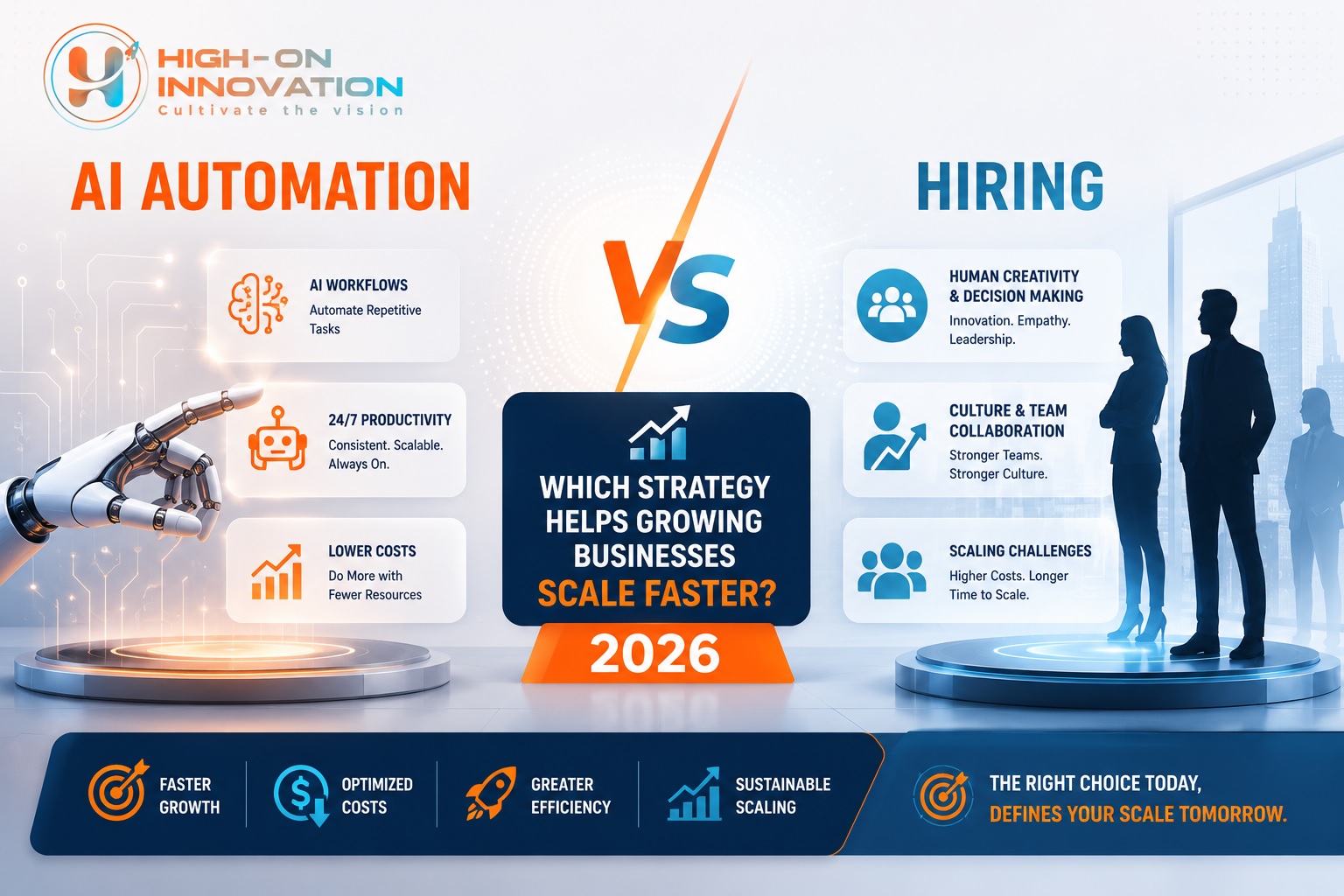
AI automation and hiring are often treated as competing options, but in reality they solve different business problems.
AI automation is best for repetitive, process-driven tasks.
Hiring is best for strategic, creative, and people-focused work.
Growing businesses that rely only on hiring often face rising costs and slower execution. Businesses that over-automate risk losing the human intelligence needed for innovation and customer trust.
The most successful companies in 2026 are building hybrid operating systems, where AI handles repetitive operations and human teams focus on growth-driving activities.
AI Automation vs Hiring: What Growing Companies Should Do
1. Use AI Automation to Eliminate Repetitive Work
One of the biggest growth barriers for businesses is the amount of time teams spend on repetitive manual tasks. Activities like:
Data entry
Report generation
Scheduling
Lead assignment
Customer query handling
consume valuable time but add little strategic value.
AI automation can manage these tasks with speed and consistency, helping teams focus on work that directly impacts growth.
Benefits of automating repetitive work:
Reduced operational workload
Faster execution
Fewer human errors
Improved employee productivity
Lower long-term operating costs
Instead of hiring more people for repetitive tasks, automation allows businesses to scale efficiently.
2. Hiring Still Matters for Strategic Growth
While automation improves efficiency, human talent remains essential for areas where creativity, critical thinking, and relationship management matter.
These include:
Strategic planning
Product innovation
Customer relationships
Leadership
Problem-solving
AI can optimize workflows, but it cannot replace human judgment, emotional intelligence, or creative innovation.
Best areas to invest in hiring:
Leadership roles
Product development
Sales strategy
Client success
Brand building
Businesses should reserve human talent for high-impact responsibilities rather than repetitive operations.
3. AI Automation Improves Scalability Better Than Hiring Alone
Traditional hiring scales linearly:
More customers = more workload
More workload = more employees
More employees = higher cost
This creates a direct link between growth and operational expense.
AI automation breaks that pattern.
Once automated systems are implemented, they can manage increasing workloads with minimal added cost.
This enables businesses to:
Handle larger volumes of work
Maintain faster turnaround times
Reduce dependence on team expansion
Improve scalability without major cost increases
This is why AI automation is becoming essential for scaling businesses in competitive markets.
4. Cost Efficiency Favors Automation for Operational Tasks
Hiring employees involves more than salaries. Additional costs include:
Recruitment
Training
Benefits
Infrastructure
Management overhead
These costs grow rapidly as businesses expand.
AI automation usually requires:
Initial setup investment
Process integration
Ongoing optimization
But once in place, it reduces the need for additional hires and lowers operational costs over time.
Operational advantages of AI automation:
Lower long-term cost
Higher process efficiency
Faster execution
Consistent output
For routine processes, automation often delivers better ROI than expanding teams.
5. The Real Problem Is Often Broken Systems, Not Lack of Staff
Many companies believe growth problems can be solved by hiring more people. But often the real issue is inefficient workflows.
Signs of broken systems include:
Teams overwhelmed by manual work
Delayed execution
Poor process visibility
Repeated errors
Rising operational costs
Hiring more people into inefficient systems only adds complexity.
Automation addresses the root issue by improving the system itself.
Before hiring, companies should ask:
Can this task be automated?
Is the workflow efficient?
Are we solving workload or solving inefficiency?
This shift in thinking leads to better growth decisions.
6. The Winning Strategy in 2026 Is a Hybrid Growth Model
The future of business growth is not AI instead of people.
It is:
Automation for execution + Hiring for innovation
This hybrid model creates a stronger business foundation by combining:
AI for operational efficiency
Human teams for strategic growth
In a hybrid model:
AI handles repetitive workflows
Employees focus on creative and strategic work
Costs remain controlled
Growth becomes scalable
This allows businesses to grow faster without compromising quality or agility.
Conclusion
The debate around AI automation vs hiring in 2026 is not about choosing one over the other. It is about knowing where each creates the most value.
Businesses that rely only on hiring face:
Rising labor costs
Slower execution
Operational complexity
Businesses that over-rely on automation risk losing:
Creativity
Human insight
Strategic flexibility
The smartest companies are building hybrid systems where automation powers efficiency and people drive innovation.
That is how modern businesses scale faster, reduce inefficiencies, and create sustainable long-term growth.
About the Author
Harshit Gupta is a technology researcher and business systems writer focused on helping businesses scale through AI automation, digital transformation, and operational strategy. He writes about how companies can use emerging technologies to improve efficiency, reduce complexity, and build systems designed for long-term growth.
Comments
Loading comments…
Latest Market Trends

Sep 9, 2026
MVP Development Cost for Australian Businesses in 2026
A simple customer portal, booking application, SaaS dashboard, marketplace, AI-powered platform, fintech product, healthcare application, or enterprise workflow system can all be described as an "MVP", but their development requirements can be dramatically different.

Sep 3, 2026
How to Choose an MVP Development Company for Your Startup
Choosing the right MVP development company can have a major impact on your startup's first product launch. The right development partner does more than write code. They help translate your business idea into a focused product, identify technical risks, prioritize features, and create an MVP that can be tested with real users.

Sep 8, 2026
MVP Development Cost for Canadian Businesses in 2026: Complete Guide to Pricing, Features and Process
Discover MVP development cost Canada in 2026, including startup MVP cost, development factors, timelines, features, technology, compliance, and how to choose the right MVP development company.
Popular Post
MVP Development Cost for Australian Businesses in 2026
A simple customer portal, booking application, SaaS dashboard, marketplace, AI-powered platform, fintech product, healthcare application, or enterprise workflow system can all be described as an "MVP", but their development requirements can be dramatically different.
How to Choose an MVP Development Company for Your Startup
Choosing the right MVP development company can have a major impact on your startup's first product launch. The right development partner does more than write code. They help translate your business idea into a focused product, identify technical risks, prioritize features, and create an MVP that can be tested with real users.
MVP Development Cost for Canadian Businesses in 2026: Complete Guide to Pricing, Features and Process
Discover MVP development cost Canada in 2026, including startup MVP cost, development factors, timelines, features, technology, compliance, and how to choose the right MVP development company.
MVP Development Cost for USA Startups in 2026
An MVP, or Minimum Viable Product, gives founders a way to turn an idea into a usable product, launch it with real users, collect feedback, and understand whether the market actually wants the solution.