Digital Transformation Challenges and How to Overcome Them
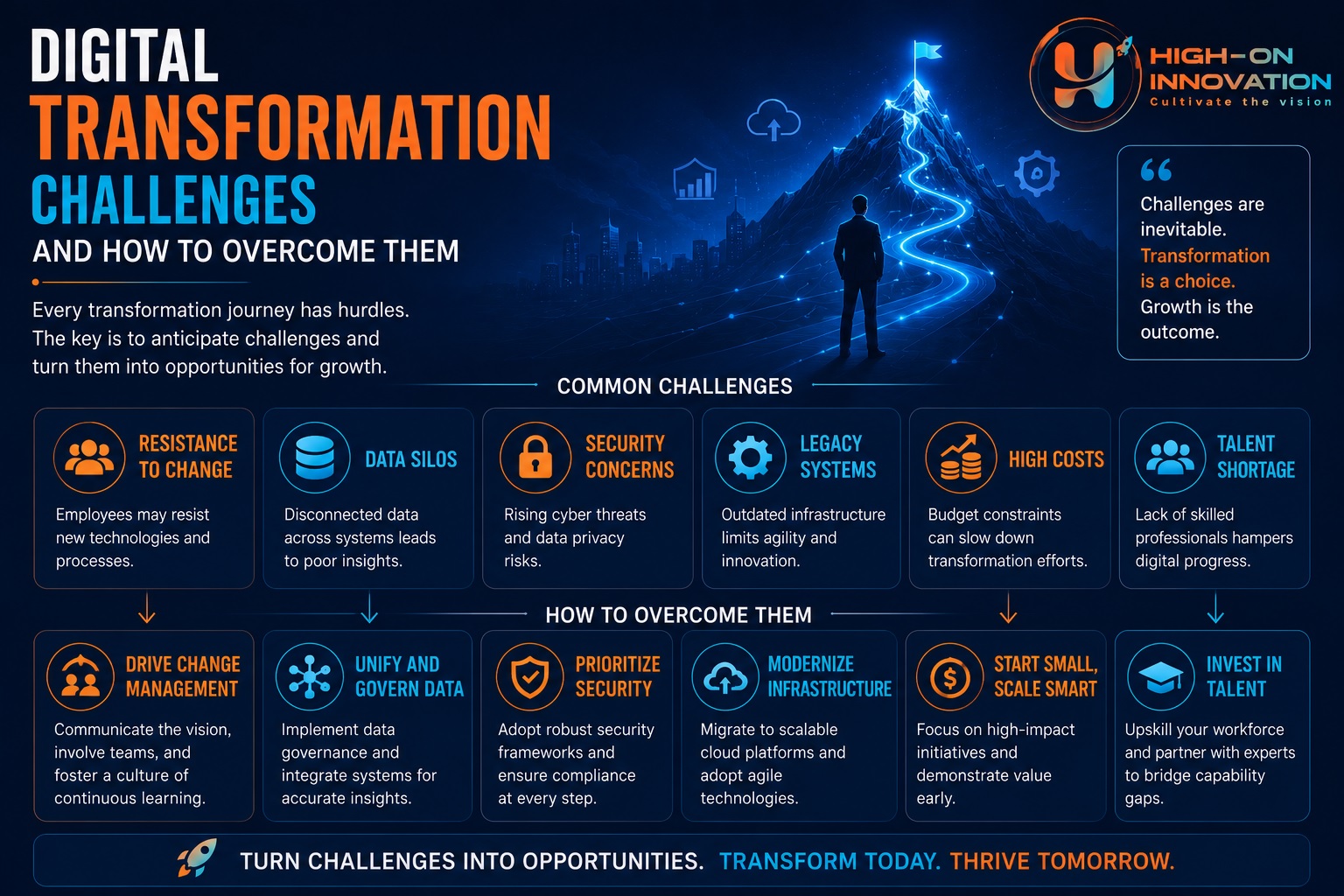
Key Takeaways
Digital transformation challenges often involve people, processes, and technology.
Employee resistance is one of the most common transformation barriers.
Legacy systems limit scalability, flexibility, and innovation.
Strong cybersecurity is essential for digital business operations.
A clear transformation strategy improves success rates significantly.
Businesses should focus on continuous learning, scalability, and optimization.
Introduction
Digital transformation has become essential for businesses looking to improve efficiency, customer experiences, scalability, and long-term growth. Organizations across industries are investing heavily in technologies like artificial intelligence, cloud computing, automation, analytics, and intelligent digital ecosystems.
However, while the benefits of digital transformation are significant, the journey itself is often complex and challenging.
Many businesses struggle with outdated systems, employee resistance, cybersecurity risks, integration problems, budget limitations, and unclear transformation strategies. In fact, one of the biggest reasons digital transformation initiatives fail is not because of technology itself, but because of poor planning, lack of alignment, and organizational resistance to change.
Successful digital transformation requires more than simply implementing new tools. It demands strategic planning, cultural adaptation, strong leadership, employee engagement, and continuous optimization.
This guide explores the most common digital transformation challenges businesses face and explains practical strategies to overcome them successfully.
Why Digital Transformation Is Challenging
Digital transformation impacts almost every area of a business, including:
Operations
Customer experience
Technology infrastructure
Employee workflows
Data management
Business strategy
Unlike traditional IT upgrades, digital transformation often requires organizations to rethink how they operate entirely.
This creates challenges related to:
Technology adoption
Organizational culture
Business processes
Employee readiness
Security management
Financial investment
Businesses that recognize these challenges early are better prepared to manage transformation successfully.
Major Digital Transformation Challenges
1. Resistance to Change
Why It Happens
One of the most common digital transformation challenges is employee resistance.
People naturally become comfortable with existing systems and workflows. When businesses introduce new technologies, automation systems, or operational changes, employees may feel:
Uncertain
Overwhelmed
Fearful about job security
Frustrated by learning curves
Resistance often increases when employees do not fully understand:
Why transformation is happening
How it benefits them
What changes are expected
How to Overcome It
Communicate Clearly
Leadership should explain:
Transformation goals
Expected business benefits
Employee advantages
Long-term vision
Involve Employees Early
Employees should participate in planning, feedback, and testing processes whenever possible.
Provide Training and Support
Businesses should offer:
Digital skill training
Workshops
Hands-on guidance
Ongoing technical support
Build a Digital Culture
Encourage innovation, collaboration, adaptability, and continuous learning throughout the organization.
Employee adoption is one of the most critical success factors in digital transformation.
2. Legacy Systems and Outdated Infrastructure
Why It Happens
Many organizations still rely on older systems that were not designed for:
Cloud environments
AI integration
Modern automation
Real-time analytics
Scalable digital operations
Legacy systems often create:
Integration difficulties
Security vulnerabilities
Slow performance
High maintenance costs
Limited scalability
Outdated infrastructure becomes a major barrier to innovation.
How to Overcome It
Conduct Infrastructure Assessments
Evaluate current systems and identify modernization priorities.
Migrate Gradually
Businesses do not always need complete replacement immediately. Gradual modernization reduces risk and operational disruption.
Adopt Cloud-Based Solutions
Cloud computing improves:
Scalability
Flexibility
Integration
Accessibility
Prioritize Integration
Use APIs and modern integration platforms to connect legacy systems with newer technologies.
Modernizing infrastructure creates a stronger foundation for long-term digital transformation.
3. Lack of Clear Strategy
Why It Happens
Many businesses adopt technologies without defining:
Business objectives
Implementation priorities
Success metrics
Transformation roadmaps
Without strategic direction, digital transformation becomes fragmented and ineffective.
Organizations may end up:
Investing in unnecessary tools
Creating disconnected systems
Failing to achieve measurable outcomes
How to Overcome It
Define Business Goals
Transformation efforts should align with:
Operational improvements
Customer experience goals
Growth strategies
Revenue objectives
Create a Roadmap
Develop a structured transformation plan with:
Priorities
Timelines
Budgets
KPIs
Focus on Business Value
Technology should solve real business problems rather than simply following trends.
Measure Progress Continuously
Track performance metrics regularly to optimize transformation efforts.
A clear strategy significantly improves transformation success rates.
4. Cybersecurity and Data Privacy Risks
Why It Happens
As businesses become more digital, they collect and process larger volumes of sensitive data.
Digital transformation increases exposure to:
Cyberattacks
Data breaches
Ransomware
Unauthorized access
Compliance violations
Cloud systems, remote work environments, and connected platforms create additional security complexities.
How to Overcome It
Implement Strong Security Policies
Businesses should establish:
Access controls
Data encryption
Authentication systems
Security monitoring
Conduct Security Audits
Regular assessments help identify vulnerabilities and compliance risks.
Train Employees on Cybersecurity
Human error remains one of the biggest cybersecurity threats.
Use Modern Security Solutions
Implement:
AI-driven threat detection
Multi-factor authentication
Endpoint security
Cloud security systems
Strong cybersecurity strategies are essential for successful digital transformation.
5. Budget Constraints
Why It Happens
Digital transformation initiatives often require investment in:
Software platforms
Infrastructure upgrades
Cloud migration
Employee training
Security systems
Technical expertise
Some organizations hesitate because they fear high upfront costs and uncertain ROI.
How to Overcome It
Start With High-Impact Areas
Prioritize projects that generate measurable value quickly.
Use Scalable Solutions
Cloud and subscription-based platforms reduce infrastructure costs.
Implement Gradually
Phased transformation reduces financial pressure and operational risk.
Focus on Long-Term ROI
Digital transformation often improves:
Productivity
Customer retention
Operational efficiency
Revenue growth
Businesses should evaluate long-term strategic benefits instead of focusing only on short-term costs.
6. Skill Gaps and Talent Shortages
Why It Happens
Modern digital transformation technologies require expertise in:
AI
Cloud computing
Analytics
Automation
Cybersecurity
Data management
Many organizations lack employees with advanced digital skills.
How to Overcome It
Invest in Employee Training
Upskilling programs help teams adapt to digital technologies.
Hire Specialized Talent
Businesses may need experts in:
AI implementation
Cloud architecture
Data analytics
Security systems
Partner With Technology Experts
External consultants and digital transformation partners can provide strategic guidance and technical support.
Encourage Continuous Learning
Digital innovation evolves rapidly, making ongoing learning essential.
Building digital capabilities improves long-term transformation success.
7. Data Silos and Poor Data Management
Why It Happens
Many businesses store information across disconnected systems and departments.
This creates:
Limited visibility
Inconsistent reporting
Duplicate data
Poor decision-making
Disconnected data systems reduce transformation efficiency significantly.
How to Overcome It
Centralize Data Systems
Implement integrated data platforms and cloud-based infrastructure.
Improve Data Governance
Establish clear standards for:
Data quality
Accessibility
Security
Compliance
Use Analytics Platforms
Modern analytics tools improve visibility and business intelligence.
Connected data ecosystems improve operational efficiency and strategic decision-making.
8. Poor Leadership Alignment
Why It Happens
Digital transformation requires collaboration across:
Leadership teams
IT departments
Operations
Marketing
HR
Customer service
If leadership teams lack alignment, transformation initiatives often become inconsistent or fragmented.
How to Overcome It
Establish Executive Support
Leadership should actively support transformation goals and initiatives.
Create Cross-Department Collaboration
Departments should work together instead of operating independently.
Define Shared Objectives
Ensure all teams understand:
Transformation priorities
Business goals
Expected outcomes
Strong leadership alignment drives organizational adoption and transformation success.
9. Integration Complexity
Why It Happens
Modern businesses often use multiple software platforms and operational systems.
Integrating:
Legacy systems
Cloud applications
Analytics tools
AI systems
CRM platforms
can become technically challenging.
How to Overcome It
Use API-Based Architectures
Modern APIs improve system connectivity and scalability.
Choose Compatible Technologies
Select platforms that support integrations and future expansion.
Implement Integration Gradually
Phased integration reduces operational disruptions.
Work With Experienced Technology Teams
Proper technical planning minimizes implementation risks.
Integration planning is critical for building connected digital ecosystems.
Best Practices for Successful Digital Transformation
Focus on Customer Experience
Customer-centric transformation creates stronger business outcomes.
Start Small and Scale Gradually
Pilot projects reduce risks and improve adoption.
Build a Digital-First Culture
Encourage adaptability, collaboration, and innovation.
Invest in Employee Enablement
Training improves confidence and technology adoption.
Prioritize Security and Compliance
Protect digital infrastructure and customer trust.
Continuously Optimize
Digital transformation is an ongoing process, not a one-time project.
Industries Facing Digital Transformation Challenges
Healthcare
Challenges include:
Data privacy
Legacy infrastructure
Compliance requirements
Banking and Finance
Financial institutions face:
Cybersecurity risks
Regulatory complexity
System integration challenges
Manufacturing
Manufacturers struggle with:
Legacy equipment
IoT integration
Workforce adaptation
Retail
Retailers face:
Omnichannel integration
Inventory visibility
Customer personalization challenges
The Future of Digital Transformation Challenges
As technologies continue evolving, businesses will face new challenges related to:
AI governance
Data ethics
Advanced cybersecurity
Intelligent automation
Hyperconnected ecosystems
Organizations that prioritize adaptability, continuous learning, and strategic planning will be better prepared for future transformation demands.
Conclusion
Digital transformation offers businesses enormous opportunities for innovation, efficiency, scalability, and growth. However, the journey also involves significant challenges that require careful planning and execution.
From employee resistance and legacy systems to cybersecurity and integration complexity, businesses must address multiple operational, cultural, and technical barriers to achieve successful transformation outcomes.
Organizations that combine strong leadership, clear strategy, employee engagement, modern infrastructure, and continuous optimization are more likely to succeed in their digital transformation journey.
Digital transformation is not simply about technology adoption. It is about building smarter, more agile, and future-ready businesses.
Frequently Asked Questions
What are the biggest digital transformation challenges?
Common challenges include employee resistance, legacy systems, cybersecurity risks, skill gaps, budget limitations, and integration complexity.
Why do digital transformation projects fail?
Many projects fail due to poor planning, unclear goals, lack of leadership alignment, and low employee adoption.
How can businesses overcome digital transformation challenges?
Businesses can succeed through strong leadership, employee training, clear strategies, scalable technologies, and continuous optimization.
Why is change management important in digital transformation?
Employees must understand and support transformation initiatives for successful adoption and long-term operational improvement.
Author Bio
Shailendra Ram – Project Manager & Head of Technology Delivery, High-On Innovation
Shailendra Ram leads project execution and technology delivery at High-On Innovation, managing development teams, project workflows, client communications, and solution implementation. With hands-on experience across web, mobile, cloud, and enterprise applications, he ensures projects are delivered efficiently while meeting business objectives and technical standards. His expertise includes software development lifecycle management, project delivery, technology implementation, agile methodologies, and client success.
Comments
Loading comments…
Latest Market Trends

Sep 9, 2026
MVP Development Cost for Australian Businesses in 2026
A simple customer portal, booking application, SaaS dashboard, marketplace, AI-powered platform, fintech product, healthcare application, or enterprise workflow system can all be described as an "MVP", but their development requirements can be dramatically different.

Sep 3, 2026
How to Choose an MVP Development Company for Your Startup
Choosing the right MVP development company can have a major impact on your startup's first product launch. The right development partner does more than write code. They help translate your business idea into a focused product, identify technical risks, prioritize features, and create an MVP that can be tested with real users.

Sep 8, 2026
MVP Development Cost for Canadian Businesses in 2026: Complete Guide to Pricing, Features and Process
Discover MVP development cost Canada in 2026, including startup MVP cost, development factors, timelines, features, technology, compliance, and how to choose the right MVP development company.
Popular Post
MVP Development Cost for Australian Businesses in 2026
A simple customer portal, booking application, SaaS dashboard, marketplace, AI-powered platform, fintech product, healthcare application, or enterprise workflow system can all be described as an "MVP", but their development requirements can be dramatically different.
How to Choose an MVP Development Company for Your Startup
Choosing the right MVP development company can have a major impact on your startup's first product launch. The right development partner does more than write code. They help translate your business idea into a focused product, identify technical risks, prioritize features, and create an MVP that can be tested with real users.
MVP Development Cost for Canadian Businesses in 2026: Complete Guide to Pricing, Features and Process
Discover MVP development cost Canada in 2026, including startup MVP cost, development factors, timelines, features, technology, compliance, and how to choose the right MVP development company.

MVP Development Cost for USA Startups in 2026
An MVP, or Minimum Viable Product, gives founders a way to turn an idea into a usable product, launch it with real users, collect feedback, and understand whether the market actually wants the solution.