How AI Is Transforming the Automotive Industry: Applications, Benefits & Future Trends
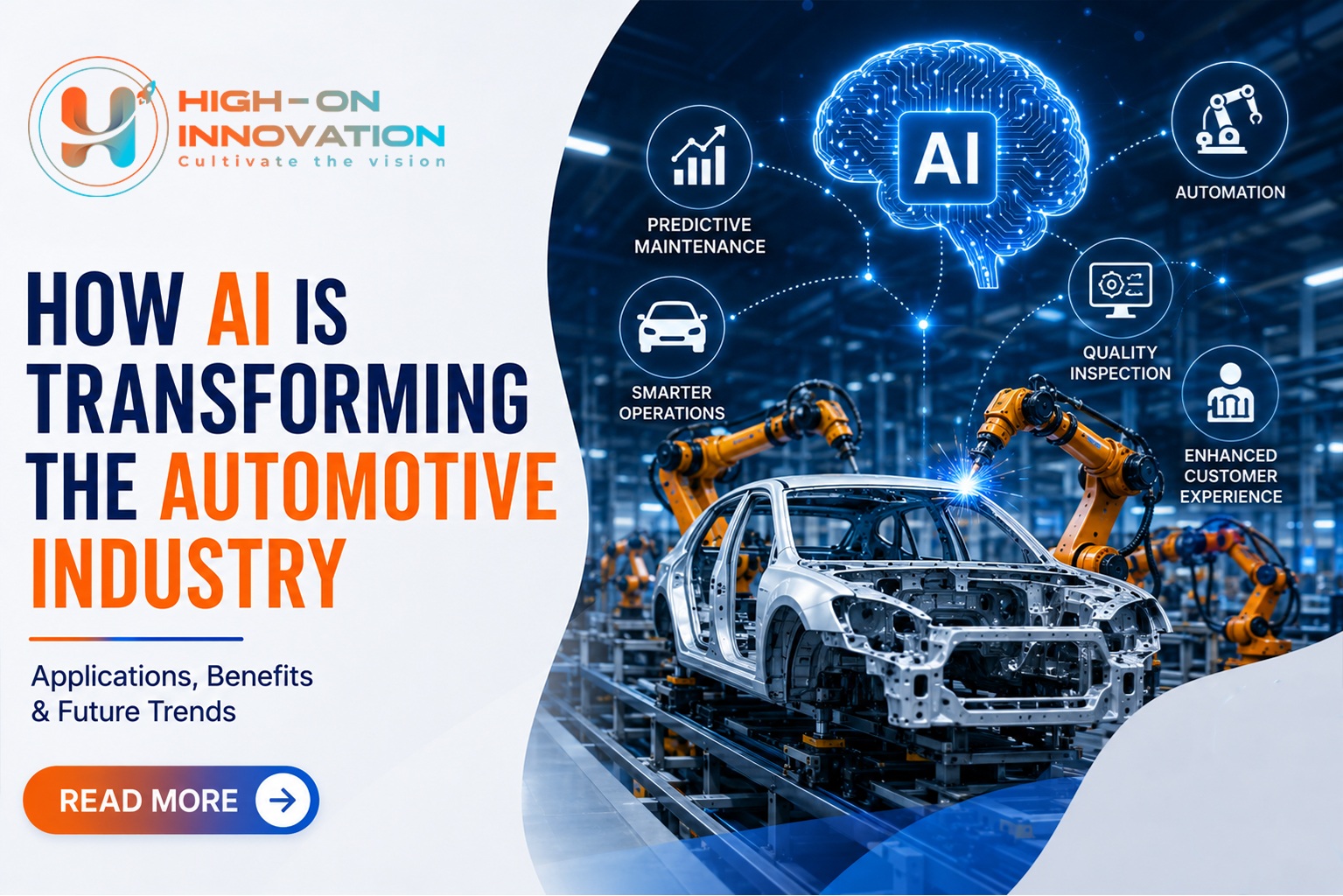
How AI Is Transforming the Automotive Industry: Applications, Benefits & Future Trends
Artificial Intelligence (AI) is reshaping every stage of the automotive value chain—from vehicle design and manufacturing to quality assurance, supply chain optimization, and connected mobility. What was once considered a futuristic concept has become a strategic capability for automotive OEMs, Tier-1 suppliers, EV manufacturers, and mobility startups seeking to improve efficiency, accelerate innovation, and remain competitive in an increasingly software-driven industry.
The automotive sector generates vast amounts of data through production equipment, connected machines, vehicle sensors, enterprise systems, and customer interactions. AI transforms this data into actionable intelligence, enabling manufacturers to make faster decisions, automate repetitive tasks, detect defects before they become costly issues, and optimize production in real time.
As the industry transitions toward electric vehicles (EVs), software-defined vehicles (SDVs), and smart factories, AI is no longer an optional investment—it is becoming a core pillar of digital transformation.
In this article, we'll explore how AI is transforming the automotive industry, its key applications, benefits, implementation considerations, and what lies ahead for manufacturers embracing intelligent automation.
What Is Artificial Intelligence in the Automotive Industry?
Artificial Intelligence refers to computer systems capable of performing tasks that traditionally require human intelligence, such as learning from data, recognizing patterns, making predictions, and supporting decision-making.
In the automotive industry, AI is applied across multiple functions, including:
Manufacturing automation
Quality inspection
Predictive maintenance
Supply chain optimization
Autonomous driving
Product engineering
Robotics
Demand forecasting
Customer experience
Vehicle diagnostics
Unlike traditional automation, AI systems continuously improve by learning from historical and real-time data. This enables manufacturers to respond dynamically to changing production conditions and make more informed operational decisions.
Related Reading: The Complete Guide to Digital Transformation in the Automotive Industry (Pillar Blog)
Why AI Matters in Modern Automotive Manufacturing
The automotive industry is under constant pressure to produce higher-quality vehicles while reducing costs, improving sustainability, and accelerating innovation.
Several trends are driving AI adoption:
Rapid growth of electric vehicles
Increasing vehicle software complexity
Global supply chain disruptions
Rising customer expectations
Labor shortages in manufacturing
Stricter quality and regulatory requirements
Traditional manufacturing approaches struggle to address these challenges at scale. AI enables organizations to process large volumes of operational data, identify inefficiencies, and optimize processes in ways that manual analysis cannot.
For example, instead of inspecting every component manually, AI-powered vision systems can analyze thousands of parts per hour with consistent accuracy, helping reduce defects and improve production throughput.
Key Applications of AI in the Automotive Industry
AI delivers value across the automotive ecosystem, from engineering and production to logistics and customer service. Below are some of its most impactful applications.
1. AI-Powered Quality Inspection
Maintaining consistent product quality is essential in automotive manufacturing, where even minor defects can lead to recalls, warranty claims, and reputational damage.
Traditional quality inspection relies heavily on manual checks, which can be time-consuming and prone to human error. AI-powered computer vision systems address these limitations by analyzing high-resolution images and sensor data to identify defects with remarkable precision.
Common inspection use cases include:
Paint surface defect detection
Weld quality verification
Battery cell inspection for EVs
Component alignment validation
Assembly verification
Surface crack detection
Dimensional accuracy checks
These systems can operate continuously, ensuring consistent quality while reducing inspection time and improving first-pass yield.
Business Benefits:
Improved product quality
Faster inspection cycles
Reduced scrap and rework
Enhanced customer satisfaction
Lower warranty costs
Related Blog: Computer Vision Applications in Automotive Manufacturing
2. Predictive Maintenance
Unexpected equipment failures can halt production lines, resulting in costly downtime and missed delivery schedules.
AI-powered predictive maintenance helps manufacturers move beyond reactive repairs by analyzing machine data to predict failures before they occur.
Sensors installed on production equipment continuously monitor parameters such as:
Temperature
Vibration
Pressure
Motor current
Lubrication levels
Acoustic signals
Machine learning models analyze these data streams to identify patterns associated with equipment degradation.
When anomalies are detected, maintenance teams receive alerts, allowing repairs to be scheduled during planned downtime.
Benefits include:
Reduced unplanned downtime
Lower maintenance costs
Extended equipment lifespan
Improved production reliability
Better spare parts planning
For automotive plants operating around the clock, predictive maintenance can significantly improve Overall Equipment Effectiveness (OEE) and reduce operational disruptions.
Related Blog: Predictive Maintenance for Automotive Manufacturing Plants
3. Intelligent Production Planning
Production scheduling in automotive manufacturing involves balancing numerous variables, including customer demand, material availability, workforce capacity, and machine utilization.
AI-powered planning systems analyze historical production data alongside real-time operational information to optimize manufacturing schedules.
For example, AI can:
Predict production bottlenecks
Optimize assembly line sequencing
Recommend resource allocation
Improve workforce scheduling
Reduce idle machine time
This enables manufacturers to respond more effectively to changing market conditions while improving operational efficiency.
Business Impact
Traditional Planning
AI-Driven Planning
Static schedules
Dynamic optimization
Manual adjustments
Automated recommendations
Reactive decision-making
Predictive insights
Limited visibility
Real-time production monitoring
Higher downtime
Improved equipment utilization
4. AI in Supply Chain Optimization
Automotive supply chains are among the most complex in the manufacturing sector, involving thousands of suppliers across multiple regions.
AI enhances supply chain resilience by analyzing data from procurement systems, logistics providers, inventory databases, and external sources to improve decision-making.
Key use cases include:
Demand forecasting
Inventory optimization
Supplier risk assessment
Logistics route optimization
Procurement analytics
Delivery time prediction
For example, AI can detect early indicators of supplier disruptions and recommend alternative sourcing strategies before production is affected.
This proactive approach helps manufacturers reduce delays, minimize inventory costs, and improve customer satisfaction.
5. AI-Powered Robotics and Automation
Industrial robots have been used in automotive manufacturing for decades, but AI is making them significantly more intelligent and adaptable.
Modern AI-enabled robots can:
Recognize objects using computer vision
Adjust movements based on environmental changes
Collaborate safely with human workers
Optimize assembly operations
Learn from operational data
Collaborative robots (co bots) are increasingly deployed for tasks such as:
Precision assembly
Fastening components
Material handling
Packaging
Inspection support
Unlike traditional robots that require fixed programming, AI-powered systems can adapt to product variations and changing production requirements.
6. AI in Automotive Product Engineering
AI is also transforming how vehicles are designed and engineered.
Engineering teams increasingly use AI to:
Optimize component designs
Simulate vehicle performance
Improve aerodynamics
Accelerate battery development
Enhance crash simulations
Support generative design
By evaluating thousands of design alternatives, AI helps engineers identify solutions that balance performance, weight, cost, and manufacturability.
This accelerates product development while reducing the need for physical prototypes.
Benefits of AI Adoption in the Automotive Industry
Implementing AI delivers measurable value across manufacturing and business operations.
Some of the most significant benefits include:
Increased production efficiency
Improved product quality
Reduced manufacturing costs
Lower equipment downtime
Faster product development
Better supply chain visibility
Enhanced workplace safety
More accurate forecasting
Improved sustainability through optimized resource utilization
These benefits make AI a critical enabler of long-term competitiveness in an increasingly digital automotive landscape.
Challenges of Implementing AI in the Automotive Industry
While the business case for AI is compelling, successful implementation requires more than deploying algorithms or purchasing new software. Automotive manufacturers often face organizational, technical, and operational challenges that must be addressed to realize long-term value.
1. Data Quality and Integration
AI models are only as effective as the data they are trained on. Many automotive manufacturers operate with data spread across manufacturing execution systems (MES), enterprise resource planning (ERP), product lifecycle management (PLM), quality management systems (QMS), and legacy equipment.
Common challenges include:
Data silos across departments
Inconsistent data formats
Missing or incomplete datasets
Limited connectivity with legacy machinery
A strong data governance strategy is essential to ensure AI systems receive reliable, standardized, and high-quality data.
2. Legacy Infrastructure
Many production facilities still rely on machines that were not designed for digital connectivity. Replacing an entire production line is rarely practical or cost-effective.
Instead, manufacturers can modernize incrementally by:
Retrofitting legacy equipment with IIoT sensors
Integrating edge gateways for real-time data collection
Connecting operational technology (OT) with IT systems
Adopting cloud-based analytics platforms
This phased approach minimizes disruption while laying the foundation for AI-driven operations.
3. Skills and Workforce Readiness
AI adoption introduces new responsibilities for engineering, production, and maintenance teams. Employees need the skills to interpret AI-driven insights, manage intelligent systems, and make data-informed decisions.
Organizations should invest in:
AI and data analytics training
Cross-functional collaboration between IT and OT teams
Change management initiatives
Continuous learning programs
Empowering employees to work alongside AI technologies is just as important as the technology itself.
4. Cybersecurity and Data Privacy
As AI systems become increasingly connected, cybersecurity becomes a critical consideration. Automotive manufacturers must protect production systems, intellectual property, and sensitive operational data from evolving cyber threats.
Best practices include:
Implementing Zero Trust security principles
Encrypting data in transit and at rest
Regular vulnerability assessments
Secure API integrations
Role-based access controls
Continuous monitoring and incident response
A secure AI ecosystem protects both operational continuity and customer trust.
A Practical Roadmap for AI Adoption
Successful AI initiatives begin with clear business objectives rather than technology for its own sake. The following roadmap can help automotive manufacturers implement AI strategically.
Phase
Objective
Example Activities
Assess
Identify high-impact opportunities
Evaluate production bottlenecks, quality issues, and maintenance challenges
Prepare
Build a reliable data foundation
Integrate data sources, improve governance, and connect equipment
Pilot
Validate AI use cases
Deploy AI for defect detection or predictive maintenance in a single production line
Scale
Expand successful implementations
Roll out AI across plants, production lines, and business functions
Optimize
Continuously improve performance
Monitor KPIs, retrain AI models, and refine processes based on operational insights
Rather than attempting a large-scale transformation all at once, manufacturers often achieve better results by proving value through targeted pilot projects before expanding across the organization.
Real-World AI Use Cases in Automotive Manufacturing
AI is already delivering measurable business value across the automotive sector. While implementation approaches vary, the following examples illustrate how manufacturers can apply AI to improve operational performance.
EV Battery Manufacturing
Battery quality directly affects vehicle safety, range, and performance. AI-powered vision systems inspect battery cells for surface defects, contamination, and dimensional inconsistencies that may be difficult to detect manually.
Benefits include:
Higher battery reliability
Reduced scrap rates
Faster inspection cycles
Improved traceability
Smart Assembly Lines
AI analyzes production data from connected equipment to optimize assembly sequences, reduce idle time, and balance workloads across production stations.
This enables manufacturers to:
Improve throughput
Reduce bottlenecks
Increase equipment utilization
Adapt production schedules more quickly
Supplier Risk Monitoring
AI combines procurement data with external factors such as weather events, transportation delays, and geopolitical developments to identify potential supply chain disruptions before they impact production.
This proactive visibility helps manufacturers:
Diversify suppliers
Adjust inventory levels
Minimize production delays
Improve supply chain resilience
Warranty and Service Analytics
AI analyzes warranty claims, dealership service records, and customer feedback to identify recurring quality issues.
These insights help engineering teams:
Improve future vehicle designs
Reduce warranty costs
Enhance customer satisfaction
Prioritize product improvements
Best Practices for AI Implementation
Organizations that achieve the greatest success with AI typically follow several common principles.
Start with Business Problems
Rather than adopting AI because it is a popular technology, focus on measurable operational challenges such as reducing downtime, improving quality, or optimizing inventory.
Prioritize High-Value Use Cases
Early successes build organizational confidence. Use cases such as predictive maintenance, quality inspection, and production scheduling often deliver faster returns on investment.
Ensure Cross-Functional Collaboration
AI initiatives require collaboration between manufacturing, engineering, IT, quality, and operations teams. Shared ownership improves adoption and long-term success.
Measure Business Outcomes
Define key performance indicators (KPIs) before implementation, such as:
Overall Equipment Effectiveness (OEE)
First-pass yield
Mean Time Between Failures (MTBF)
Maintenance costs
Scrap rate
Production cycle time
Tracking these metrics helps demonstrate the value of AI investments.
The Future of AI in the Automotive Industry
Artificial intelligence will continue to play a central role in the evolution of the automotive industry. Several emerging trends are expected to shape the next generation of manufacturing and mobility.
Generative AI for Engineering
Generative AI is helping engineers accelerate concept development, generate software code, summarize technical documentation, and explore optimized product designs based on performance requirements.
AI-Powered Digital Twins
Combining AI with digital twins enables manufacturers to simulate production scenarios, predict equipment behavior, and optimize factory performance before making changes in the physical environment.
Autonomous Manufacturing
Future smart factories will increasingly rely on AI to make real-time operational decisions, automatically adjust production schedules, and optimize resource allocation with minimal human intervention.
AI-Driven Sustainability
AI will support environmental goals by optimizing energy consumption, reducing material waste, improving logistics efficiency, and enabling more sustainable manufacturing practices.
As AI technologies mature, manufacturers that invest in scalable digital capabilities today will be better positioned to adapt to future market demands.
Key Takeaways
AI is transforming the automotive industry by improving manufacturing efficiency, quality, and operational agility.
Predictive maintenance, computer vision, intelligent robotics, and supply chain optimization are among the highest-value AI applications.
Successful AI implementation depends on high-quality data, secure digital infrastructure, and workforce readiness.
A phased adoption strategy helps manufacturers minimize risk while delivering measurable business outcomes.
AI will continue to drive innovation across smart manufacturing, software-defined vehicles, and connected mobility.
Frequently Asked Questions
What is AI in the automotive industry?
AI in the automotive industry refers to the use of machine learning, computer vision, natural language processing, and advanced analytics to improve vehicle development, manufacturing, quality control, supply chain management, and customer experiences.
How is AI used in automotive manufacturing?
AI is commonly used for predictive maintenance, automated quality inspection, production planning, robotics, demand forecasting, inventory optimization, and process automation.
What are the benefits of AI for automotive manufacturers?
Key benefits include improved production efficiency, reduced downtime, enhanced product quality, lower operational costs, faster decision-making, and better supply chain visibility.
Can AI improve vehicle quality?
Yes. AI-powered computer vision systems can detect manufacturing defects with greater consistency and speed than traditional manual inspections, helping reduce rework and warranty claims.
Is AI only useful for large automotive companies?
No. While large OEMs often implement AI at scale, small and mid-sized manufacturers can also benefit by starting with focused use cases such as predictive maintenance or quality inspection and expanding over time.
Conclusion
Artificial Intelligence is redefining how vehicles are designed, manufactured, and supported throughout their lifecycle. From intelligent quality inspection and predictive maintenance to optimized production planning and resilient supply chains, AI enables automotive manufacturers to make smarter decisions, improve operational performance, and respond more effectively to changing market conditions.
However, achieving meaningful results requires more than adopting new technology. Success depends on a well-defined digital transformation strategy, reliable data, skilled teams, and a commitment to continuous improvement. Organizations that approach AI as a long-term business capability—not simply a technology initiative—will be better equipped to navigate the transition toward software-defined vehicles, smart factories, and connected mobility.
As competition intensifies and customer expectations continue to evolve, AI will remain a critical differentiator for automotive manufacturers seeking sustainable growth and operational excellence.
How High On Innovation Can Help
High On Innovation partners with automotive OEMs, Tier-1 suppliers, EV manufacturers, and mobility companies to accelerate AI adoption through tailored digital engineering and smart manufacturing solutions.
Our expertise includes:
Artificial Intelligence and Machine Learning
Industrial IoT (IIoT)
Smart Factory Solutions
Predictive Maintenance Platforms
Computer Vision for Quality Inspection
Digital Twins
Data Analytics and Business Intelligence
Embedded Engineering
Automotive Software Development
Cloud and Edge Computing
Whether you're modernizing a production facility or launching AI-powered manufacturing initiatives, our team can help you design scalable solutions aligned with your business goals.
Sachikanta Mohanty is the Digital Marketing Manager and Lead Strategist at High-On Innovation, responsible for driving digital growth initiatives for both internal and client projects. He specializes in SEO, content strategy, digital transformation marketing, lead generation, performance marketing, and online brand growth. With extensive experience in developing data-driven marketing strategies, he helps businesses improve visibility, customer acquisition, and long-term digital success.
Comments
Loading comments…
Latest Market Trends

Sep 9, 2026
MVP Development Cost for Australian Businesses in 2026
A simple customer portal, booking application, SaaS dashboard, marketplace, AI-powered platform, fintech product, healthcare application, or enterprise workflow system can all be described as an "MVP", but their development requirements can be dramatically different.

Sep 3, 2026
How to Choose an MVP Development Company for Your Startup
Choosing the right MVP development company can have a major impact on your startup's first product launch. The right development partner does more than write code. They help translate your business idea into a focused product, identify technical risks, prioritize features, and create an MVP that can be tested with real users.

Sep 8, 2026
MVP Development Cost for Canadian Businesses in 2026: Complete Guide to Pricing, Features and Process
Discover MVP development cost Canada in 2026, including startup MVP cost, development factors, timelines, features, technology, compliance, and how to choose the right MVP development company.
Popular Post
MVP Development Cost for Australian Businesses in 2026
A simple customer portal, booking application, SaaS dashboard, marketplace, AI-powered platform, fintech product, healthcare application, or enterprise workflow system can all be described as an "MVP", but their development requirements can be dramatically different.
How to Choose an MVP Development Company for Your Startup
Choosing the right MVP development company can have a major impact on your startup's first product launch. The right development partner does more than write code. They help translate your business idea into a focused product, identify technical risks, prioritize features, and create an MVP that can be tested with real users.
MVP Development Cost for Canadian Businesses in 2026: Complete Guide to Pricing, Features and Process
Discover MVP development cost Canada in 2026, including startup MVP cost, development factors, timelines, features, technology, compliance, and how to choose the right MVP development company.

MVP Development Cost for USA Startups in 2026
An MVP, or Minimum Viable Product, gives founders a way to turn an idea into a usable product, launch it with real users, collect feedback, and understand whether the market actually wants the solution.