MVP Development Timeline: How Long Does It Take to Build an MVP?
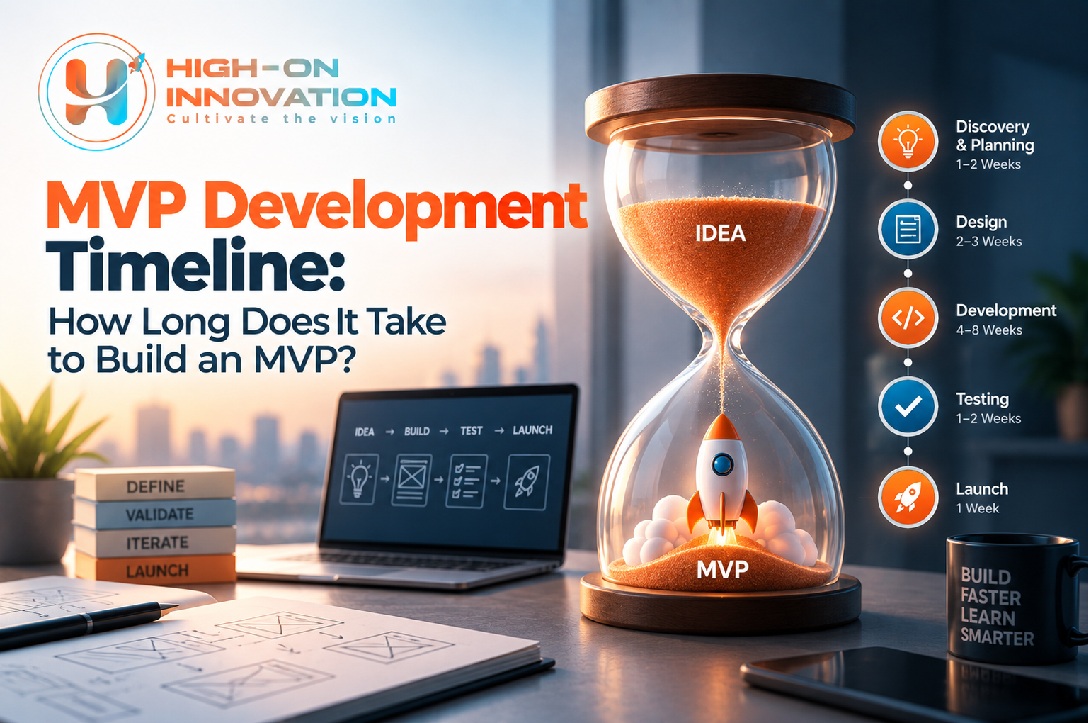
For a startup, knowing how long MVP development takes is critical for planning investment, coordinating teams, preparing a launch strategy, and setting realistic expectations with stakeholders.
There is no universal MVP development timeline. A simple MVP with a limited number of features can be launched in a matter of weeks, while a complex SaaS platform, marketplace, fintech product, or AI-powered application may take several months.
The key is to understand which development stages affect the timeline and how startups can keep the first release focused without compromising product quality.
How Long Does It Take to Build an MVP?
A typical MVP can take 8–16 weeks to move from initial discovery through development, testing, and launch. However, this is only a general benchmark.
The actual MVP development timeline depends on:
Product complexity
Number of features
Web, mobile, or multi-platform requirements
UX/UI design requirements
Third-party integrations
Backend complexity
Technology stack
Security and compliance requirements
Testing requirements
Availability of product and development teams
A simple MVP may require less time, while products involving complex workflows, AI functionality, payments, real-time systems, or regulatory requirements may require considerably more.
For a broader understanding of the development methodology, see our guide to the MVP development process.
MVP Development Timeline by Stage
Breaking the project into individual stages provides a more realistic view of how long MVP development takes.
1. Product Discovery and Requirements: 1–2 Weeks
The first stage is about defining what needs to be built and why.
The team works on:
Business objectives
Target users
Core problem
Product requirements
User journeys
Technical requirements
MVP scope
This stage is important because unclear requirements often create delays later in development.
The objective is not to document every possible future feature. It is to establish a clear scope for the first product release.
2. UX/UI Design: 2–4 Weeks
Once the MVP scope is defined, the team translates requirements into user flows, wireframes, prototypes, and final interface designs.
The timeline depends on the number of screens and user journeys involved.
A straightforward MVP with a small number of workflows may require significantly less design work than a marketplace or multi-role SaaS application.
What happens during MVP design?
The design team typically works through:
Information architecture
User flows
Wireframes
Interactive prototype
UI design
Design refinement
Developer handoff
Completing the critical user experience before extensive development can reduce rework later.
3. MVP Development: 6–10 Weeks
Development is generally the largest component of the timeline.
The frontend, backend, database, APIs, authentication, integrations, and core business logic are developed during this stage.
The actual timeframe depends heavily on scope.
For example, a basic web application with authentication and a small number of workflows will generally require less development time than a platform involving multiple user roles, payment processing, real-time communication, analytics, and external integrations.
Development is often performed in iterations rather than as one continuous phase. This allows the team to identify technical issues early and adjust implementation when necessary.
4. Testing and Quality Assurance: 1–3 Weeks
Testing should not be treated as an optional final step.
QA teams test the MVP for:
Functional issues
Usability problems
Responsive behavior
Browser and device compatibility
Integration failures
Performance issues
Security vulnerabilities
Some testing happens throughout development, while final QA focuses on ensuring the release candidate is stable enough for real users.
5. Deployment and Launch: Around 1 Week
Once the MVP has passed the required testing, the product can be prepared for deployment.
This may involve:
Production environment setup
Database configuration
Domain and hosting configuration
App store submission, where applicable
Analytics implementation
Monitoring
Final production testing
The launch itself may take only a few days, but preparation should be included in the overall timeline.
Typical MVP Development Timeline
A simplified project schedule might look like this:
Development Stage | Estimated Time |
Discovery & requirements | 1–2 weeks |
UX/UI design | 2–4 weeks |
Development | 6–10 weeks |
QA & testing | 1–3 weeks |
Deployment & launch | ~1 week |
Overall timeline | 8–16+ weeks |
These phases can sometimes overlap. For example, backend development may begin while the design team completes later screens, which can shorten the overall calendar time.
Therefore, adding the duration of every phase does not necessarily give the exact project completion date.
What Factors Affect the MVP Development Timeline?
Product Complexity
Complex products naturally require more time.
An MVP with five core workflows will generally have a shorter timeline than one supporting multiple user types, advanced dashboards, real-time communication, payments, and sophisticated business rules.
Feature Scope
The number of features is one of the biggest contributors to development time.
Every additional feature introduces design, development, testing, and potential integration requirements.
This is why defining a strict MVP scope is essential.
Platform Requirements
Building for one platform can be faster than launching across web, iOS, and Android simultaneously.
A startup should determine whether multiple platforms are genuinely required for the initial validation stage.
Third-Party Integrations
Payment gateways, CRMs, communication platforms, maps, analytics tools, AI APIs, and other external services can add development and testing requirements.
Security and Compliance
Products operating in industries such as healthcare, fintech, or other regulated environments may require additional security, privacy, documentation, and compliance work.
These requirements can significantly affect the timeline.
Changes During Development
Frequent scope changes can extend the project considerably.
Adding features after development has started may require changes to architecture, database structures, APIs, UI designs, and testing plans.
A controlled change-management process helps protect the original timeline.
How to Reduce Your MVP Development Timeline
Speed should not mean skipping important development activities. Instead, startups should remove unnecessary work.
Define the Core User Journey
Identify the smallest product experience that can demonstrate your value proposition.
Prioritize Must-Have Features
Separate launch-critical functionality from features that can be added after receiving user feedback.
Use Proven Technologies
A technology stack should match the product requirements without introducing unnecessary technical complexity.
Prepare Content and Requirements Early
Delays can occur when development teams are waiting for product decisions, content, assets, credentials, or integration information.
Use Iterative Development
Short development cycles make it easier to identify blockers and resolve issues before they affect the entire project.
Does a Faster MVP Mean a Better MVP?
Not necessarily.
The objective of MVP development is not simply to launch as quickly as possible. It is to learn quickly while delivering a reliable product experience.
An extremely rushed MVP may contain usability problems, unstable functionality, poor architecture, or security issues. These problems can damage early user trust and create additional development costs later.
A better approach is to optimize for time-to-learning rather than simply time-to-launch.
The right question is:
What is the fastest responsible way to launch a product that can generate meaningful user feedback?
How to Plan Your MVP Development Timeline
Before development begins, establish:
The business objective
Target users
Core user journey
MVP feature list
Technical requirements
Design requirements
Development milestones
Testing requirements
Launch criteria
Post-launch measurement plan
A clear scope allows the development team to provide a more realistic timeline and identify potential risks before work begins.
If you're still evaluating the financial side of your project, our guide to MVP development cost explains the major factors that influence startup MVP budgets.
Frequently Asked Questions
1. How long does it take to develop an MVP?
Most startup MVPs can take around 8–16 weeks, depending on scope and complexity. Simple products may take less time, while complex applications involving multiple platforms, integrations, AI, payments, or compliance requirements can take longer.
2. Can an MVP be built in 4 weeks?
Yes, but only when the product has a very narrow scope and limited technical complexity. A four-week timeline may be realistic for a simple proof-oriented MVP, but it should not be treated as a standard timeline for every startup product.
3. What takes the most time when building an MVP?
Development is typically the largest stage, but the total timeline can also be heavily affected by requirements, design, feature changes, integrations, testing, and decision-making delays.
4. How can I speed up MVP development?
The most effective approach is to reduce unnecessary scope, prioritize essential features, make product decisions early, use an appropriate technology stack, and maintain a clear development roadmap. Cutting QA or essential discovery work is generally not a good way to accelerate a product launch.
5. What happens after the MVP is launched?
After launch, the startup should collect user feedback, monitor relevant product metrics, identify usability issues, and prioritize improvements. The MVP should become the foundation for iterative product development rather than the final version of the product.
Conclusion
The MVP development timeline depends less on how many weeks a development team promises and more on how clearly the product is defined. A focused MVP with a well-prioritized scope can move from discovery to launch significantly faster than an overloaded first release.
For most startups, planning around an 8–16-week timeframe provides a useful starting benchmark, but the final schedule should be based on actual requirements, technical complexity, and launch objectives.
High On Innovation helps startups plan, design, develop, test, and launch MVPs with a structured approach focused on reducing unnecessary scope while creating a reliable foundation for future growth.
Have an MVP idea and need a realistic development timeline? Contact High On Innovation to discuss your product requirements and get a project roadmap tailored to your startup.
Sachikanta Mohanty is the Digital Marketing Manager and Lead Strategist at High-On Innovation, responsible for driving digital growth initiatives for both internal and client projects. He specializes in SEO, content strategy, digital transformation marketing, lead generation, performance marketing, and online brand growth. With extensive experience in developing data-driven marketing strategies, he helps businesses improve visibility, customer acquisition, and long-term digital success.
Comments
Loading comments…
Latest Market Trends

Sep 9, 2026
MVP Development Cost for Australian Businesses in 2026
A simple customer portal, booking application, SaaS dashboard, marketplace, AI-powered platform, fintech product, healthcare application, or enterprise workflow system can all be described as an "MVP", but their development requirements can be dramatically different.

Sep 3, 2026
How to Choose an MVP Development Company for Your Startup
Choosing the right MVP development company can have a major impact on your startup's first product launch. The right development partner does more than write code. They help translate your business idea into a focused product, identify technical risks, prioritize features, and create an MVP that can be tested with real users.

Sep 8, 2026
MVP Development Cost for Canadian Businesses in 2026: Complete Guide to Pricing, Features and Process
Discover MVP development cost Canada in 2026, including startup MVP cost, development factors, timelines, features, technology, compliance, and how to choose the right MVP development company.
Popular Post
MVP Development Cost for Australian Businesses in 2026
A simple customer portal, booking application, SaaS dashboard, marketplace, AI-powered platform, fintech product, healthcare application, or enterprise workflow system can all be described as an "MVP", but their development requirements can be dramatically different.
How to Choose an MVP Development Company for Your Startup
Choosing the right MVP development company can have a major impact on your startup's first product launch. The right development partner does more than write code. They help translate your business idea into a focused product, identify technical risks, prioritize features, and create an MVP that can be tested with real users.
MVP Development Cost for Canadian Businesses in 2026: Complete Guide to Pricing, Features and Process
Discover MVP development cost Canada in 2026, including startup MVP cost, development factors, timelines, features, technology, compliance, and how to choose the right MVP development company.
MVP Development Cost for USA Startups in 2026
An MVP, or Minimum Viable Product, gives founders a way to turn an idea into a usable product, launch it with real users, collect feedback, and understand whether the market actually wants the solution.