The Future of Digital Transformation and Emerging Technologies
Key Takeaways
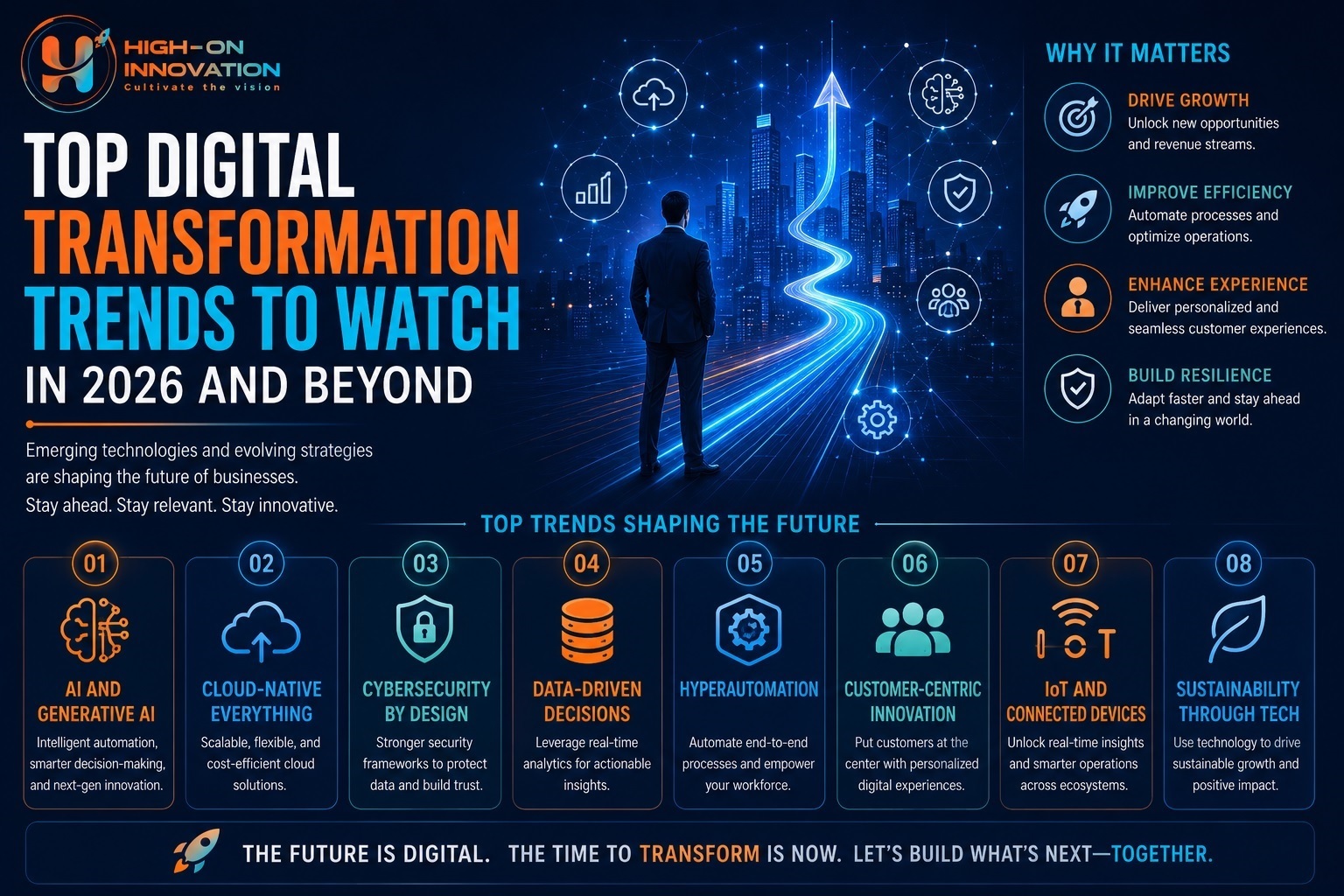
AI and generative AI are becoming major drivers of future digital transformation.
Hyperautomation will automate entire business workflows and operations.
Cloud-native infrastructure supports scalable and agile digital ecosystems.
IoT and analytics enable real-time operational intelligence.
Blockchain improves transparency, security, and digital trust.
Future businesses will rely heavily on intelligent automation and predictive decision-making.
Introduction
Digital transformation is evolving faster than ever before. What began as a shift toward cloud computing, automation, and online systems has now expanded into intelligent ecosystems powered by artificial intelligence, real-time analytics, hyperautomation, connected devices, and advanced digital experiences.
Businesses today are no longer asking whether digital transformation is necessary. Instead, they are focusing on how quickly they can adapt to emerging technologies and remain competitive in a rapidly changing digital economy.
The future of digital transformation will be driven by organizations that can combine innovation, agility, automation, and data-driven intelligence to create smarter operations and more personalized customer experiences.
Technologies such as generative AI, machine learning, IoT, blockchain, edge computing, and intelligent automation are reshaping industries and redefining how businesses operate.
This article explores the future of digital transformation and the emerging technologies that will shape the next generation of business innovation.
Understanding the Future of Digital Transformation
Digital transformation is no longer limited to digitizing existing business processes. The future focuses on building intelligent, connected, and adaptive digital ecosystems that continuously evolve based on data, automation, and customer behavior.
Future digital transformation strategies will prioritize:
AI-powered decision-making
Real-time business intelligence
Hyperautomation
Predictive analytics
Personalized customer experiences
Cloud-native infrastructure
Intelligent cybersecurity
Autonomous business operations
Organizations that embrace these innovations early will gain stronger competitive advantages and long-term scalability.
Why Emerging Technologies Matter
Emerging technologies help businesses:
Improve efficiency
Reduce operational complexity
Accelerate innovation
Enhance customer engagement
Automate decision-making
Increase scalability
Improve agility
These technologies are transforming industries by enabling businesses to operate faster, smarter, and more intelligently than ever before.
Companies that delay digital innovation risk falling behind competitors that adapt more quickly to technological advancements and changing customer expectations.
Emerging Technologies Shaping the Future of Digital Transformation
1. Artificial Intelligence (AI)
The Growing Role of AI
Artificial Intelligence is becoming the foundation of modern digital transformation.
AI systems can:
Analyze massive datasets
Automate workflows
Predict outcomes
Personalize customer experiences
Improve operational efficiency
Support intelligent decision-making
AI is moving businesses from reactive operations to predictive and proactive business models.
Future AI Applications
Intelligent Automation
AI will automate increasingly complex business operations across industries.
Predictive Business Intelligence
Organizations will use AI to forecast trends, customer behavior, and operational risks more accurately.
AI-Powered Customer Experiences
Businesses will deliver hyper-personalized digital experiences in real time.
Autonomous Decision Systems
AI systems will assist or independently manage operational decisions in specific environments.
AI will continue becoming one of the most transformative technologies for modern businesses.
2. Generative AI
The Rise of Generative AI
Generative AI has become one of the fastest-growing technologies in digital transformation.
Unlike traditional AI systems that analyze data, generative AI can create:
Content
Designs
Code
Reports
Marketing assets
Business communications
Businesses are rapidly integrating generative AI into operations, customer support, and creative workflows.
Future Business Impact
Faster Content Creation
Marketing and communication teams can scale content production significantly.
AI-Assisted Software Development
Developers use generative AI to accelerate coding and debugging processes.
Intelligent Virtual Assistants
Advanced AI assistants will improve productivity and workflow management.
Personalized Customer Interactions
Generative AI enables highly customized customer engagement at scale.
Generative AI is expected to become a major productivity and innovation driver across industries.
3. Hyperautomation
What Is Hyperautomation?
Hyperautomation combines:
AI
Machine learning
Robotic process automation (RPA)
Analytics
Intelligent workflows
to automate entire business processes.
Instead of automating single tasks, hyperautomation creates connected and self-optimizing workflows.
Future Benefits of Hyperautomation
Businesses will use hyperautomation to:
Reduce manual workloads
Improve operational efficiency
Increase productivity
Minimize errors
Accelerate workflows
Industries like finance, healthcare, logistics, and manufacturing are expected to adopt hyperautomation aggressively.
4. Cloud-Native Digital Ecosystems
The Evolution of Cloud Computing
Cloud computing will remain one of the most important foundations of future digital transformation.
Future cloud environments will focus on:
Scalability
Real-time accessibility
AI integration
Edge computing
Distributed infrastructure
Businesses are increasingly shifting toward cloud-native operations to support innovation and global scalability.
Future Cloud Transformation Trends
Multi-Cloud Strategies
Organizations will use multiple cloud providers to improve flexibility and resilience.
Edge Computing Integration
Data processing will move closer to users and devices for faster performance.
AI-Powered Cloud Infrastructure
Cloud platforms will automatically optimize workloads and security using AI.
Cloud computing will continue enabling agile and scalable digital business operations.
5. Internet of Things (IoT)
The Growth of Connected Systems
IoT connects devices, machines, sensors, and systems through the internet to collect and exchange real-time data.
IoT adoption is rapidly expanding across:
Manufacturing
Healthcare
Logistics
Smart cities
Retail
Agriculture
Future IoT Applications
Smart Manufacturing
Factories will use IoT for predictive maintenance and automated monitoring.
Connected Healthcare
Wearable devices and remote monitoring systems will improve patient care.
Intelligent Supply Chains
Businesses will track products and logistics in real time.
Smart Workspaces
IoT-enabled offices will optimize energy, security, and productivity.
IoT will continue improving operational visibility and automation capabilities.
6. Advanced Data Analytics
The Future of Data-Driven Transformation
Future businesses will rely heavily on real-time analytics and predictive intelligence.
Advanced analytics systems will provide:
Automated insights
Real-time forecasting
Behavioral analysis
Intelligent recommendations
Analytics will increasingly become autonomous and AI-driven.
Future Analytics Trends
Real-Time Decision Intelligence
Businesses will make operational decisions instantly using live data streams.
Predictive Customer Insights
Organizations will anticipate customer needs before interactions occur.
Automated Reporting Systems
AI-powered systems will generate and interpret reports automatically.
Data will remain one of the most valuable strategic assets for future organizations.
7. Blockchain Technology
Blockchain Beyond Cryptocurrency
Blockchain is becoming increasingly important for secure digital ecosystems.
Businesses use blockchain for:
Secure transactions
Supply chain transparency
Digital identity management
Smart contracts
Data verification
Future Blockchain Impact
Improved Security
Blockchain improves data integrity and fraud prevention.
Transparent Supply Chains
Businesses can track product movement and authenticity more accurately.
Decentralized Digital Systems
Organizations may reduce dependence on centralized infrastructure.
Blockchain will continue expanding into industries requiring trust, security, and transparency.
8. Intelligent Cybersecurity
Why Cybersecurity Is Evolving
As businesses become more digital, cybersecurity threats continue increasing in complexity.
Future cybersecurity strategies will rely heavily on:
AI-powered threat detection
Automated security systems
Behavioral analytics
Predictive risk management
Future Security Trends
Autonomous Threat Detection
AI systems will identify and respond to threats in real time.
Zero-Trust Security Models
Organizations will strengthen access controls and identity verification.
Predictive Cybersecurity
Businesses will proactively identify vulnerabilities before attacks occur.
Cybersecurity will become deeply integrated into every digital transformation initiative.
9. Extended Reality (XR) Technologies
The Growth of Immersive Digital Experiences
Extended Reality includes:
Virtual Reality (VR)
Augmented Reality (AR)
Mixed Reality (MR)
Businesses are beginning to use XR technologies for:
Employee training
Product visualization
Customer engagement
Remote collaboration
Future XR Applications
Virtual Workspaces
Teams may collaborate in immersive digital environments.
Interactive Customer Experiences
Retailers and brands will offer more immersive shopping experiences.
Advanced Training Simulations
Industries like healthcare and manufacturing will use realistic virtual training systems.
XR technologies are expected to become increasingly important in digital engagement strategies.
Industries Being Reshaped by Emerging Technologies
Healthcare
AI diagnostics, IoT monitoring, and telemedicine are improving patient care and operational efficiency.
Banking and Finance
Financial institutions are using AI, blockchain, and predictive analytics for fraud prevention and digital banking.
Retail and Ecommerce
Retailers are implementing personalization, automation, and intelligent analytics.
Manufacturing
Smart factories use IoT, robotics, AI, and predictive maintenance systems.
Logistics
Supply chains are becoming increasingly automated and data-driven.
Education
Digital learning platforms and AI-powered personalization are transforming education systems.
Challenges Businesses Will Face
Despite exciting opportunities, businesses will also face future challenges such as:
AI ethics and governance
Data privacy concerns
Cybersecurity threats
Talent shortages
Infrastructure complexity
Rapid technology changes
Organizations must focus on adaptability, continuous learning, and responsible innovation.
How Businesses Can Prepare for the Future
Build a Digital-First Culture
Encourage innovation, experimentation, and adaptability.
Invest in Scalable Infrastructure
Cloud-native systems support long-term digital growth.
Prioritize Data and Analytics
Data-driven decision-making improves agility and competitiveness.
Focus on Employee Upskilling
Future digital success depends on digital talent and continuous learning.
Adopt Emerging Technologies Strategically
Technology adoption should align with real business objectives.
Strengthen Cybersecurity
Protect digital ecosystems through proactive security strategies.
The Future of Business in a Digital Economy
The future digital economy will be shaped by businesses that can:
Innovate continuously
Adapt quickly
Automate intelligently
Use data effectively
Deliver personalized experiences
Scale efficiently
Digital transformation will increasingly become less about individual technologies and more about building connected, intelligent, and adaptive business ecosystems.
Organizations that embrace emerging technologies today are positioning themselves for long-term leadership and sustainable growth.
Conclusion
The future of digital transformation will be driven by AI, automation, cloud computing, analytics, IoT, blockchain, and intelligent digital ecosystems.
Emerging technologies are fundamentally changing how businesses operate, engage customers, manage data, and scale operations. Organizations that successfully adapt to these innovations will become more agile, efficient, scalable, and competitive in the future digital economy.
Digital transformation is no longer simply about modernization. It is about creating intelligent, future-ready businesses capable of continuous innovation and long-term growth.
Businesses that prepare today will lead tomorrow.
Frequently Asked Questions
What technologies are shaping the future of digital transformation?
AI, generative AI, cloud computing, IoT, analytics, blockchain, hyperautomation, and cybersecurity technologies are major future drivers.
How will AI impact future businesses?
AI will improve automation, customer experiences, predictive analytics, and intelligent decision-making across industries.
What is hyperautomation?
Hyperautomation combines AI, automation, analytics, and intelligent workflows to automate complex business operations.
Why is cloud computing important for future digital transformation?
Cloud computing provides scalable infrastructure, flexibility, real-time access, and support for advanced digital technologies.
Author Bio
Harsit Gupta – Founder, High-On Innovation
Harsit Gupta is the Founder of High-On Innovation and is responsible for shaping the company's vision, business model, growth strategy, and market expansion initiatives. He specializes in identifying emerging opportunities, driving innovation, and helping businesses navigate digital transformation in a rapidly evolving technology landscape. His expertise includes business strategy, digital innovation, startup growth, market positioning, and future-focused technology adoption.
Comments
Loading comments…
Latest Market Trends

Sep 9, 2026
MVP Development Cost for Australian Businesses in 2026
A simple customer portal, booking application, SaaS dashboard, marketplace, AI-powered platform, fintech product, healthcare application, or enterprise workflow system can all be described as an "MVP", but their development requirements can be dramatically different.

Sep 3, 2026
How to Choose an MVP Development Company for Your Startup
Choosing the right MVP development company can have a major impact on your startup's first product launch. The right development partner does more than write code. They help translate your business idea into a focused product, identify technical risks, prioritize features, and create an MVP that can be tested with real users.

Sep 8, 2026
MVP Development Cost for Canadian Businesses in 2026: Complete Guide to Pricing, Features and Process
Discover MVP development cost Canada in 2026, including startup MVP cost, development factors, timelines, features, technology, compliance, and how to choose the right MVP development company.
Popular Post
MVP Development Cost for Australian Businesses in 2026
A simple customer portal, booking application, SaaS dashboard, marketplace, AI-powered platform, fintech product, healthcare application, or enterprise workflow system can all be described as an "MVP", but their development requirements can be dramatically different.
How to Choose an MVP Development Company for Your Startup
Choosing the right MVP development company can have a major impact on your startup's first product launch. The right development partner does more than write code. They help translate your business idea into a focused product, identify technical risks, prioritize features, and create an MVP that can be tested with real users.
MVP Development Cost for Canadian Businesses in 2026: Complete Guide to Pricing, Features and Process
Discover MVP development cost Canada in 2026, including startup MVP cost, development factors, timelines, features, technology, compliance, and how to choose the right MVP development company.
MVP Development Cost for USA Startups in 2026
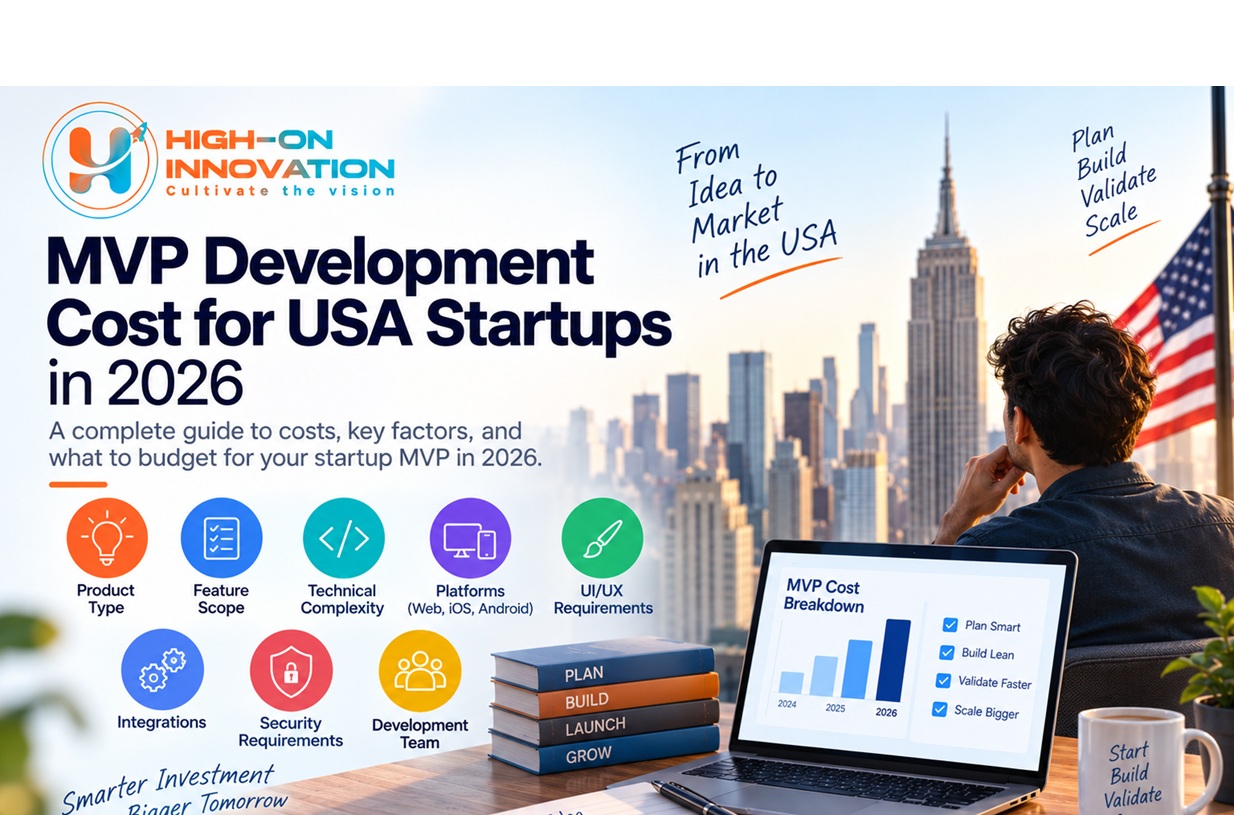
An MVP, or Minimum Viable Product, gives founders a way to turn an idea into a usable product, launch it with real users, collect feedback, and understand whether the market actually wants the solution.