Cloud Computing and Its Role in Digital Transformation
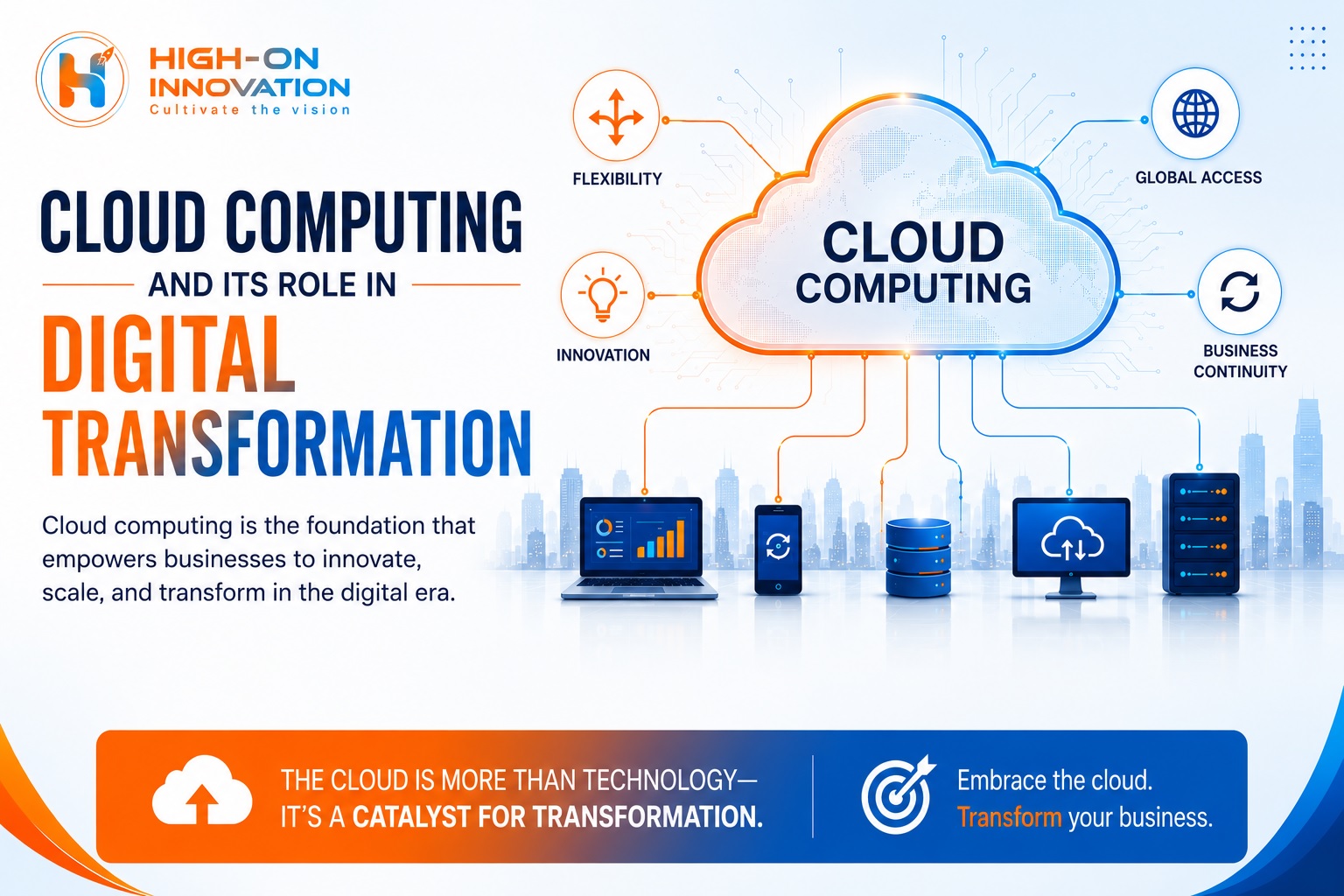
Key Takeaways
Cloud computing is a major enabler of digital transformation.
Businesses use cloud systems for scalability, flexibility, and operational efficiency.
Cloud platforms support AI, analytics, automation, and remote collaboration.
Modern cloud infrastructure improves security and business continuity.
Cloud transformation helps organizations modernize legacy systems and accelerate innovation.
Businesses adopting cloud technologies are becoming more agile and future-ready.
Introduction
Modern businesses are operating in an environment where speed, flexibility, scalability, and innovation are critical for long-term success. Traditional IT infrastructure often struggles to support rapidly changing business demands, remote collaboration, real-time data access, and modern customer expectations.
This is where cloud computing becomes a foundational pillar of digital transformation.
Cloud computing enables businesses to access technology resources, applications, storage, and computing power through the internet instead of relying solely on traditional on-premise systems. It provides the flexibility and scalability organizations need to innovate faster, improve operational efficiency, and support modern digital business models.
Today, cloud computing is no longer just an IT upgrade. It has become a strategic business enabler that powers automation, AI adoption, analytics, remote work, and scalable digital ecosystems.
What Is Cloud Computing?
Cloud computing is the delivery of computing services such as servers, databases, networking, software, analytics, and storage over the internet.
Instead of managing physical infrastructure internally, businesses can access cloud services on demand through cloud providers.
Cloud computing allows organizations to:
Store and access data remotely
Run applications online
Scale resources dynamically
Improve collaboration
Reduce infrastructure complexity
Accelerate digital innovation
Cloud systems offer businesses greater operational flexibility while reducing infrastructure maintenance burdens.
Understanding Digital Transformation
Digital transformation is the process of integrating digital technologies into business operations, customer experiences, workflows, and decision-making systems.
It involves:
Modernizing legacy systems
Automating business operations
Using AI and analytics
Improving customer experiences
Creating scalable digital infrastructure
Cloud computing serves as the backbone of many digital transformation initiatives because it provides the technological foundation needed for innovation and scalability.
Why Cloud Computing Is Essential for Digital Transformation
Digital transformation requires businesses to operate faster, collaborate better, process data efficiently, and adapt quickly to changing market conditions.
Traditional IT systems often create limitations such as:
High infrastructure costs
Limited scalability
Complex maintenance
Slow deployment cycles
Reduced flexibility
Cloud computing solves these challenges by offering scalable, agile, and accessible digital infrastructure.
Businesses using cloud technologies can:
Launch services faster
Scale operations easily
Support remote teams
Improve security
Reduce operational costs
Integrate advanced technologies like AI and analytics
Cloud computing has become one of the most important technologies enabling modern business transformation.
How Cloud Computing Supports Digital Transformation
1. Business Scalability and Flexibility
One of the biggest advantages of cloud computing is scalability.
Traditional infrastructure often requires businesses to purchase and maintain expensive hardware even when usage fluctuates.
Cloud platforms allow organizations to:
Increase or decrease resources instantly
Handle traffic spikes
Expand operations globally
Support business growth efficiently
Real Business Impact
A growing ecommerce company can scale server resources during seasonal shopping periods without investing in permanent infrastructure upgrades.
This flexibility allows businesses to grow faster and operate more efficiently.
2. Faster Innovation and Deployment
Cloud computing significantly reduces the time required to develop, test, and launch digital solutions.
Businesses can deploy:
Applications
Websites
AI systems
Analytics platforms
Collaboration tools
much faster compared to traditional infrastructure environments.
Benefits Include
Faster product launches
Improved agility
Shorter development cycles
Continuous innovation
Cloud environments allow businesses to experiment, iterate, and innovate quickly.
3. Improved Remote Collaboration
Remote and hybrid work environments have become standard for many organizations.
Cloud computing enables employees to access systems, files, and applications from anywhere using internet-connected devices.
Cloud collaboration tools improve:
Team communication
Workflow management
Real-time collaboration
File sharing
Project coordination
This improves workforce productivity and operational continuity.
4. Cost Optimization
Traditional IT infrastructure requires:
Hardware investments
Maintenance costs
Data center management
Software licensing
IT staffing
Cloud computing reduces many of these expenses through flexible subscription-based models.
Businesses only pay for the resources they use.
Financial Benefits
Reduced infrastructure costs
Lower maintenance expenses
Predictable operational spending
Reduced downtime costs
Cloud solutions help businesses optimize IT budgets while improving performance.
5. Enhanced Data Security and Backup
Data security is one of the biggest priorities in modern digital transformation.
Leading cloud providers invest heavily in:
Data encryption
Threat monitoring
Disaster recovery
Multi-factor authentication
Security compliance systems
Cloud platforms also provide automated backups and recovery systems that improve business continuity.
Why This Matters
Businesses can recover faster from:
Cyberattacks
Hardware failures
Data corruption
Operational disruptions
Modern cloud infrastructure often provides stronger security than many traditional internal systems.
6. AI and Analytics Integration
Cloud computing plays a major role in supporting AI and data analytics systems.
AI and analytics require:
Large-scale computing power
High-speed data processing
Scalable infrastructure
Cloud platforms provide the computing resources needed to run:
Machine learning models
Predictive analytics
Business intelligence systems
Customer data platforms
This allows businesses to use real-time insights for smarter decision-making.
7. Legacy System Modernization
Many organizations still rely on outdated systems that limit innovation and operational efficiency.
Cloud migration helps businesses:
Replace outdated infrastructure
Improve software integration
Increase system performance
Reduce maintenance complexity
Modern cloud environments allow businesses to build flexible and future-ready digital ecosystems.
Types of Cloud Computing Models
Public Cloud
Public cloud services are managed by third-party providers and shared across multiple organizations.
Examples include:
AWS
Microsoft Azure
Google Cloud
Best For
Scalability
Cost efficiency
Rapid deployment
Private Cloud
Private cloud infrastructure is dedicated to a single organization.
Best For
Enhanced security
Compliance requirements
Enterprise-level control
Hybrid Cloud
Hybrid cloud combines public and private cloud environments.
Businesses can balance:
Flexibility
Security
Performance
Scalability
Hybrid models are increasingly popular among large enterprises.
Industries Benefiting From Cloud-Driven Digital Transformation
Healthcare
Healthcare organizations use cloud systems for:
Telemedicine
Digital patient records
AI diagnostics
Secure data sharing
Banking and Finance
Financial institutions implement cloud platforms for:
Digital banking
Fraud detection
Financial analytics
Customer experience systems
Retail and Ecommerce
Retail businesses use cloud computing for:
Ecommerce platforms
Inventory management
Customer analytics
Omnichannel experiences
Manufacturing
Manufacturers use cloud systems for:
IoT monitoring
Supply chain management
Predictive maintenance
Automation systems
Education
Educational institutions use cloud platforms for:
Virtual learning
Remote collaboration
Digital classrooms
Learning management systems
Challenges of Cloud Adoption
Despite its benefits, cloud transformation also comes with challenges.
Data Privacy Concerns
Businesses must ensure secure data handling and regulatory compliance.
Migration Complexity
Moving from legacy systems to cloud infrastructure can be technically challenging.
Vendor Dependency
Organizations should avoid overdependence on a single cloud provider.
Skill Gaps
Cloud adoption may require technical training and expertise.
Cost Management
Poorly optimized cloud usage can lead to unexpected operational costs.
A well-planned cloud strategy helps businesses overcome these challenges successfully.
Best Practices for Successful Cloud Transformation
Start With a Clear Strategy
Define business goals, infrastructure needs, and transformation priorities.
Assess Existing Systems
Evaluate current infrastructure and identify modernization opportunities.
Focus on Security
Implement strong cybersecurity policies and access controls.
Use Scalable Solutions
Choose cloud systems that support long-term business growth.
Train Employees
Help teams understand cloud tools and workflows.
Monitor and Optimize Performance
Track cloud performance, security, and operational efficiency regularly.
The Future of Cloud Computing in Digital Transformation
Cloud computing will continue evolving alongside:
Artificial intelligence
Edge computing
IoT ecosystems
Advanced analytics
Hyperautomation
Generative AI
Future businesses will increasingly rely on cloud-native technologies to support innovation, scalability, and intelligent digital operations.
Cloud computing is becoming the foundation for modern digital ecosystems.
Conclusion
Cloud computing plays a critical role in digital transformation by helping businesses become more agile, scalable, secure, and innovative.
From remote collaboration and AI integration to automation and cost optimization, cloud technologies provide the infrastructure modern organizations need to compete in a digital-first world.
Businesses that invest in cloud transformation today are building the foundation for long-term operational efficiency, innovation, and future growth.
Cloud computing is no longer optional for modern businesses. It is now a core driver of digital transformation success.
Frequently Asked Questions
What is cloud computing in simple terms?
Cloud computing is the delivery of computing services like storage, software, and servers over the internet instead of using local infrastructure.
Why is cloud computing important for digital transformation?
Cloud computing provides the scalability, flexibility, security, and infrastructure businesses need for modern digital operations and innovation.
How does cloud computing improve business scalability?
Cloud systems allow businesses to increase or decrease resources instantly based on operational needs and growth demands.
What industries benefit most from cloud computing?
Industries like healthcare, finance, retail, manufacturing, logistics, and education benefit significantly from cloud technologies.
Author Bio
Bhuwan Vohra – Co-Founder, High-On Innovation
Bhuwan Vohra is the Co-Founder of High-On Innovation and oversees technology operations, administrative management, infrastructure planning, and resource optimization. He plays a key role in building scalable technology frameworks and ensuring efficient delivery of digital solutions across projects. His expertise includes cloud infrastructure, technology management, system architecture, operational efficiency, resource planning, and enterprise technology implementation.
Comments
Loading comments…
Latest Market Trends

Sep 9, 2026
MVP Development Cost for Australian Businesses in 2026
A simple customer portal, booking application, SaaS dashboard, marketplace, AI-powered platform, fintech product, healthcare application, or enterprise workflow system can all be described as an "MVP", but their development requirements can be dramatically different.

Sep 3, 2026
How to Choose an MVP Development Company for Your Startup
Choosing the right MVP development company can have a major impact on your startup's first product launch. The right development partner does more than write code. They help translate your business idea into a focused product, identify technical risks, prioritize features, and create an MVP that can be tested with real users.

Sep 8, 2026
MVP Development Cost for Canadian Businesses in 2026: Complete Guide to Pricing, Features and Process
Discover MVP development cost Canada in 2026, including startup MVP cost, development factors, timelines, features, technology, compliance, and how to choose the right MVP development company.
Popular Post
MVP Development Cost for Australian Businesses in 2026
A simple customer portal, booking application, SaaS dashboard, marketplace, AI-powered platform, fintech product, healthcare application, or enterprise workflow system can all be described as an "MVP", but their development requirements can be dramatically different.
How to Choose an MVP Development Company for Your Startup
Choosing the right MVP development company can have a major impact on your startup's first product launch. The right development partner does more than write code. They help translate your business idea into a focused product, identify technical risks, prioritize features, and create an MVP that can be tested with real users.
MVP Development Cost for Canadian Businesses in 2026: Complete Guide to Pricing, Features and Process
Discover MVP development cost Canada in 2026, including startup MVP cost, development factors, timelines, features, technology, compliance, and how to choose the right MVP development company.

MVP Development Cost for USA Startups in 2026
An MVP, or Minimum Viable Product, gives founders a way to turn an idea into a usable product, launch it with real users, collect feedback, and understand whether the market actually wants the solution.