Digital Twins in Automotive Product Development and Manufacturing: Driving Smarter Engineering and Production
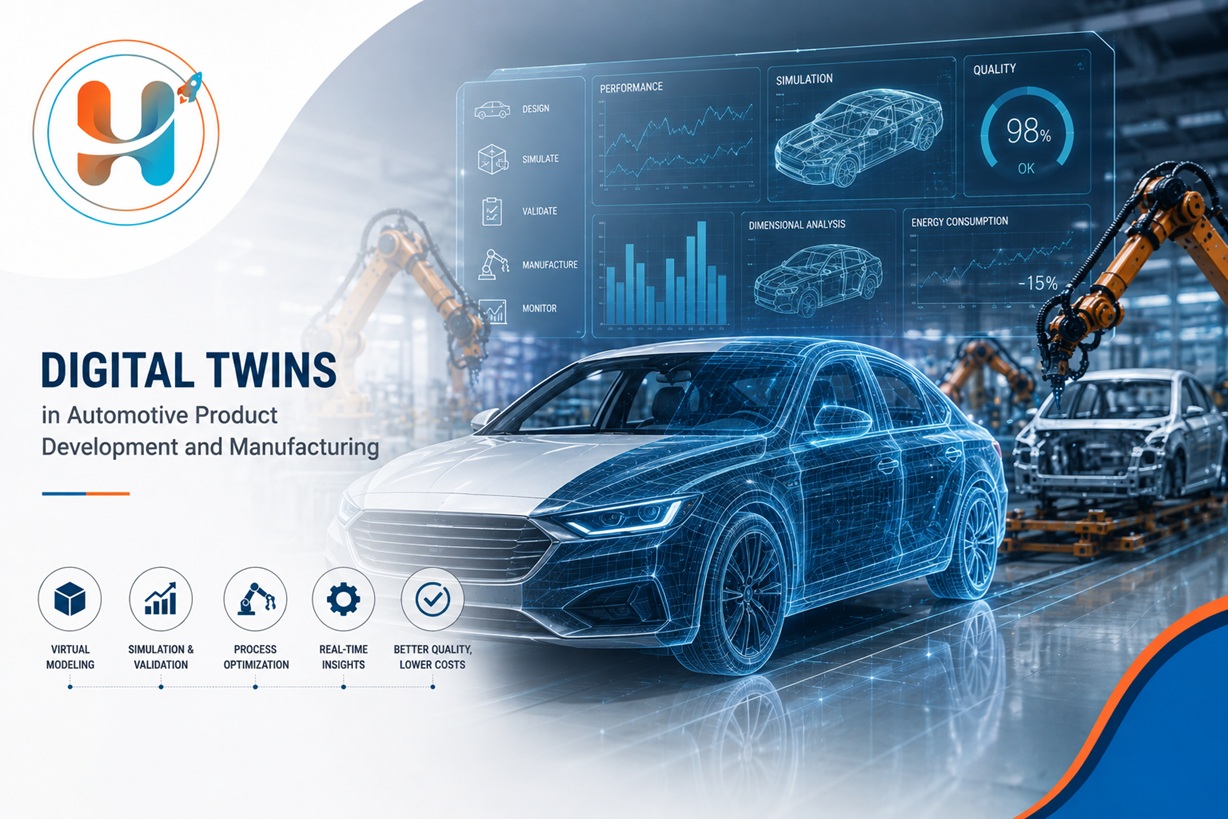
Digital Twins in Automotive Product Development and Manufacturing
The automotive industry is rapidly embracing digital technologies to accelerate innovation, improve manufacturing efficiency, and reduce product development costs. One technology at the heart of this transformation is the Digital Twin. By creating a virtual replica of a physical product, machine, or manufacturing process, digital twins enable automotive companies to simulate, monitor, and optimize operations before making changes in the real world.
From designing electric vehicle (EV) battery systems to optimizing robotic assembly lines, digital twins help manufacturers make data-driven decisions with greater confidence. Combined with Artificial Intelligence (AI), Industrial Internet of Things (IIoT), and cloud computing, digital twins are becoming an essential component of Industry 4.0 strategies.
In this article, we'll explore how digital twins work, their applications in automotive manufacturing, key benefits, implementation challenges, and best practices for adoption.
What Is a Digital Twin?
A digital twin is a virtual representation of a physical object, process, or system that continuously receives data from its real-world counterpart. Unlike traditional simulations, a digital twin is updated in real time using sensor data, enabling engineers to monitor performance, predict outcomes, and optimize operations throughout an asset's lifecycle.
How a Digital Twin Works
A digital twin combines several technologies:
IIoT sensors collect real-time operational data.
Edge and cloud platforms process and store the data.
AI and analytics identify trends and predict outcomes.
Dashboards visualize performance and recommend improvements.
This creates a continuous feedback loop between the physical and digital environments.
Related Reading: The Complete Guide to Digital Transformation in the Automotive Industry (Pillar Blog)
Types of Digital Twins in Automotive Manufacturing
Digital twins can be implemented at different levels depending on business objectives.
Product Digital Twin
A product digital twin models an individual component or vehicle.
Common Applications
Battery pack simulation
Crash testing
Aerodynamic analysis
Thermal management
Structural optimization
By validating designs virtually, manufacturers reduce physical prototyping costs and accelerate product development.
Process Digital Twin
A process digital twin models manufacturing workflows.
Examples
Assembly line simulation
Welding process optimization
Paint shop performance
Material flow analysis
Engineers can test process improvements before applying them to live production.
Factory Digital Twin
A factory digital twin creates a virtual model of an entire manufacturing facility.
Benefits
Production planning
Equipment utilization analysis
Workforce optimization
Energy monitoring
Capacity planning
Factory managers gain complete visibility into plant performance without interrupting operations.
Applications of Digital Twins in Automotive Manufacturing
Digital twins deliver measurable value across engineering and production.
Product Design and Engineering
Digital twins enable engineers to evaluate product performance before manufacturing begins.
Key Benefits
Faster design iterations
Improved product quality
Reduced development costs
Shorter time-to-market
This is especially valuable for EV development, where battery performance and thermal behavior require extensive testing.
Smart Manufacturing
Manufacturers use digital twins to monitor production equipment in real time.
Common Use Cases
Machine performance monitoring
Production optimization
Capacity planning
Workflow simulation
When integrated with AI, digital twins can recommend process improvements that increase productivity and reduce waste.
Related Blog: Industry 4.0 in Automotive Manufacturing: Benefits, Challenges & Future
Predictive Maintenance
Digital twins continuously analyze equipment health using live sensor data.
They help manufacturers:
Predict equipment failures
Optimize maintenance schedules
Extend asset lifespan
Reduce downtime
Instead of reacting to machine failures, maintenance teams can address issues before they disrupt production.
Related Blog: Predictive Maintenance for Automotive Manufacturing Plants
Quality Control
Digital twins support quality assurance by comparing real-time production data with expected performance models.
Manufacturers can identify:
Dimensional deviations
Process variations
Equipment anomalies
Assembly inconsistencies
This improves first-pass yield while reducing scrap and rework.
Benefits of Digital Twins
Digital twins improve decision-making throughout the automotive value chain.
Traditional Manufacturing
Digital Twin-Enabled Manufacturing
Physical testing only
Virtual simulation before implementation
Reactive problem-solving
Predictive optimization
Limited operational visibility
Real-time monitoring
Manual process improvements
AI-driven recommendations
Static production planning
Dynamic optimization
Business Benefits
Accelerated product development
Improved manufacturing efficiency
Reduced prototyping costs
Higher equipment reliability
Better product quality
Increased production flexibility
Lower operational costs
Improved sustainability through optimized resource usage
Challenges of Implementing Digital Twins
Although digital twins provide significant value, organizations should address several implementation challenges.
Integrating Legacy Systems
Many manufacturing facilities operate older equipment with limited connectivity.
Retrofitting machines with IIoT sensors and edge devices enables gradual digital transformation without replacing existing assets.
Data Quality
Digital twins depend on accurate, real-time operational data.
Manufacturers should establish strong data governance to ensure:
Reliable sensor readings
Consistent data formats
Secure data transmission
Centralized data management
Cybersecurity
Because digital twins exchange operational data across connected systems, cybersecurity is essential.
Recommended practices include:
Zero Trust security
Multi-factor authentication
Network segmentation
Continuous monitoring
Secure cloud architecture
Best Practices for Successful Adoption
To maximize return on investment, automotive manufacturers should follow a structured implementation approach.
Start with High-Value Assets
Prioritize equipment or production processes that have the greatest impact on operations, such as robotic welding cells, battery production lines, or paint shops.
Integrate with Existing Platforms
Digital twins deliver greater value when connected to:
Manufacturing Execution Systems (MES)
Enterprise Resource Planning (ERP)
Product Lifecycle Management (PLM)
Industrial IoT platforms
AI analytics solutions
Measure Performance
Track KPIs such as:
Overall Equipment Effectiveness (OEE)
Production throughput
Downtime
First-pass yield
Energy consumption
Asset utilization
Continuous monitoring supports ongoing optimization.
Future of Digital Twins in Automotive
Digital twin technology continues to evolve alongside AI, cloud computing, and connected manufacturing.
Emerging trends include:
AI-powered digital twins with autonomous recommendations
Integration with Generative AI for engineering design
Real-time digital thread connecting design, manufacturing, and service
Digital twins for autonomous and software-defined vehicles
Sustainability optimization through energy and emissions modeling
As these technologies mature, digital twins will become increasingly important in helping manufacturers build resilient, intelligent, and sustainable production systems.
Key Takeaways
Digital twins create real-time virtual models of products, machines, and manufacturing facilities.
Automotive manufacturers use digital twins to improve product design, production planning, quality control, and predictive maintenance.
Combining digital twins with AI and IIoT enables smarter decision-making and continuous optimization.
Successful implementation requires reliable data, secure infrastructure, and integration with enterprise systems.
Digital twins are a foundational technology for Industry 4.0 and the future of smart automotive manufacturing.
Frequently Asked Questions
What is a digital twin in automotive manufacturing?
A digital twin is a real-time virtual representation of a vehicle, manufacturing process, or production asset that uses live operational data to simulate, monitor, and optimize performance.
How do digital twins improve product development?
They allow engineers to test and validate designs virtually, reducing the need for physical prototypes, lowering development costs, and accelerating time-to-market.
What technologies support digital twins?
Digital twins rely on Industrial IoT, AI, machine learning, cloud computing, edge computing, and advanced analytics.
Can digital twins improve manufacturing efficiency?
Yes. Digital twins help optimize production workflows, monitor equipment health, improve quality control, and support predictive maintenance.
Are digital twins only useful for large manufacturers?
No. Small and mid-sized automotive manufacturers can begin with high-value assets or production lines and expand their digital twin strategy as they scale.
Conclusion
Digital twins are transforming automotive product development and manufacturing by bridging the gap between the physical and digital worlds. They enable manufacturers to simulate designs, optimize production processes, predict equipment failures, and improve product quality using real-time operational data.
As the automotive industry moves toward electric mobility, connected vehicles, and intelligent factories, digital twins will play a critical role in helping organizations innovate faster, reduce costs, and build more resilient manufacturing operations. Companies that adopt digital twin technology today will be better positioned to respond to changing market demands and maintain a competitive advantage in the era of Industry 4.0.
How High On Innovation Can Help
High On Innovation helps automotive manufacturers implement digital twin solutions that integrate seamlessly with AI, IIoT, cloud platforms, and smart factory initiatives. Our expertise spans product engineering, manufacturing optimization, predictive maintenance, and digital transformation, enabling organizations to improve operational efficiency while accelerating innovation.
Shailendra Ram leads project execution and technology delivery at High-On Innovation, managing development teams, project workflows, client communications, and solution implementation. With hands-on experience across web, mobile, cloud, and enterprise applications, he ensures projects are delivered efficiently while meeting business objectives and technical standards. His expertise includes software development lifecycle management, project delivery, technology implementation, agile methodologies, and client success.
Comments
Loading comments…
Latest Market Trends

Sep 9, 2026
MVP Development Cost for Australian Businesses in 2026
A simple customer portal, booking application, SaaS dashboard, marketplace, AI-powered platform, fintech product, healthcare application, or enterprise workflow system can all be described as an "MVP", but their development requirements can be dramatically different.

Sep 3, 2026
How to Choose an MVP Development Company for Your Startup
Choosing the right MVP development company can have a major impact on your startup's first product launch. The right development partner does more than write code. They help translate your business idea into a focused product, identify technical risks, prioritize features, and create an MVP that can be tested with real users.

Sep 8, 2026
MVP Development Cost for Canadian Businesses in 2026: Complete Guide to Pricing, Features and Process
Discover MVP development cost Canada in 2026, including startup MVP cost, development factors, timelines, features, technology, compliance, and how to choose the right MVP development company.
Popular Post
MVP Development Cost for Australian Businesses in 2026
A simple customer portal, booking application, SaaS dashboard, marketplace, AI-powered platform, fintech product, healthcare application, or enterprise workflow system can all be described as an "MVP", but their development requirements can be dramatically different.
How to Choose an MVP Development Company for Your Startup
Choosing the right MVP development company can have a major impact on your startup's first product launch. The right development partner does more than write code. They help translate your business idea into a focused product, identify technical risks, prioritize features, and create an MVP that can be tested with real users.
MVP Development Cost for Canadian Businesses in 2026: Complete Guide to Pricing, Features and Process
Discover MVP development cost Canada in 2026, including startup MVP cost, development factors, timelines, features, technology, compliance, and how to choose the right MVP development company.

MVP Development Cost for USA Startups in 2026
An MVP, or Minimum Viable Product, gives founders a way to turn an idea into a usable product, launch it with real users, collect feedback, and understand whether the market actually wants the solution.