Industry 4.0 in Automotive Manufacturing: Benefits, Challenges & Future
Key Takeaways
Industry 4.0 integrates AI, IIoT, robotics, cloud computing, and digital twins to create intelligent manufacturing environments.
Automotive manufacturers use Industry 4.0 to improve efficiency, quality, flexibility, and supply chain resilience.
A phased implementation strategy minimizes risk and accelerates return on investment.
Success depends on data quality, workforce readiness, cybersecurity, and cross-functional collaboration.
As the industry evolves toward electric, connected, and software-defined vehicles, Industry 4.0 will remain the foundation of future automotive manufacturing.
The automotive industry has always been at the forefront of manufacturing innovation. From Henry Ford's moving assembly line to industrial robotics and lean manufacturing, each technological breakthrough has redefined how vehicles are designed and produced. Today, the industry is undergoing another major transformation driven by Industry 4.0—a new era of intelligent, connected, and data-driven manufacturing.
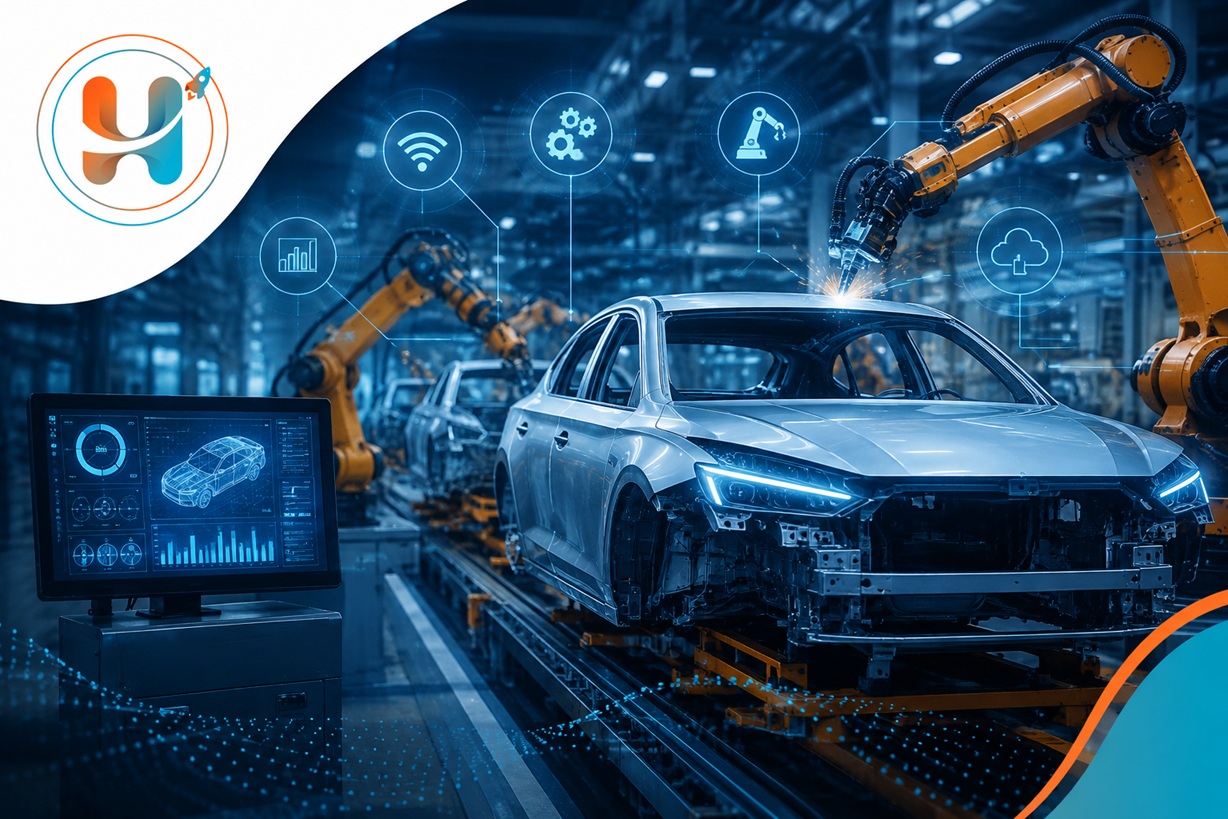
Industry 4.0 combines technologies such as Artificial Intelligence (AI), the Industrial Internet of Things (IIoT), robotics, cloud computing, digital twins, edge computing, and advanced analytics to create smart factories capable of monitoring, optimizing, and adapting production processes in real time.
For automotive manufacturers, Industry 4.0 is more than a technology upgrade. It is a strategic approach to improving operational efficiency, product quality, supply chain resilience, and production flexibility while preparing for the growing demands of electric vehicles (EVs), connected vehicles, and software-defined vehicles.
In this article, we'll explore how Industry 4.0 is transforming automotive manufacturing, its core technologies, business benefits, implementation challenges, and what the future holds for smart automotive factories.
What Is Industry 4.0?
Industry 4.0, often referred to as the Fourth Industrial Revolution, represents the convergence of physical manufacturing systems with digital technologies. Unlike previous industrial revolutions that focused on mechanization, mass production, or automation, Industry 4.0 creates interconnected manufacturing ecosystems where machines, software, sensors, and people collaborate using real-time data.
At the heart of Industry 4.0 is the concept of cyber-physical systems—production environments where physical equipment continuously communicates with digital platforms to support intelligent decision-making.
In automotive manufacturing, this means that machines can monitor their own performance, production lines can automatically adjust to changing demand, and engineers can access real-time operational insights from anywhere.
Related Reading: The Complete Guide to Digital Transformation in the Automotive Industry (Pillar Blog)
The Evolution of Automotive Manufacturing
Understanding Industry 4.0 is easier when viewed through the evolution of manufacturing.
Industry 1.0 – Mechanization
The first industrial revolution introduced steam-powered machines, replacing manual labor with mechanized production.
Industry 2.0 – Mass Production
Electricity enabled assembly line manufacturing, allowing automotive companies to produce vehicles at unprecedented scale.
Industry 3.0 – Automation
Computers, programmable logic controllers (PLCs), and industrial robots automated repetitive manufacturing tasks, improving speed and consistency.
Industry 4.0 – Intelligent Manufacturing
Today's manufacturing facilities integrate AI, IIoT, robotics, analytics, and cloud computing into connected production systems capable of learning, adapting, and optimizing continuously.
Unlike earlier manufacturing models, Industry 4.0 is driven by data rather than isolated automation.
Why the Automotive Industry Needs Industry 4.0
The automotive industry is facing unprecedented transformation driven by evolving consumer expectations, increasing product complexity, and global competition.
Several factors make Industry 4.0 essential for modern manufacturers.
Rising Vehicle Complexity
Modern vehicles contain thousands of mechanical, electrical, and software components.
Electric vehicles introduce additional complexity through:
Battery management systems
Advanced electronics
Embedded software
Autonomous driving technologies
Connected vehicle platforms
Managing this complexity requires intelligent manufacturing systems capable of processing large volumes of production data in real time.
Demand for Production Flexibility
Customers increasingly expect personalized vehicle configurations, while manufacturers must produce multiple vehicle models on shared production lines.
Traditional manufacturing systems struggle with this level of flexibility.
Industry 4.0 enables adaptive production lines that can adjust automatically to changing production schedules and customer requirements.
Supply Chain Volatility
Global supply chains have become increasingly vulnerable to disruptions caused by geopolitical events, material shortages, and transportation delays.
Connected manufacturing systems provide real-time visibility into inventory, supplier performance, and logistics operations, helping manufacturers respond proactively to potential disruptions.
Sustainability Goals
Governments and consumers continue to demand more sustainable manufacturing practices.
Industry 4.0 helps manufacturers reduce:
Energy consumption
Material waste
Carbon emissions
Water usage
Through intelligent monitoring and analytics, manufacturers can identify inefficiencies and optimize resource utilization.
Core Technologies Driving Industry 4.0
Industry 4.0 is built on several interconnected technologies that work together to create intelligent manufacturing environments.
Artificial Intelligence (AI)
AI enables manufacturers to analyze production data, predict equipment failures, automate quality inspection, and optimize production planning.
Typical applications include:
Predictive maintenance
Defect detection
Demand forecasting
Intelligent scheduling
Process optimization
Rather than relying solely on historical reports, AI provides real-time recommendations that improve operational decision-making.
Related Blog: How AI Is Transforming the Automotive Industry
Industrial Internet of Things (IIoT)
IIoT connects production equipment, sensors, robotics, and enterprise systems into a unified network.
Smart sensors continuously monitor variables such as:
Temperature
Pressure
Vibration
Energy consumption
Machine utilization
Production throughput
This real-time operational visibility forms the foundation for predictive analytics and intelligent manufacturing.
Related Blog: Industrial IoT Applications in Automotive Manufacturing
Robotics and Intelligent Automation
Automotive manufacturing has long relied on industrial robots for welding, painting, and assembly.
Industry 4.0 introduces more intelligent robotics capable of adapting to changing production conditions.
Collaborative robots (cobots) can safely work alongside human operators while AI-powered robots continuously optimize their performance using operational data.
Applications include:
Assembly operations
Material handling
Packaging
Inspection
Machine tending
Digital Twins
A digital twin is a real-time virtual representation of a physical product, machine, or manufacturing facility.
Digital twins enable manufacturers to:
Simulate production changes
Optimize factory layouts
Monitor equipment health
Predict operational outcomes
Reduce engineering risks
Instead of experimenting on physical production lines, manufacturers can evaluate changes virtually before implementation.
Related Blog: Digital Twins in Automotive Product Development and Manufacturing
Cloud Computing
Cloud platforms provide centralized access to manufacturing data collected from multiple facilities.
Benefits include:
Enterprise-wide visibility
Remote monitoring
Data sharing
Scalable analytics
Faster software deployment
Cloud infrastructure also supports AI model training and advanced business intelligence applications.
Edge Computing
Certain manufacturing processes require near-instant responses.
For example:
Robot control
Automated inspection
Machine safety
Collision avoidance
Edge computing processes operational data close to production equipment, reducing latency while enabling real-time decision-making.
Benefits of Industry 4.0 in Automotive Manufacturing
Industry 4.0 creates measurable improvements across manufacturing operations.
Improved Production Efficiency
Connected production systems optimize workflows by automatically identifying bottlenecks, balancing workloads, and improving machine utilization.
Manufacturers benefit from:
Shorter production cycles
Higher throughput
Reduced idle time
Better Overall Equipment Effectiveness (OEE)
Enhanced Product Quality
AI-powered quality inspection and computer vision systems detect manufacturing defects more consistently than manual inspections.
Benefits include:
Lower defect rates
Reduced rework
Improved first-pass yield
Better customer satisfaction
Reduced Downtime
Predictive maintenance uses AI and IIoT data to identify equipment issues before failures occur.
This allows maintenance teams to perform repairs during planned shutdowns rather than responding to unexpected breakdowns.
Greater Manufacturing Flexibility
Industry 4.0 enables manufacturers to quickly adapt production lines for:
New vehicle models
EV production
Customized configurations
Changing customer demand
This flexibility is increasingly important as vehicle platforms become more diverse.
Better Decision-Making
Real-time dashboards provide plant managers with immediate visibility into production performance, enabling faster and more informed operational decisions.
Instead of relying on historical reports, leaders can respond to issues as they occur.
Business Impact Comparison
Traditional Manufacturing
Industry 4.0 Manufacturing
Manual monitoring
Real-time monitoring
Reactive maintenance
Predictive maintenance
Limited production visibility
Connected operations
Static production planning
AI-driven optimization
Manual quality inspection
AI-powered inspection
Siloed data
Integrated manufacturing intelligence
Challenges of Implementing Industry 4.0
Although Industry 4.0 offers significant advantages, achieving a successful transformation requires careful planning, organizational alignment, and continuous investment. Automotive manufacturers often encounter several challenges during implementation.
1. Legacy Manufacturing Infrastructure
Many automotive production facilities still operate legacy machines that were designed before the advent of connected manufacturing. These systems often lack built-in communication capabilities, making integration with modern digital platforms difficult.
Instead of replacing existing equipment, many manufacturers adopt a phased modernization strategy by:
Installing IIoT sensors on legacy machines
Using edge gateways to collect production data
Integrating Manufacturing Execution Systems (MES) with ERP platforms
Connecting operational technology (OT) with enterprise IT systems
This approach extends the life of existing assets while enabling gradual digital transformation.
2. High Initial Investment
Implementing Industry 4.0 technologies involves investments in:
Smart sensors
Network infrastructure
Robotics
AI platforms
Cloud services
Cybersecurity
Employee training
While the upfront costs may appear significant, organizations often realize long-term value through increased productivity, reduced downtime, improved product quality, and lower operating costs.
A phased implementation strategy helps spread investment over time while delivering measurable business outcomes at each stage.
3. Data Management Complexity
Industry 4.0 environments generate massive amounts of production data every second.
Without effective governance, organizations may struggle with:
Duplicate data
Inconsistent formats
Poor data quality
Limited visibility
Difficulty integrating multiple systems
Establishing standardized data governance practices ensures AI models and analytics platforms receive reliable information for accurate decision-making.
4. Cybersecurity Risks
Connected factories significantly increase the digital attack surface.
Industrial control systems, connected machinery, cloud platforms, and supplier networks all require robust cybersecurity protections.
Manufacturers should implement:
Zero Trust Architecture
Network segmentation
Multi-factor authentication
Continuous threat monitoring
Secure API management
Endpoint detection and response (EDR)
Regular penetration testing
Cybersecurity should be integrated into every stage of Industry 4.0 implementation rather than treated as an afterthought.
5. Workforce Transformation
Industry 4.0 changes how people work.
Rather than replacing employees, digital technologies augment human capabilities by automating repetitive tasks and providing data-driven insights.
Manufacturers should prioritize workforce development through:
Digital skills training
Robotics education
Data literacy programs
AI awareness workshops
Cross-functional collaboration between engineering, operations, and IT
A digitally skilled workforce is essential for maximizing the value of Industry 4.0 investments.
A Practical Industry 4.0 Implementation Roadmap
Successful automotive manufacturers rarely attempt to transform every production line simultaneously. Instead, they follow a structured roadmap that reduces risk and demonstrates measurable value before scaling.
Phase
Objective
Typical Activities
Assess
Identify business priorities
Evaluate production bottlenecks, equipment performance, and digital maturity
Connect
Build data visibility
Deploy IIoT sensors, integrate MES, ERP, and production systems
Pilot
Validate high-impact use cases
Test predictive maintenance, AI inspection, or smart scheduling on a single production line
Scale
Expand across operations
Extend successful solutions to additional plants and business units
Optimize
Drive continuous improvement
Monitor KPIs, retrain AI models, refine workflows, and enhance automation
This phased strategy allows manufacturers to realize early wins while minimizing operational disruption.
Real-World Industry 4.0 Use Cases
Industry 4.0 technologies are delivering measurable improvements across automotive manufacturing operations.
Smart Assembly Lines
Connected production equipment continuously monitors production speed, equipment utilization, and cycle times.
When bottlenecks occur, AI-powered systems recommend adjustments to improve throughput without compromising quality.
Benefits include:
Reduced idle time
Improved productivity
Better resource allocation
Higher Overall Equipment Effectiveness (OEE)
Predictive Maintenance
Traditional maintenance schedules are based on predefined intervals rather than actual equipment condition.
Industry 4.0 combines IIoT sensors with AI to continuously monitor machine health and predict failures before they occur.
Business outcomes include:
Lower maintenance costs
Fewer production interruptions
Longer equipment lifespan
Improved maintenance planning
Related Blog: Predictive Maintenance for Automotive Manufacturing Plants
Digital Quality Inspection
Computer vision systems inspect vehicle components, welds, paint finishes, and assemblies with greater consistency than manual inspections.
AI identifies defects in real time, allowing manufacturers to correct issues before defective products progress through the production line.
Benefits include:
Higher first-pass yield
Reduced rework
Lower warranty claims
Improved customer satisfaction
Related Blog: Computer Vision Applications in Automotive Manufacturing
Intelligent Inventory Management
Industry 4.0 enables real-time inventory visibility across warehouses and production facilities.
AI analyzes historical demand, supplier performance, and production schedules to optimize inventory levels while reducing excess stock.
This improves:
Material availability
Warehouse efficiency
Working capital utilization
Supply chain resilience
Energy Optimization
Manufacturing plants consume significant amounts of electricity, compressed air, and water.
Connected sensors continuously monitor energy consumption and identify opportunities to improve efficiency.
Manufacturers can:
Detect energy-intensive equipment
Reduce peak demand
Optimize production schedules
Support sustainability initiatives
Best Practices for Successful Industry 4.0 Adoption
Organizations that achieve the highest returns from Industry 4.0 typically follow several best practices.
Align Technology with Business Objectives
Digital transformation initiatives should support measurable business goals such as reducing downtime, improving quality, increasing production throughput, or lowering operating costs.
Technology investments should always align with broader organizational priorities.
Prioritize High-Impact Use Cases
Rather than digitizing every process simultaneously, manufacturers should begin with projects that deliver clear business value.
Common starting points include:
Predictive maintenance
AI-powered quality inspection
Production monitoring
Energy management
Asset tracking
Successful pilot projects create momentum for larger transformation initiatives.
Build an Integrated Data Ecosystem
Industry 4.0 depends on seamless data flow across manufacturing systems.
Organizations should integrate:
Manufacturing Execution Systems (MES)
Enterprise Resource Planning (ERP)
Product Lifecycle Management (PLM)
Quality Management Systems (QMS)
Industrial IoT platforms
Cloud analytics solutions
This creates a unified view of operations and supports more effective decision-making.
Measure Success with KPIs
Establish clear performance metrics before implementation.
Common KPIs include:
Overall Equipment Effectiveness (OEE)
First-pass yield
Production cycle time
Equipment availability
Scrap rate
Energy consumption
Mean Time Between Failures (MTBF)
Tracking these metrics demonstrates the business value of Industry 4.0 investments and identifies opportunities for continuous improvement.
The Future of Industry 4.0 in Automotive Manufacturing
The next phase of automotive manufacturing will be increasingly autonomous, intelligent, and sustainable.
Several emerging trends are expected to shape the future.
AI-Driven Autonomous Factories
Future factories will use AI to optimize production schedules, coordinate robotics, manage inventory, and automatically adapt to changing production conditions with minimal human intervention.
Digital Thread Integration
Manufacturers are moving toward a connected digital thread that links product design, engineering, manufacturing, quality, and after-sales service.
This improves traceability while accelerating product development and innovation.
Generative AI in Manufacturing
Generative AI will support engineers by:
Accelerating product design
Generating technical documentation
Optimizing manufacturing workflows
Improving engineering collaboration
Sustainable Smart Manufacturing
Industry 4.0 technologies will continue helping manufacturers achieve environmental objectives by reducing waste, optimizing energy consumption, and improving resource efficiency.
Sustainability will increasingly become a competitive advantage alongside operational excellence.
Frequently Asked Questions
What is Industry 4.0 in automotive manufacturing?
Industry 4.0 refers to the integration of connected technologies such as AI, Industrial IoT, robotics, cloud computing, and digital twins into automotive manufacturing to create intelligent, data-driven production environments.
How does Industry 4.0 improve automotive manufacturing?
Industry 4.0 improves production efficiency, reduces downtime, enhances quality control, optimizes supply chains, enables predictive maintenance, and supports real-time operational decision-making.
What technologies are part of Industry 4.0?
Core Industry 4.0 technologies include:
Artificial Intelligence
Industrial Internet of Things (IIoT)
Robotics
Cloud Computing
Edge Computing
Digital Twins
Big Data Analytics
Computer Vision
What are the biggest challenges of Industry 4.0 adoption?
Common challenges include integrating legacy equipment, managing large volumes of data, addressing cybersecurity risks, investing in workforce development, and ensuring measurable return on investment.
Why is Industry 4.0 important for EV manufacturing?
Electric vehicle production requires greater precision, software integration, battery quality management, and production flexibility. Industry 4.0 technologies help manufacturers address these complexities through intelligent automation and real-time monitoring.
Conclusion
Industry 4.0 is fundamentally transforming automotive manufacturing by connecting machines, systems, and people into intelligent production ecosystems. By leveraging AI, IIoT, robotics, cloud computing, and digital twins, manufacturers can optimize operations, improve quality, increase flexibility, and respond more effectively to evolving market demands.
However, technology alone is not enough. Long-term success depends on a clear digital transformation strategy, a robust data foundation, strong cybersecurity practices, and a workforce equipped with the skills to thrive in an increasingly connected environment.
As automotive organizations navigate the shift toward electric vehicles, software-defined architectures, and sustainable manufacturing, Industry 4.0 will continue to serve as the foundation for innovation, resilience, and competitive advantage.
How High On Innovation Can Help
High On Innovation partners with automotive manufacturers to accelerate Industry 4.0 adoption through tailored digital engineering and smart manufacturing solutions.
Our capabilities include:
Industry 4.0 Strategy and Consulting
Industrial IoT Solutions
Artificial Intelligence and Machine Learning
Smart Factory Development
Digital Twin Implementation
Predictive Maintenance Platforms
Computer Vision for Automated Inspection
Cloud and Edge Computing
Robotics and Industrial Automation
Manufacturing Data Analytics
Whether you're modernizing a legacy production facility or building a next-generation smart factory, our team can help you implement scalable, future-ready solutions aligned with your operational goals.
Sachikanta Mohanty is the Digital Marketing Manager and Lead Strategist at High-On Innovation, responsible for driving digital growth initiatives for both internal and client projects. He specializes in SEO, content strategy, digital transformation marketing, lead generation, performance marketing, and online brand growth. With extensive experience in developing data-driven marketing strategies, he helps businesses improve visibility, customer acquisition, and long-term digital success.
Comments
Loading comments…
Latest Market Trends

Sep 9, 2026
MVP Development Cost for Australian Businesses in 2026
A simple customer portal, booking application, SaaS dashboard, marketplace, AI-powered platform, fintech product, healthcare application, or enterprise workflow system can all be described as an "MVP", but their development requirements can be dramatically different.

Sep 3, 2026
How to Choose an MVP Development Company for Your Startup
Choosing the right MVP development company can have a major impact on your startup's first product launch. The right development partner does more than write code. They help translate your business idea into a focused product, identify technical risks, prioritize features, and create an MVP that can be tested with real users.

Sep 8, 2026
MVP Development Cost for Canadian Businesses in 2026: Complete Guide to Pricing, Features and Process
Discover MVP development cost Canada in 2026, including startup MVP cost, development factors, timelines, features, technology, compliance, and how to choose the right MVP development company.
Popular Post
MVP Development Cost for Australian Businesses in 2026
A simple customer portal, booking application, SaaS dashboard, marketplace, AI-powered platform, fintech product, healthcare application, or enterprise workflow system can all be described as an "MVP", but their development requirements can be dramatically different.
How to Choose an MVP Development Company for Your Startup
Choosing the right MVP development company can have a major impact on your startup's first product launch. The right development partner does more than write code. They help translate your business idea into a focused product, identify technical risks, prioritize features, and create an MVP that can be tested with real users.
MVP Development Cost for Canadian Businesses in 2026: Complete Guide to Pricing, Features and Process
Discover MVP development cost Canada in 2026, including startup MVP cost, development factors, timelines, features, technology, compliance, and how to choose the right MVP development company.
MVP Development Cost for USA Startups in 2026
An MVP, or Minimum Viable Product, gives founders a way to turn an idea into a usable product, launch it with real users, collect feedback, and understand whether the market actually wants the solution.