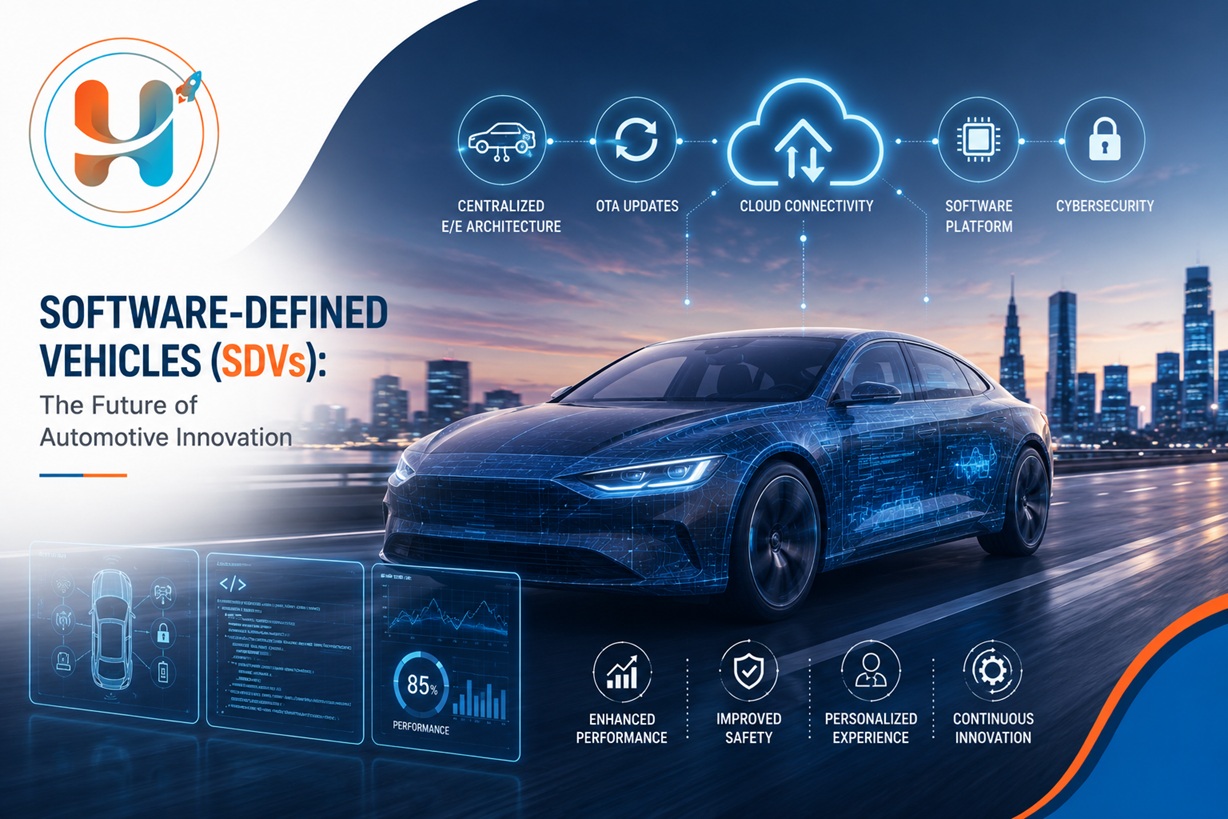
Software-Defined Vehicles (SDVs): The Future of Automotive Innovation
Key Takeaways
Software-Defined Vehicles shift automotive innovation from hardware-centric design to software-driven functionality.
OTA updates, AI, cloud connectivity, and centralized computing enable continuous vehicle improvement.
SDVs support faster innovation, improved customer experiences, and new digital business models.
Cybersecurity and modern software architectures are essential for successful SDV implementation.
SDVs will become the foundation for connected, electric, and autonomous vehicles.
The automotive industry is shifting from hardware-centric engineering to software-driven innovation. Vehicles are no longer defined solely by their engines, mechanical systems, or physical features—they are increasingly differentiated by software capabilities that enhance performance, safety, connectivity, and user experience. This evolution has given rise to the Software-Defined Vehicle (SDV).
A Software-Defined Vehicle is designed with software at its core, allowing manufacturers to continuously improve vehicle functionality through updates, new digital services, and intelligent automation throughout the vehicle's lifecycle. From over-the-air (OTA) updates and advanced driver assistance systems (ADAS) to AI-powered personalization and connected mobility services, SDVs are redefining what customers expect from modern vehicles.
For automotive OEMs and EV manufacturers, SDVs represent more than a technological trend. They enable faster innovation, new revenue models, reduced development complexity, and stronger customer engagement. In this article, we'll explore how software-defined vehicles work, their architecture, key technologies, business benefits, implementation challenges, and future opportunities.
What Is a Software-Defined Vehicle?
A Software-Defined Vehicle (SDV) is a vehicle where software controls and enhances most core functions, while hardware serves as a flexible platform for delivering those capabilities.
Unlike traditional vehicles that rely on numerous independent Electronic Control Units (ECUs), SDVs use centralized computing architectures capable of managing multiple vehicle functions through integrated software platforms.
Key Characteristics of SDVs
Centralized computing architecture
Over-the-air (OTA) software updates
Cloud-native connectivity
AI-powered vehicle intelligence
Continuous feature enhancement
Real-time diagnostics
Cybersecurity by design
This architecture allows manufacturers to improve vehicle performance and introduce new features long after the vehicle has left the production line.
Related Reading: The Complete Guide to Digital Transformation in the Automotive Industry (Pillar Blog)
Why the Automotive Industry Is Moving Toward SDVs
Consumer expectations and technological advancements are driving the transition toward software-defined vehicles.
Growing Demand for Connected Experiences
Today's drivers expect their vehicles to deliver experiences similar to smartphones, including:
Automatic software updates
Personalized settings
Voice assistants
Connected navigation
Remote diagnostics
Smartphone integration
Software enables manufacturers to continuously enhance these experiences without requiring physical modifications.
Accelerating Electric Vehicle Adoption
Electric vehicles rely heavily on software to manage:
Battery performance
Charging optimization
Energy efficiency
Thermal management
Regenerative braking
As EV adoption grows, software becomes increasingly important for maximizing vehicle performance and driving range.
Faster Innovation Cycles
Traditional vehicle development required new hardware to introduce additional functionality.
With SDVs, manufacturers can:
Deploy new features remotely
Improve existing capabilities
Fix software issues quickly
Reduce recall costs
Accelerate product innovation
This significantly shortens development and release cycles.
Core Technologies Behind Software-Defined Vehicles
Several advanced technologies work together to enable SDVs.
Centralized Vehicle Computing
Instead of relying on dozens of isolated ECUs, SDVs consolidate vehicle functions into high-performance computing platforms.
Benefits
Simplified vehicle architecture
Reduced hardware complexity
Faster software deployment
Easier maintenance
Improved system integration
Over-the-Air (OTA) Updates
OTA technology allows manufacturers to update vehicle software remotely.
Common OTA Applications
Security patches
Infotainment updates
Battery optimization
Navigation improvements
Performance enhancements
Feature activation
OTA updates reduce dealership visits while ensuring vehicles remain current throughout their lifecycle.
Artificial Intelligence
AI enhances SDVs by enabling intelligent decision-making.
AI Applications
Driver behavior analysis
Predictive diagnostics
Personalized infotainment
Energy optimization
Voice recognition
Autonomous driving support
Related Blog: How AI Is Transforming the Automotive Industry
Cloud Connectivity
Cloud platforms connect vehicles with manufacturers, service providers, and mobility ecosystems.
Cloud connectivity supports:
Fleet management
Vehicle diagnostics
Software deployment
Usage analytics
Connected services
Manufacturers can continuously monitor vehicle performance and improve products using real-world operational data.
Applications of Software-Defined Vehicles
SDVs create opportunities across multiple automotive domains.
Advanced Driver Assistance Systems (ADAS)
Software enables intelligent safety features such as:
Adaptive cruise control
Lane-keeping assistance
Automatic emergency braking
Traffic sign recognition
Driver monitoring systems
Continuous software improvements enhance ADAS performance over time.
Predictive Vehicle Diagnostics
Connected vehicles continuously monitor system health.
Manufacturers can identify potential issues before failures occur, improving:
Vehicle reliability
Maintenance planning
Customer satisfaction
Warranty management
Personalized User Experiences
Software allows vehicles to remember individual driver preferences.
Examples include:
Seat position
Climate control
Infotainment settings
Driving modes
Navigation history
These personalized experiences strengthen customer loyalty and brand differentiation.
Connected Mobility Services
SDVs enable new mobility solutions such as:
Vehicle sharing
Subscription-based features
Fleet optimization
Remote vehicle management
Usage-based insurance
Software becomes the foundation for recurring digital revenue streams.
Benefits of Software-Defined Vehicles
Software-defined architectures create value for both manufacturers and vehicle owners.
Traditional Vehicles
Software-Defined Vehicles
Hardware-dependent upgrades
Remote software updates
Limited post-sale improvements
Continuous feature enhancements
Multiple isolated ECUs
Centralized computing platforms
Reactive maintenance
Predictive diagnostics
Fixed functionality
Flexible software-driven capabilities
Business Benefits
Faster product innovation
Reduced development costs
Improved customer experience
Lower recall expenses
Enhanced cybersecurity updates
New digital revenue opportunities
Better vehicle performance
Longer product lifecycle
Challenges of SDV Implementation
While SDVs offer significant advantages, manufacturers must overcome several challenges.
Managing Software Complexity
Modern vehicles contain millions of lines of code across numerous systems.
Manufacturers need robust software development, testing, and lifecycle management processes to ensure reliability and performance.
Cybersecurity
Connected vehicles require strong protection against cyber threats.
Best practices include:
Secure boot processes
End-to-end encryption
Zero Trust Architecture
Continuous vulnerability monitoring
Compliance with ISO/SAE 21434 and UNECE WP.29
Cybersecurity must be integrated throughout the software development lifecycle.
Legacy Vehicle Architectures
Many existing vehicle platforms were not designed for centralized software management.
Transitioning to SDVs often requires significant changes to electrical and electronic (E/E) architectures, as well as close collaboration between hardware and software teams.
Best Practices for SDV Development
Manufacturers can accelerate successful SDV adoption by following these best practices.
Adopt a Modular Software Architecture
Modular software enables independent updates and easier integration of new features, reducing development complexity.
Invest in Cloud-Native Development
Cloud-native tools support continuous integration, continuous deployment (CI/CD), and faster software delivery.
Prioritize Cybersecurity
Implement secure development practices, regular security testing, and compliance with automotive cybersecurity standards from the outset.
Use Data to Drive Continuous Improvement
Analyze real-world vehicle data to enhance performance, improve reliability, and deliver new customer features through OTA updates.
Future Trends in Software-Defined Vehicles
The SDV ecosystem continues to evolve rapidly.
Emerging trends include:
AI-powered autonomous driving
Generative AI for software development
Vehicle-to-Everything (V2X) communication
Digital twins for software validation
Edge AI for real-time decision-making
Service-oriented vehicle architectures
Subscription-based software features
As software becomes the primary driver of innovation, SDVs will play a central role in the future of connected and autonomous mobility.
Frequently Asked Questions
What is a Software-Defined Vehicle?
A Software-Defined Vehicle is a vehicle where software controls and continuously enhances core vehicle functions through centralized computing and over-the-air updates.
How are SDVs different from traditional vehicles?
Traditional vehicles depend primarily on hardware upgrades, while SDVs deliver new features, performance improvements, and security updates through software.
Why are SDVs important for electric vehicles?
Electric vehicles rely on software for battery management, charging optimization, thermal control, and energy efficiency, making SDV architecture essential for maximizing performance.
What technologies enable Software-Defined Vehicles?
Core technologies include centralized computing, AI, cloud computing, OTA updates, edge computing, cybersecurity, and connected vehicle platforms.
What are the biggest challenges of SDV adoption?
Manufacturers must address software complexity, cybersecurity risks, legacy architectures, and the need for continuous software lifecycle management.
Conclusion
Software-Defined Vehicles are fundamentally changing how vehicles are designed, developed, and experienced. By placing software at the center of vehicle architecture, manufacturers can continuously improve performance, deliver new digital services, and respond more quickly to changing customer expectations.
As the automotive industry transitions toward electric, connected, and autonomous mobility, SDVs will become the foundation for innovation. Organizations that invest in scalable software platforms, secure architectures, and cloud-native development practices today will be better equipped to compete in the next generation of automotive engineering.
How High On Innovation Can Help
High On Innovation helps automotive companies accelerate Software-Defined Vehicle development through expertise in embedded engineering, automotive software development, cloud integration, AI, cybersecurity, and digital engineering. We work with OEMs and mobility innovators to build scalable software platforms that enable connected, intelligent, and future-ready vehicles.
Shailendra Ram leads project execution and technology delivery at High-On Innovation, managing development teams, project workflows, client communications, and solution implementation. With hands-on experience across web, mobile, cloud, and enterprise applications, he ensures projects are delivered efficiently while meeting business objectives and technical standards. His expertise includes software development lifecycle management, project delivery, technology implementation, agile methodologies, and client success.
Comments
Loading comments…
Latest Market Trends

Sep 9, 2026
MVP Development Cost for Australian Businesses in 2026
A simple customer portal, booking application, SaaS dashboard, marketplace, AI-powered platform, fintech product, healthcare application, or enterprise workflow system can all be described as an "MVP", but their development requirements can be dramatically different.

Sep 3, 2026
How to Choose an MVP Development Company for Your Startup
Choosing the right MVP development company can have a major impact on your startup's first product launch. The right development partner does more than write code. They help translate your business idea into a focused product, identify technical risks, prioritize features, and create an MVP that can be tested with real users.

Sep 8, 2026
MVP Development Cost for Canadian Businesses in 2026: Complete Guide to Pricing, Features and Process
Discover MVP development cost Canada in 2026, including startup MVP cost, development factors, timelines, features, technology, compliance, and how to choose the right MVP development company.
Popular Post
MVP Development Cost for Australian Businesses in 2026
A simple customer portal, booking application, SaaS dashboard, marketplace, AI-powered platform, fintech product, healthcare application, or enterprise workflow system can all be described as an "MVP", but their development requirements can be dramatically different.
How to Choose an MVP Development Company for Your Startup
Choosing the right MVP development company can have a major impact on your startup's first product launch. The right development partner does more than write code. They help translate your business idea into a focused product, identify technical risks, prioritize features, and create an MVP that can be tested with real users.
MVP Development Cost for Canadian Businesses in 2026: Complete Guide to Pricing, Features and Process
Discover MVP development cost Canada in 2026, including startup MVP cost, development factors, timelines, features, technology, compliance, and how to choose the right MVP development company.

MVP Development Cost for USA Startups in 2026
An MVP, or Minimum Viable Product, gives founders a way to turn an idea into a usable product, launch it with real users, collect feedback, and understand whether the market actually wants the solution.