Predictive Maintenance for Automotive Manufacturing Plants: Benefits, Use Cases & Best Practices
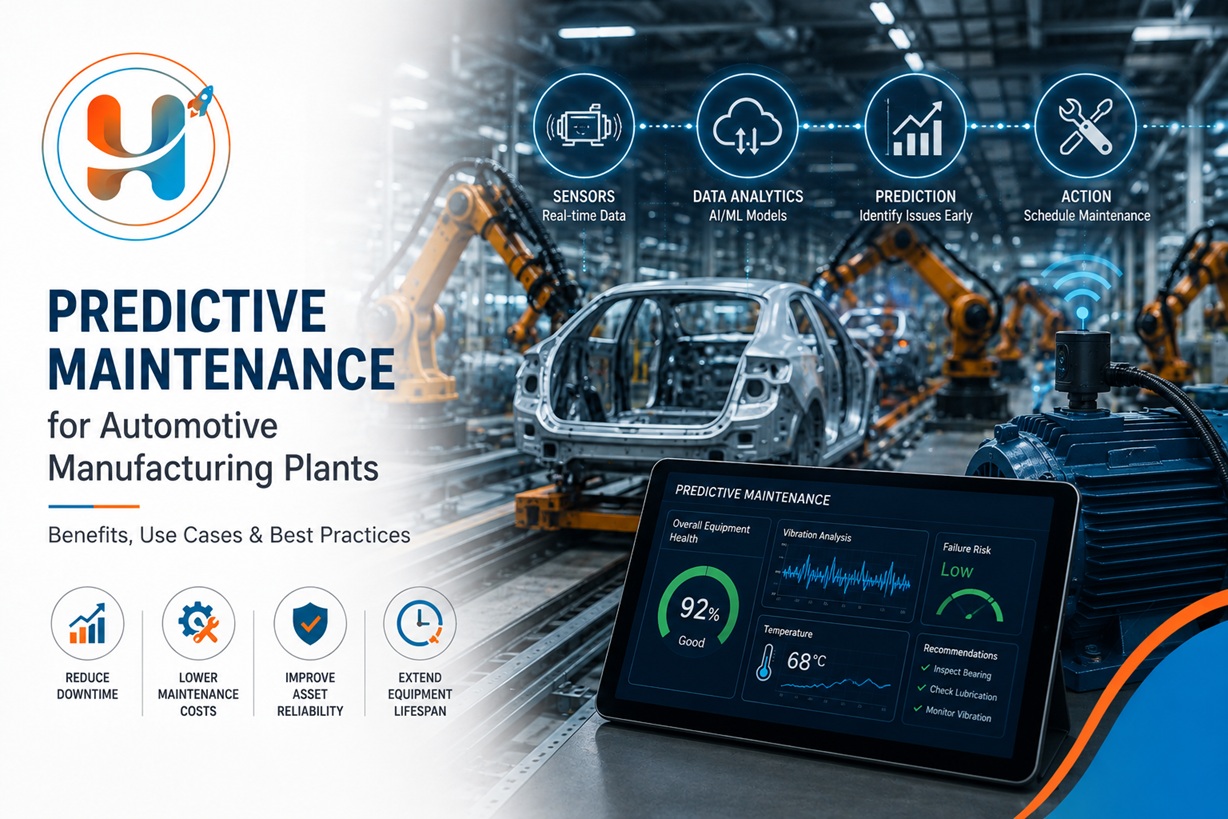
Equipment reliability is the backbone of automotive manufacturing. A single unplanned machine failure can stop an entire production line, delay vehicle deliveries, increase maintenance costs, and impact customer commitments. As manufacturers strive to improve productivity while reducing operational risks, traditional maintenance strategies are proving insufficient.
This is where predictive maintenance is transforming automotive manufacturing.
Unlike reactive maintenance, which addresses failures after they occur, or preventive maintenance, which follows fixed service schedules, predictive maintenance uses Artificial Intelligence (AI), Industrial Internet of Things (IIoT) sensors, machine learning, and advanced analytics to monitor equipment health continuously and predict failures before they happen.
By identifying early signs of wear, abnormal operating conditions, or declining performance, predictive maintenance enables maintenance teams to schedule repairs at the optimal time—minimizing downtime, extending equipment life, and improving overall operational efficiency.
As automotive manufacturing becomes increasingly automated and connected, predictive maintenance has become a cornerstone of Industry 4.0 and smart factory initiatives.
In this guide, we'll explore how predictive maintenance works, why it matters, its major applications, and how automotive manufacturers can successfully implement it.
What Is Predictive Maintenance?
Predictive maintenance (PdM) is a proactive maintenance strategy that uses real-time equipment data, historical performance records, and AI-powered analytics to determine when machinery is likely to fail.
Instead of replacing components based on fixed maintenance intervals, predictive maintenance evaluates the actual condition of equipment.
This allows manufacturers to perform maintenance:
Before failures occur
Only when necessary
Based on actual equipment health
The result is improved reliability without unnecessary maintenance activities.
Related Reading: The Complete Guide to Digital Transformation in the Automotive Industry (Pillar Blog)
Why Predictive Maintenance Matters in Automotive Manufacturing
Modern automotive plants rely on hundreds of interconnected machines operating around the clock.
Critical assets include:
Robotic welding systems
CNC machining centers
Press machines
Paint shop equipment
Conveyors
Automated Guided Vehicles (AGVs)
Injection molding machines
Battery production equipment
Industrial compressors
Failure of even one critical machine can create a ripple effect across the production process.
Predictive maintenance helps manufacturers detect problems early, reducing the likelihood of unexpected production interruptions.
The Limitations of Traditional Maintenance
Reactive Maintenance
Reactive maintenance follows a "run-to-failure" approach.
Repairs begin only after equipment has already failed.
While suitable for non-critical assets, this strategy often results in:
Unexpected downtime
Emergency repair costs
Production losses
Increased safety risks
Higher spare parts expenses
Preventive Maintenance
Preventive maintenance schedules service activities based on time or operating hours.
Examples include:
Monthly inspections
Quarterly lubrication
Annual component replacement
Although more effective than reactive maintenance, preventive maintenance has limitations:
Healthy components may be replaced unnecessarily.
Hidden failures can still occur between service intervals.
Maintenance resources may not be allocated efficiently.
Predictive Maintenance
Predictive maintenance overcomes these limitations by continuously assessing equipment condition.
Instead of relying on assumptions, maintenance decisions are driven by real-time operational data.
This approach improves asset reliability while reducing unnecessary maintenance work.
How Predictive Maintenance Works
Predictive maintenance combines connected technologies to monitor equipment health continuously.
The process typically involves five stages.
Step 1: Data Collection
Industrial IoT sensors collect operational data from production equipment.
Common parameters include:
Temperature
Vibration
Pressure
Motor current
Oil quality
Acoustic signals
Rotational speed
Humidity
This data provides a detailed picture of machine health.
Step 2: Data Transmission
Sensor data is securely transmitted through industrial communication networks to edge devices or cloud platforms.
Modern architectures often combine edge computing for real-time processing with cloud platforms for enterprise-wide analytics.
Step 3: AI and Machine Learning Analysis
Machine learning algorithms analyze both historical and live operational data.
These models identify:
Equipment degradation
Performance anomalies
Abnormal operating conditions
Failure patterns
Remaining useful life (RUL)
As more operational data becomes available, prediction accuracy improves over time.
Step 4: Maintenance Alerts
When the system detects a developing issue, maintenance teams receive automated alerts.
These notifications often include:
Affected equipment
Severity level
Probable cause
Recommended maintenance action
Suggested maintenance window
This enables teams to schedule repairs before production is affected.
Step 5: Continuous Improvement
Every maintenance event generates additional data.
Organizations use this information to:
Improve AI models
Refine maintenance schedules
Optimize spare parts inventory
Enhance equipment reliability
Predictive maintenance becomes increasingly accurate as the system learns from operational history.
Technologies Enabling Predictive Maintenance
Several Industry 4.0 technologies work together to support predictive maintenance.
Industrial Internet of Things (IIoT)
IIoT sensors continuously monitor equipment health and operational performance.
Without connected sensors, predictive maintenance would not have access to the real-time data required for accurate predictions.
Related Blog: Industrial IoT Applications in Automotive Manufacturing
Artificial Intelligence and Machine Learning
AI identifies patterns that human operators may overlook.
Machine learning models can detect subtle performance changes indicating early equipment degradation.
These insights allow maintenance teams to act before failures occur.
Related Blog: How AI Is Transforming the Automotive Industry
Edge Computing
Certain maintenance decisions require immediate responses.
Edge computing processes sensor data close to production equipment, enabling:
Low-latency anomaly detection
Immediate alerts
Faster operational responses
Cloud Computing
Cloud platforms aggregate maintenance data from multiple production facilities.
Manufacturers gain enterprise-wide visibility into:
Equipment performance
Maintenance history
Failure trends
Asset utilization
Cloud analytics also support long-term optimization initiatives.
Digital Twins
Digital twins create virtual models of physical equipment using live operational data.
Engineers can simulate equipment behavior, evaluate maintenance scenarios, and predict future performance without disrupting production.
Related Blog: Digital Twins in Automotive Product Development and Manufacturing
Major Applications of Predictive Maintenance in Automotive Manufacturing
Predictive maintenance supports a wide range of production assets.
Robotic Welding Systems
Welding robots are essential for vehicle body assembly.
Predictive maintenance monitors:
Servo motors
Welding current
Arm movement
Joint wear
Cycle consistency
Early detection prevents unexpected robot failures that could halt production.
CNC Machines
CNC equipment requires high precision.
Predictive maintenance tracks:
Spindle vibration
Bearing condition
Cutting tool wear
Lubrication quality
Motor temperature
This improves machining accuracy while extending equipment life.
Paint Shop Equipment
Paint quality depends on stable operating conditions.
Predictive maintenance monitors:
Pump performance
Spray nozzle condition
Air pressure
Conveyor systems
Drying ovens
Maintaining optimal equipment performance helps reduce defects and rework.
Conveyor Systems
Conveyors move components and vehicles between production stages.
Monitoring focuses on:
Motor performance
Belt alignment
Gearbox health
Bearing wear
Drive system efficiency
Continuous monitoring helps avoid production bottlenecks caused by conveyor failures.
Battery Manufacturing Equipment
Battery production for electric vehicles requires highly reliable equipment.
Predictive maintenance monitors:
Cell assembly machines
Cooling systems
Press equipment
Environmental controls
Automated inspection systems
Reliable battery production improves product quality and manufacturing consistency.
Benefits of Predictive Maintenance
Manufacturers implementing predictive maintenance often realize measurable improvements across operations.
Traditional Maintenance
Predictive Maintenance
Fixed maintenance schedules
Condition-based maintenance
Reactive repairs
Early failure detection
Higher downtime
Reduced unplanned downtime
Manual equipment inspections
Continuous automated monitoring
Unexpected spare parts demand
Better inventory planning
Limited equipment visibility
Real-time asset health insights
Key Business Benefits
Reduced unplanned downtime
Lower maintenance costs
Improved Overall Equipment Effectiveness (OEE)
Longer equipment lifespan
Better maintenance planning
Increased production reliability
Higher product quality
Improved workplace safety
Optimized spare parts inventory
Better return on equipment investments
Challenges of Implementing Predictive Maintenance
While predictive maintenance offers substantial operational benefits, successful implementation requires more than installing sensors or deploying analytics software. Automotive manufacturers must address several technical, organizational, and operational challenges to maximize return on investment.
1. Integrating Legacy Equipment
Many automotive manufacturing facilities operate equipment that was installed years—or even decades—ago. These machines often lack built-in connectivity, making it difficult to collect the real-time data needed for predictive maintenance.
Manufacturers can modernize legacy assets by:
Retrofitting IIoT sensors
Installing edge gateways
Connecting PLCs to centralized monitoring platforms
Integrating Operational Technology (OT) with IT systems
This phased approach enables organizations to extend the life of existing equipment while gaining valuable operational insights.
2. Data Quality and Management
Predictive maintenance depends on accurate, consistent, and timely data.
Common data-related challenges include:
Incomplete sensor readings
Inconsistent data formats
Duplicate records
Missing maintenance history
Poor calibration of monitoring devices
Establishing strong data governance practices—including standardized data collection, validation, and storage—is essential for generating reliable predictions.
3. AI Model Accuracy
Machine learning models require sufficient historical data to accurately predict equipment failures.
Organizations may initially face challenges such as:
Limited historical failure data
False-positive maintenance alerts
Changing production conditions
Equipment operating under varying loads
Regular model training and continuous performance monitoring help improve prediction accuracy over time.
4. Workforce Adoption
Predictive maintenance changes traditional maintenance workflows.
Technicians must learn how to:
Interpret AI-generated recommendations
Use monitoring dashboards
Analyze equipment health trends
Prioritize maintenance activities based on risk
Training maintenance personnel and encouraging collaboration between maintenance, production, and IT teams are key to successful adoption.
5. Cybersecurity Risks
Connected maintenance systems exchange operational data across machines, edge devices, cloud platforms, and enterprise applications.
Without robust cybersecurity controls, manufacturers may be exposed to:
Unauthorized system access
Malware attacks
Data breaches
Production disruptions
Recommended security practices include:
Zero Trust Architecture
Multi-factor authentication (MFA)
Role-based access controls
Network segmentation
Data encryption
Continuous monitoring and threat detection
Cybersecurity should be considered a foundational component of every predictive maintenance initiative.
A Practical Predictive Maintenance Implementation Roadmap
A phased implementation strategy enables manufacturers to validate predictive maintenance capabilities before scaling across multiple production lines.
Phase
Objective
Key Activities
Assess
Identify critical assets
Evaluate equipment reliability, maintenance history, and business impact
Connect
Collect operational data
Deploy IIoT sensors, integrate equipment, and establish data pipelines
Analyze
Generate predictive insights
Develop AI models, configure dashboards, and define maintenance thresholds
Pilot
Validate business value
Implement predictive maintenance on selected equipment and measure KPIs
Scale
Expand deployment
Standardize processes, integrate with CMMS and ERP systems, and roll out across facilities
This incremental approach reduces implementation risk while delivering measurable improvements at each stage.
Real-World Predictive Maintenance Use Cases
Predictive maintenance supports numerous manufacturing processes within automotive production facilities.
Press Shop Equipment
Press machines operate under extreme mechanical stress.
Predictive maintenance monitors:
Hydraulic pressure
Bearing condition
Motor temperature
Tool wear
Lubrication performance
Early detection of abnormal operating conditions helps avoid costly production stoppages.
Robotic Assembly Lines
Industrial robots perform thousands of repetitive movements each day.
Continuous monitoring enables maintenance teams to detect:
Servo motor degradation
Joint wear
Positioning inaccuracies
Electrical issues
Predictive maintenance minimizes unexpected robot failures while maintaining production efficiency.
Paint Shop Systems
Paint shop equipment requires precise environmental conditions.
Predictive maintenance helps monitor:
Air filtration systems
Pumps
Spray nozzles
Drying ovens
Conveyor mechanisms
Maintaining equipment performance reduces paint defects and rework.
Battery Manufacturing
Electric vehicle battery production depends on highly reliable manufacturing equipment.
Predictive maintenance improves:
Cooling system reliability
Cell assembly accuracy
Environmental control
Equipment availability
Production consistency
These improvements directly contribute to battery quality and manufacturing efficiency.
HVAC and Utility Systems
Supporting infrastructure - including HVAC systems, compressed air equipment, and industrial chillers - is essential for stable production environments.
Predictive maintenance helps prevent failures that could indirectly disrupt manufacturing operations.
Best Practices for Successful Predictive Maintenance
Organizations that achieve the highest value from predictive maintenance typically follow several best practices.
Focus on Critical Equipment
Begin with assets whose failure would have the greatest impact on production.
Examples include:
Robotic welding systems
CNC machining centers
Paint shop equipment
Press machines
Battery production lines
Prioritizing high-value assets helps maximize return on investment.
Build a Reliable Data Foundation
Reliable predictions require reliable data.
Manufacturers should ensure:
Proper sensor calibration
Consistent data collection
Centralized data storage
Standardized naming conventions
High data quality
A strong data foundation improves AI model performance and maintenance decision-making.
Integrate Predictive Maintenance with Enterprise Systems
Predictive maintenance delivers greater value when integrated with:
Manufacturing Execution Systems (MES)
Enterprise Resource Planning (ERP)
Computerized Maintenance Management Systems (CMMS)
Industrial IoT platforms
Analytics dashboards
This integration streamlines maintenance workflows and improves operational visibility.
Monitor Key Performance Indicators
Establish measurable KPIs to evaluate the effectiveness of predictive maintenance initiatives.
Common metrics include:
Overall Equipment Effectiveness (OEE)
Mean Time Between Failures (MTBF)
Mean Time to Repair (MTTR)
Equipment availability
Maintenance cost per asset
Downtime hours
Spare parts inventory turnover
First-pass yield
Regular KPI reviews help identify opportunities for continuous improvement.
Future Trends in Predictive Maintenance
As Industry 4.0 technologies continue to mature, predictive maintenance is evolving into a more intelligent and autonomous capability.
AI-Powered Maintenance Recommendations
Next-generation AI platforms will not only predict failures but also recommend optimal maintenance actions based on equipment history, production schedules, and available resources.
Digital Twins for Asset Optimization
Digital twins combined with live IIoT data will allow engineers to simulate maintenance scenarios, predict equipment performance, and evaluate repair strategies before taking action.
Edge AI
Edge computing will increasingly enable predictive analytics directly at production equipment, reducing latency and allowing immediate responses to equipment anomalies.
Generative AI for Maintenance Knowledge
Generative AI can assist maintenance teams by:
Summarizing equipment manuals
Generating troubleshooting guides
Recommending repair procedures
Supporting technician training
Answering maintenance-related queries using organizational knowledge bases
Autonomous Maintenance
Future manufacturing environments may combine robotics, AI, and predictive analytics to automate routine inspections and maintenance tasks, allowing human teams to focus on complex repairs and strategic improvements.
Key Takeaways
Predictive maintenance enables automotive manufacturers to detect equipment issues before failures occur.
AI, IIoT, machine learning, and cloud analytics work together to improve maintenance planning and equipment reliability.
Compared to reactive and preventive maintenance, predictive maintenance reduces downtime, lowers maintenance costs, and extends asset life.
A phased implementation strategy focused on critical assets and high-quality data improves project success.
Emerging technologies such as Edge AI, Digital Twins, and Generative AI will further enhance predictive maintenance capabilities.
Frequently Asked Questions
What is predictive maintenance in automotive manufacturing?
Predictive maintenance is a proactive maintenance strategy that uses sensor data, AI, and analytics to monitor equipment health and predict failures before they occur, allowing maintenance to be scheduled at the optimal time.
How does predictive maintenance differ from preventive maintenance?
Preventive maintenance follows fixed schedules based on time or usage, whereas predictive maintenance is condition-based and relies on real-time equipment data to determine when maintenance is actually needed.
Which technologies support predictive maintenance?
Core technologies include:
Artificial Intelligence (AI)
Machine Learning
Industrial Internet of Things (IIoT)
Edge Computing
Cloud Computing
Digital Twins
Advanced Analytics
What equipment benefits most from predictive maintenance?
High-value manufacturing assets such as robotic welding systems, CNC machines, press equipment, paint shop systems, conveyor lines, battery production equipment, compressors, and HVAC systems benefit significantly from predictive maintenance.
What KPIs should manufacturers track?
Common KPIs include Overall Equipment Effectiveness (OEE), Mean Time Between Failures (MTBF), Mean Time to Repair (MTTR), equipment availability, maintenance costs, downtime, and production throughput.
Conclusion
Predictive maintenance has become an essential capability for automotive manufacturers seeking to improve operational reliability, reduce maintenance costs, and increase production efficiency. By leveraging AI, Industrial IoT, machine learning, and advanced analytics, organizations can shift from reactive maintenance strategies to proactive, data-driven asset management.
The greatest value comes from integrating predictive maintenance into a broader Industry 4.0 strategy. When connected with digital twins, cloud platforms, enterprise systems, and intelligent analytics, predictive maintenance becomes more than a maintenance function—it becomes a strategic driver of operational excellence.
As automotive manufacturing continues to evolve toward electric vehicles, connected production systems, and smart factories, organizations that invest in predictive maintenance today will be better positioned to enhance resilience, maximize equipment performance, and maintain a competitive edge.
How High On Innovation Can Help
High On Innovation helps automotive manufacturers build intelligent maintenance ecosystems that improve equipment reliability and operational efficiency.
Our expertise includes:
AI-Powered Predictive Maintenance
Industrial IoT Integration
Smart Factory Solutions
Digital Twin Development
Manufacturing Data Analytics
Edge and Cloud Computing
Computer Vision for Equipment Monitoring
Enterprise System Integration (MES, ERP, CMMS)
Asset Performance Management
Industry 4.0 Consulting
Whether you're modernizing a legacy production facility or implementing predictive maintenance across multiple plants, our team can help you develop scalable solutions that reduce downtime and improve manufacturing performance.
Sachikanta Mohanty is the Digital Marketing Manager and Lead Strategist at High-On Innovation, responsible for driving digital growth initiatives for both internal and client projects. He specializes in SEO, content strategy, digital transformation marketing, lead generation, performance marketing, and online brand growth. With extensive experience in developing data-driven marketing strategies, he helps businesses improve visibility, customer acquisition, and long-term digital success.
Comments
Loading comments…
Latest Market Trends

Sep 9, 2026
MVP Development Cost for Australian Businesses in 2026
A simple customer portal, booking application, SaaS dashboard, marketplace, AI-powered platform, fintech product, healthcare application, or enterprise workflow system can all be described as an "MVP", but their development requirements can be dramatically different.

Sep 3, 2026
How to Choose an MVP Development Company for Your Startup
Choosing the right MVP development company can have a major impact on your startup's first product launch. The right development partner does more than write code. They help translate your business idea into a focused product, identify technical risks, prioritize features, and create an MVP that can be tested with real users.

Sep 8, 2026
MVP Development Cost for Canadian Businesses in 2026: Complete Guide to Pricing, Features and Process
Discover MVP development cost Canada in 2026, including startup MVP cost, development factors, timelines, features, technology, compliance, and how to choose the right MVP development company.
Popular Post
MVP Development Cost for Australian Businesses in 2026
A simple customer portal, booking application, SaaS dashboard, marketplace, AI-powered platform, fintech product, healthcare application, or enterprise workflow system can all be described as an "MVP", but their development requirements can be dramatically different.
How to Choose an MVP Development Company for Your Startup
Choosing the right MVP development company can have a major impact on your startup's first product launch. The right development partner does more than write code. They help translate your business idea into a focused product, identify technical risks, prioritize features, and create an MVP that can be tested with real users.
MVP Development Cost for Canadian Businesses in 2026: Complete Guide to Pricing, Features and Process
Discover MVP development cost Canada in 2026, including startup MVP cost, development factors, timelines, features, technology, compliance, and how to choose the right MVP development company.

MVP Development Cost for USA Startups in 2026
An MVP, or Minimum Viable Product, gives founders a way to turn an idea into a usable product, launch it with real users, collect feedback, and understand whether the market actually wants the solution.