Top Benefits of Digital Transformation for Growing Businesses
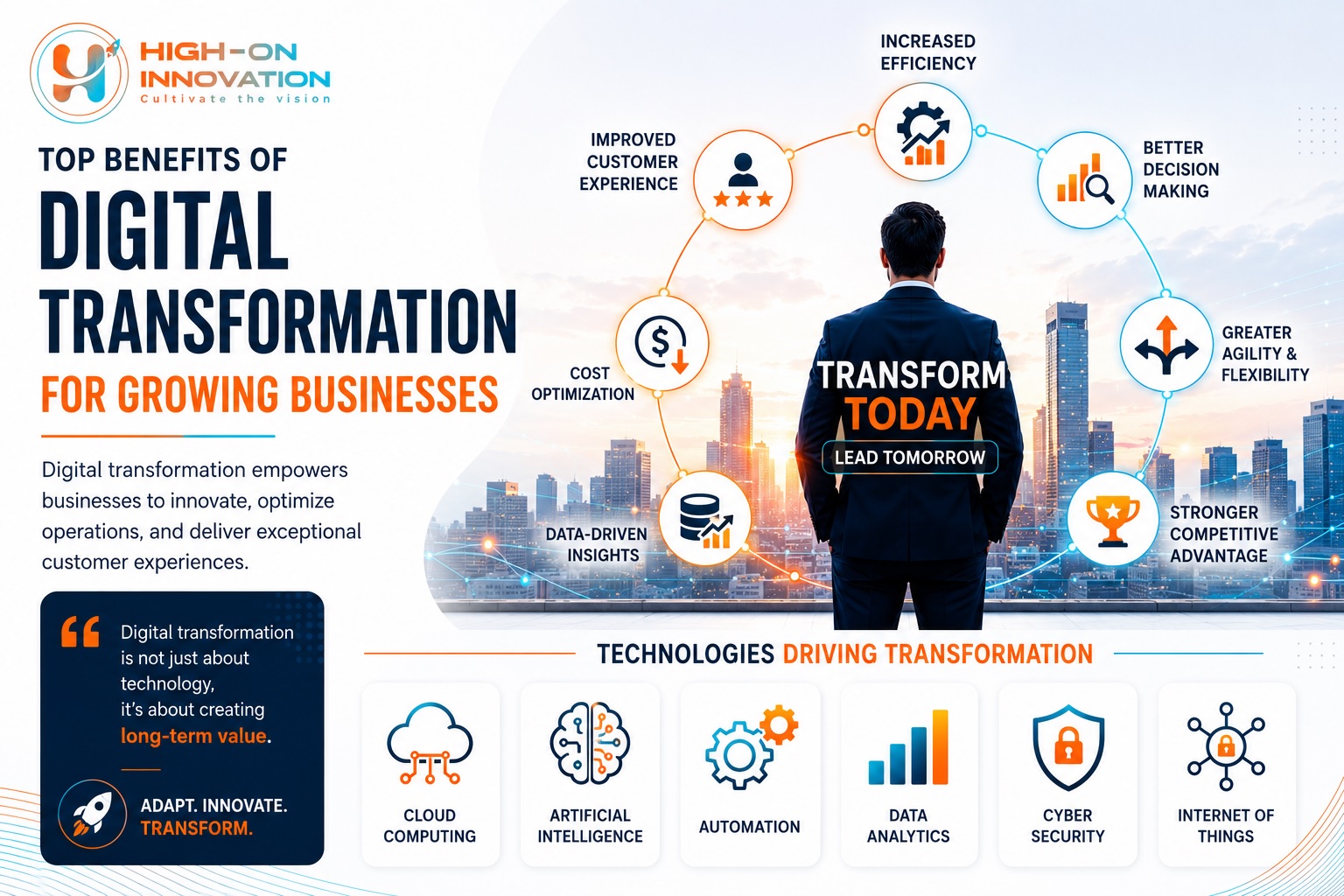
Key Takeaways
Digital transformation improves productivity and operational efficiency.
Businesses can enhance customer experiences using AI and automation.
Cloud technologies support scalability and business growth.
Analytics enables smarter data-driven decision-making.
Digitally transformed businesses adapt faster to changing market demands.
Digital transformation creates long-term competitive advantages.
Introduction
Businesses today are operating in a highly competitive and technology-driven environment where customer expectations, operational efficiency, and innovation play a major role in long-term success.
Companies that still rely heavily on manual workflows, disconnected systems, and outdated technologies often struggle with productivity, scalability, and customer engagement.
Digital transformation helps businesses modernize operations, improve customer experiences, automate processes, and unlock new growth opportunities using technologies like AI, cloud computing, analytics, and automation.
Whether you are a startup, SMB, or enterprise organization, understanding the benefits of digital transformation can help you make smarter decisions for future growth.
What Is Digital Transformation?
Digital transformation is the process of integrating digital technologies into business operations, workflows, customer interactions, and decision-making processes.
It involves:
Automating repetitive tasks
Modernizing legacy systems
Using AI and analytics
Improving digital customer experiences
Enhancing operational efficiency
Building scalable business infrastructure
The goal is to create more agile, efficient, and future-ready organizations.
Why Digital Transformation Matters Today
Modern customers expect:
Faster services
Personalized experiences
Digital accessibility
Seamless communication
Real-time support
At the same time, businesses face increasing pressure to improve efficiency, reduce costs, and adapt quickly to changing market conditions.
Digital transformation enables organizations to stay competitive while improving both customer satisfaction and internal productivity.
Top Benefits of Digital Transformation
1. Improved Operational Efficiency
One of the biggest advantages of digital transformation is increased efficiency.
Automation and modern digital tools reduce manual work, repetitive tasks, and operational bottlenecks.
Businesses can automate:
Customer support workflows
Data entry
Invoice processing
HR operations
Inventory management
Marketing campaigns
This allows teams to focus more on strategic and high-value work.
Real Impact
Businesses that automate repetitive processes often experience:
Faster operations
Fewer human errors
Better productivity
Reduced delays
2. Better Customer Experience
Customer experience has become a major competitive factor for modern businesses.
Digital transformation helps organizations create:
Personalized experiences
Faster response times
Omnichannel communication
Mobile-friendly interactions
AI-powered support systems
Businesses can better understand customer behavior through analytics and deliver more relevant services.
Example
AI chatbots and customer automation systems can provide instant support 24/7, improving customer satisfaction significantly.
3. Increased Business Scalability
Traditional systems often make business growth difficult due to infrastructure limitations and operational inefficiencies.
Digital transformation enables scalable business operations through:
Cloud computing
Flexible digital infrastructure
Automated workflows
Centralized systems
Businesses can expand operations more efficiently without significantly increasing operational complexity.
Why Scalability Matters
Scalable systems allow businesses to:
Handle higher customer demand
Expand into new markets
Support remote teams
Launch new services faster
4. Data-Driven Decision Making
Modern businesses generate massive amounts of data every day.
Digital transformation allows organizations to collect, analyze, and use data effectively for strategic decision-making.
Analytics tools help businesses:
Track performance
Understand customer behavior
Predict trends
Optimize marketing campaigns
Improve operational efficiency
Data-driven companies make faster and more informed business decisions.
5. Reduced Operational Costs
Automation, cloud solutions, and optimized workflows help businesses lower operational expenses.
Digital transformation reduces costs associated with:
Manual labor
Physical infrastructure
System maintenance
Operational inefficiencies
Paper-based processes
Cloud-based systems also reduce the need for expensive on-premise infrastructure.
6. Enhanced Employee Productivity
Modern digital tools help employees work more efficiently and collaboratively.
Businesses use:
Cloud collaboration platforms
Automated workflows
Digital communication systems
Centralized project management tools
These technologies improve:
Team coordination
Workflow visibility
Task management
Remote collaboration
Employees spend less time on repetitive tasks and more time on productive work.
7. Faster Innovation
Digital transformation creates a more agile business environment where organizations can innovate faster.
Businesses can:
Launch products more quickly
Test new ideas faster
Adapt to customer feedback
Improve services continuously
Modern technologies accelerate product development, experimentation, and market adaptation.
8. Improved Business Agility
Market trends and customer behavior change rapidly.
Digitally transformed businesses can respond faster to:
Customer demands
Industry changes
Economic shifts
Competitive pressures
Agile businesses are better prepared to adapt and grow in uncertain market conditions.
9. Stronger Cybersecurity and Data Management
As businesses become more digital, cybersecurity becomes increasingly important.
Modern digital transformation strategies often include:
Advanced security protocols
Cloud security solutions
Multi-factor authentication
Data encryption
Automated monitoring systems
Improved cybersecurity helps protect sensitive business and customer data.
10. Competitive Advantage
Businesses that adopt digital transformation often outperform competitors that rely on outdated systems and processes.
Digital-first companies can:
Deliver faster services
Improve customer experiences
Operate more efficiently
Scale faster
Innovate continuously
This creates a long-term competitive advantage in the market.
Real Examples of Digital Transformation Benefits
Retail Industry
Retail businesses use AI-powered recommendation systems and automated inventory management to improve sales and customer experiences.
Banking and Finance
Banks use mobile banking apps, AI fraud detection, and digital payment systems to improve convenience and security.
Healthcare
Healthcare providers use telemedicine, digital records, and AI diagnostics to improve patient care and operational efficiency.
Manufacturing
Manufacturers use IoT devices and automation for predictive maintenance and operational monitoring.
Education
Educational institutions use digital learning platforms and cloud collaboration tools for remote and hybrid education.
Challenges Businesses May Face
Despite its benefits, digital transformation also comes with challenges such as:
Resistance to change
Legacy system integration
Budget limitations
Cybersecurity concerns
Technical skill gaps
A clear strategy and experienced implementation partners can help businesses overcome these challenges successfully.
How Businesses Can Maximize Digital Transformation Benefits
Define Clear Goals
Set measurable objectives for automation, customer experience, efficiency, and growth.
Focus on Customer Experience
Prioritize seamless digital interactions and personalized services.
Invest in Scalable Technologies
Choose flexible digital solutions that support future expansion.
Train Employees
Help teams adapt to new tools and digital workflows.
Monitor Performance
Use analytics and KPIs to continuously improve business operations.
The Future of Digital Transformation
Digital transformation will continue evolving through:
Generative AI
Advanced automation
Intelligent analytics
Smart business ecosystems
Hyper-personalized customer experiences
Businesses investing in digital innovation today are preparing for long-term growth and future market leadership.
Conclusion
Digital transformation provides businesses with the tools, technologies, and strategies needed to improve efficiency, enhance customer experiences, reduce costs, and accelerate growth.
From automation and analytics to AI and cloud computing, digital transformation helps organizations become more agile, scalable, and competitive in today’s digital economy.
Businesses that embrace digital transformation are not only improving current operations but also building a strong foundation for future success.
Frequently Asked Questions
What are the main benefits of digital transformation?
The main benefits include improved efficiency, better customer experiences, automation, scalability, cost reduction, and faster innovation.
How does digital transformation improve business growth?
Digital transformation helps businesses streamline operations, improve decision-making, and create scalable systems that support growth.
Why is customer experience important in digital transformation?
Modern customers expect faster, personalized, and seamless digital experiences, making customer experience a major business priority.
Is digital transformation only for large businesses?
No, businesses of all sizes can benefit from digital transformation by improving efficiency, customer engagement, and scalability.
Author Bio
Harsit Gupta – Founder, High-On Innovation
Harsit Gupta is the Founder of High-On Innovation and is responsible for shaping the company's vision, business model, growth strategy, and market expansion initiatives. He specializes in identifying emerging opportunities, driving innovation, and helping businesses navigate digital transformation in a rapidly evolving technology landscape. His expertise includes business strategy, digital innovation, startup growth, market positioning, and future-focused technology adoption.
Comments
Loading comments…
Latest Market Trends

Sep 9, 2026
MVP Development Cost for Australian Businesses in 2026
A simple customer portal, booking application, SaaS dashboard, marketplace, AI-powered platform, fintech product, healthcare application, or enterprise workflow system can all be described as an "MVP", but their development requirements can be dramatically different.

Sep 3, 2026
How to Choose an MVP Development Company for Your Startup
Choosing the right MVP development company can have a major impact on your startup's first product launch. The right development partner does more than write code. They help translate your business idea into a focused product, identify technical risks, prioritize features, and create an MVP that can be tested with real users.

Sep 8, 2026
MVP Development Cost for Canadian Businesses in 2026: Complete Guide to Pricing, Features and Process
Discover MVP development cost Canada in 2026, including startup MVP cost, development factors, timelines, features, technology, compliance, and how to choose the right MVP development company.
Popular Post
MVP Development Cost for Australian Businesses in 2026
A simple customer portal, booking application, SaaS dashboard, marketplace, AI-powered platform, fintech product, healthcare application, or enterprise workflow system can all be described as an "MVP", but their development requirements can be dramatically different.
How to Choose an MVP Development Company for Your Startup
Choosing the right MVP development company can have a major impact on your startup's first product launch. The right development partner does more than write code. They help translate your business idea into a focused product, identify technical risks, prioritize features, and create an MVP that can be tested with real users.
MVP Development Cost for Canadian Businesses in 2026: Complete Guide to Pricing, Features and Process
Discover MVP development cost Canada in 2026, including startup MVP cost, development factors, timelines, features, technology, compliance, and how to choose the right MVP development company.

MVP Development Cost for USA Startups in 2026
An MVP, or Minimum Viable Product, gives founders a way to turn an idea into a usable product, launch it with real users, collect feedback, and understand whether the market actually wants the solution.