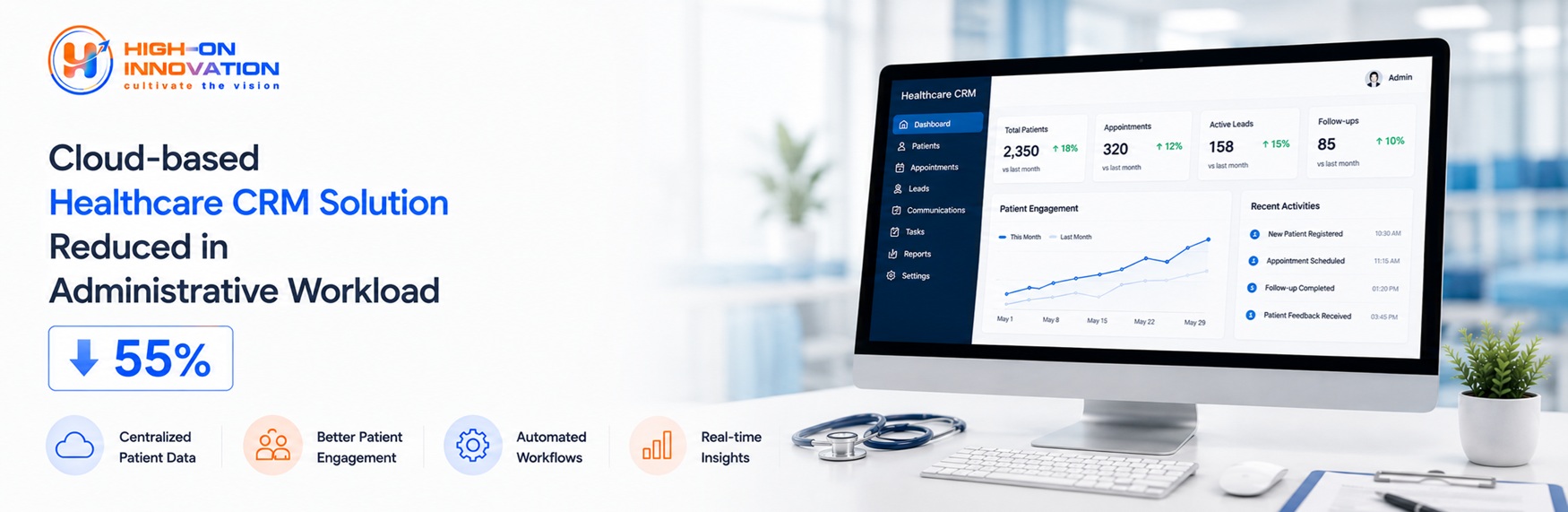
Reduced in Administrative Workload

Key Metrics

55%
Reduced in Administrative Workload
40%
Increase in Patient Engagement
35%
Reduced in Missed Appointments
30%
Increase in Staff Productivity

About the Company

Our customer is a growing multi-location healthcare provider offering outpatient consultations, diagnostics, specialty care, and preventive health services. As patient demand increased, managing appointments, follow-ups, referrals, billing coordination, and patient communication became increasingly challenging.

The hospital relied on multiple disconnected systems and manual processes, resulting in delays, inconsistent patient experiences, and operational inefficiencies. To overcome these challenges, the organization partnered with High-On Innovation (HOI) to implement an AI-powered Healthcare CRM that centralized patient interactions, automated workflows, and provided real-time operational insights.

Challenges

Disconnected Patient Communication

Appointment bookings, follow-ups, reminders, billing updates, and patient inquiries were managed across multiple platforms, making communication inconsistent and difficult to track.

Manual Administrative Work

Front-office staff spent significant time managing appointments, updating patient records, coordinating with doctors, and handling routine patient requests, reducing overall productivity.

High No-Show Rates

Without automated reminders and follow-up workflows, patients frequently missed appointments, leading to unused consultation slots and revenue loss.

Limited Operational Visibility

Hospital administrators had no centralized view of patient journeys, appointment utilization, staff performance, or service requests, making operational planning difficult.

Delayed Patient Follow-ups

Follow-up consultations, diagnostic reminders, and treatment plans often depended on manual tracking, affecting patient engagement and continuity of care.

Solutions

HOI implemented a cloud-based Healthcare CRM that unified patient engagement, automated administrative processes, and improved collaboration across departments.

Centralized Patient Relationship Management

A single CRM platform managed every patient interaction—from appointment scheduling and consultation history to follow-ups, billing status, and support requests—creating a 360-degree patient view.

Intelligent Appointment Management

The CRM automated:

  • Online Appointment Scheduling

  • Doctor Availability Management

  • Appointment Confirmations

  • SMS & Email Reminders

  • Rescheduling Requests

  • Waitlist Management

This reduced scheduling conflicts and improved appointment utilization.

Automated Patient Engagement

AI-powered workflows automatically sent:

  • Appointment Reminders

  • Diagnostic Test Notifications

  • Medication Follow-ups

  • Health Check-up Reminders

  • Feedback Surveys

  • Wellness Campaigns

This improved patient retention and strengthened long-term engagement.

Workflow Automation

The CRM streamlined key administrative processes, including:

  • Patient Registration

  • Lead-to-Patient Conversion

  • Referral Management

  • Insurance Coordination

  • Task Assignment

  • Internal Notifications

  • Case Escalation

Executive Operations Dashboard

Hospital administrators gained real-time visibility into:

  • Appointment Utilization

  • Patient Acquisition

  • No-Show Rates

  • Doctor Schedules

  • Staff Productivity

  • Patient Satisfaction

  • Revenue Performance

This enabled proactive decision-making and better resource allocation.

Technologies

  • Healthcare CRM – Centralized patient relationship management

  • Artificial Intelligence (AI) – Smart workflows and patient engagement

  • Workflow Automation – Appointment and administrative automation

  • Cloud Platform – Secure, scalable healthcare operations

  • Business Intelligence – Operational dashboards and reporting

  • API Integration – EMR, billing, laboratory, and communication systems

Results

By automating routine administrative tasks and centralizing patient information, the CRM significantly reduced manual workload for front-office and care coordination teams.

Improved Appointment Utilization

Automated reminders and intelligent scheduling reduced missed appointments, increased physician utilization, and optimized daily clinic operations.

Faster Patient Response Times

Centralized communication enabled staff to respond to patient inquiries, appointment requests, and follow-up needs more efficiently, improving the overall patient experience.

Enhanced Operational Visibility

Real-time dashboards provided leadership with actionable insights into patient flow, appointment trends, staff productivity, and operational performance, enabling continuous process improvements.

Increased Patient Retention

Personalized communication, automated follow-ups, and proactive engagement strengthened patient relationships, encouraged repeat visits, and improved continuity of care.

Scalable Healthcare Operations

The cloud-based CRM established a flexible digital foundation that supports multi-location hospitals, specialty clinics, diagnostic centers, and future healthcare expansion.

Reduced in Administrative Workload | High-On Innovation