AI in Hospitals: How Artificial Intelligence is Transforming Hospital Operations
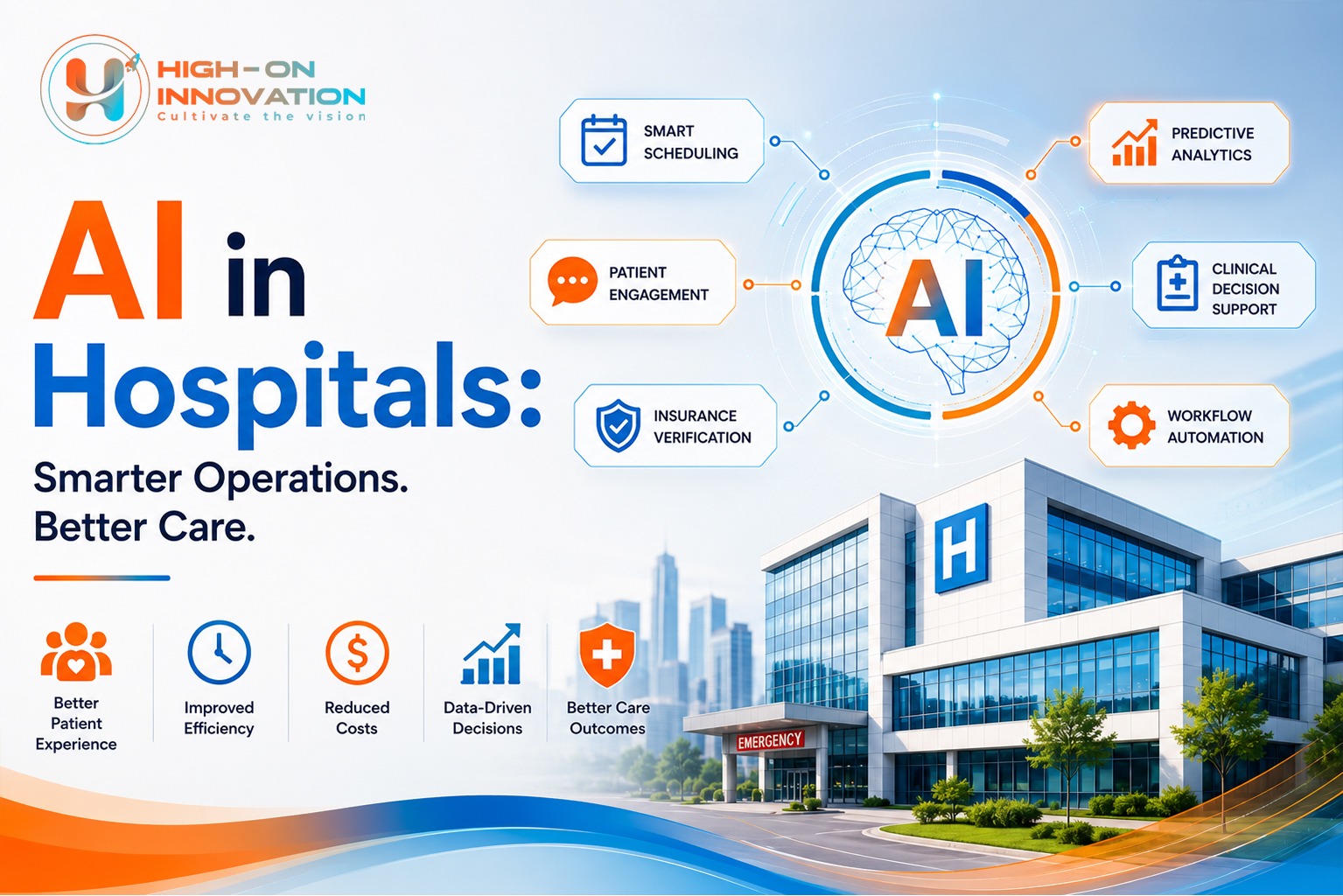
Hospitals are under unprecedented pressure to deliver high-quality patient care while managing increasing operational costs, workforce shortages, regulatory requirements, and growing patient expectations. Every day, hospital administrators must coordinate thousands of activities—from patient admissions and diagnostics to insurance verification, billing, discharge planning, and follow-up care.
While many hospitals have invested in digital systems such as Hospital Information Systems (HIS) and Electronic Medical Records (EMR), these platforms often rely on manual processes for everyday operations. Staff still spend countless hours scheduling appointments, updating patient records, verifying insurance, coordinating departments, and responding to patient inquiries.
As patient volumes continue to rise, hospitals need more than digital record-keeping—they need intelligent systems that automate repetitive work, improve decision-making, and connect departments through seamless workflows.
This is where Artificial Intelligence (AI) is making a significant impact.
AI in hospitals is no longer limited to advanced diagnostics or robotic surgery. Today, AI is transforming operational efficiency by automating administrative tasks, improving patient communication, optimizing resource utilization, accelerating claims processing, and providing real-time insights for hospital leaders.
Whether you're managing a community hospital, a multi-specialty medical center, or a super-specialty healthcare institution, AI can help your organization improve patient experiences, reduce administrative burdens, and create a more efficient healthcare ecosystem.
In this guide, you'll learn:
What AI in hospitals means
The biggest hospital challenges AI solves
Fifteen real-world AI applications
How hospitals benefit from AI automation
Best practices for successful implementation
What Does AI in Hospitals Mean?
AI in hospitals refers to the use of Artificial Intelligence, Machine Learning, intelligent automation, and data analytics to improve hospital operations, enhance patient care, and support clinical and administrative decision-making.
Unlike traditional hospital software that stores information and requires manual actions, AI-powered systems can:
Analyze large amounts of data
Recognize operational patterns
Automate repetitive workflows
Predict future events
Support clinical decisions
Improve communication across departments
AI works alongside healthcare professionals by reducing administrative workloads and enabling faster, more informed decisions.
Instead of replacing hospital staff, AI empowers them to work more efficiently.
Core Technologies Behind Hospital AI
Successful AI implementations combine multiple technologies that work together to streamline hospital operations.
Artificial Intelligence (AI)
Artificial Intelligence enables software to perform tasks that typically require human intelligence, such as recognizing patterns, making recommendations, and automating decisions.
In hospitals, AI supports:
Patient scheduling
Clinical decision support
Administrative automation
Resource planning
Insurance verification
Patient communication
Machine Learning (ML)
Machine Learning continuously learns from hospital data to improve predictions and recommendations.
Hospitals use ML to:
Forecast patient admissions
Predict appointment no-shows
Optimize staffing levels
Improve resource allocation
Identify operational bottlenecks
The more data available, the more accurate these predictions become.
Intelligent Workflow Automation
Workflow automation connects hospital departments by automatically moving tasks, documents, and approvals through predefined processes.
Examples include:
Admissions
Referrals
Laboratory requests
Discharge planning
Insurance approvals
Internal notifications
Automation eliminates unnecessary delays while ensuring consistency across departments.
Predictive Analytics
Predictive AI helps hospitals anticipate future demand and make proactive decisions.
Hospital leaders can forecast:
Bed occupancy
Emergency department demand
Staffing requirements
Equipment utilization
Patient flow
Financial performance
This enables hospitals to plan resources more effectively.
Challenges Hospitals Face That AI Can Solve
Hospitals operate in one of the most complex business environments. Every department depends on accurate information, timely communication, and efficient coordination.
AI addresses many of the operational challenges that limit hospital performance.
1. Long Patient Waiting Times
Patients often experience delays due to inefficient scheduling, manual registration, and slow administrative processes.
These delays impact patient satisfaction and reduce operational efficiency.
How AI Helps
AI optimizes appointment scheduling, streamlines patient registration, predicts appointment durations, and automates patient communication to reduce waiting times.
2. Administrative Overload
Hospital staff spend a significant portion of their day completing administrative tasks such as:
Patient registration
Appointment management
Insurance verification
Documentation
Billing
Internal coordination
These repetitive activities reduce the time available for direct patient care.
How AI Helps
AI automates repetitive administrative work, allowing staff to focus on higher-value responsibilities.
3. Department Coordination
Hospitals involve multiple interconnected departments, including emergency care, outpatient services, laboratories, radiology, pharmacy, finance, and administration.
Manual coordination often creates communication gaps and process delays.
How AI Helps
Workflow automation automatically routes tasks, notifications, approvals, and documents between departments.
4. Insurance Processing Delays
Insurance verification and prior authorizations often delay patient admissions and treatment.
Manual processes increase administrative workloads and the likelihood of errors.
How AI Helps
AI validates insurance information, identifies missing documentation, and accelerates approval workflows.
5. Patient Communication Challenges
Patients expect timely updates regarding appointments, reports, procedures, and follow-up care.
Manual communication systems often struggle to keep pace with demand.
How AI Helps
AI automates reminders, notifications, post-discharge communication, and patient engagement across multiple channels.
6. Staff Burnout
Doctors, nurses, and administrative teams frequently experience burnout due to growing workloads and repetitive administrative tasks.
How AI Helps
Automation reduces documentation, scheduling, communication, and administrative responsibilities, allowing healthcare professionals to focus on patient care.
7. Inefficient Resource Utilization
Hospitals manage expensive resources, including operating rooms, diagnostic equipment, hospital beds, and specialized staff.
Without accurate forecasting, these resources may be underutilized or overbooked.
How AI Helps
Predictive analytics optimizes scheduling, staffing, and resource allocation, improving overall operational efficiency.
15 Real-World Applications of AI in Hospitals
AI is transforming nearly every operational area within modern hospitals. Below are the first seven high-impact applications already delivering measurable improvements.
1. AI Appointment Scheduling
Appointment scheduling is one of the most visible patient-facing processes.
AI-powered scheduling systems:
Match patients with appropriate physicians
Check real-time availability
Reduce scheduling conflicts
Automate confirmations
Manage cancellations
Optimize appointment calendars
Benefits
Reduced patient waiting times
Lower no-show rates
Better physician utilization
Improved patient satisfaction
2. Patient Communication Automation
Hospitals communicate with patients throughout their healthcare journey.
AI automates:
Appointment reminders
Admission instructions
Procedure notifications
Medication reminders
Follow-up messages
Patient satisfaction surveys
Benefits
Better patient engagement
Improved treatment adherence
Reduced administrative workload
Higher patient satisfaction
3. Digital Patient Admission Automation
Hospital admissions involve multiple administrative steps that can delay patient care.
AI streamlines admissions by automating:
Online pre-registration
Digital forms
Identity verification
Insurance validation
Bed assignment notifications
Department coordination
Benefits
Faster admissions
Reduced paperwork
Improved patient experience
Lower administrative costs
4. Electronic Medical Record (EMR) Automation
Maintaining accurate patient records is essential for quality healthcare.
AI enhances EMR systems by:
Organizing clinical information
Updating patient histories
Retrieving relevant records
Summarizing documentation
Reducing duplicate entries
Benefits
Improved documentation quality
Faster record retrieval
Better clinical decision support
Reduced administrative effort
5. Insurance Verification AI
Insurance verification often requires significant manual effort before treatment begins.
AI automates:
Eligibility verification
Policy validation
Coverage confirmation
Missing documentation alerts
Approval tracking
Benefits
Faster approvals
Fewer claim rejections
Better patient experiences
Reduced administrative workload
6. AI Claims Processing
Claims processing directly impacts hospital cash flow.
AI streamlines the claims lifecycle by:
Capturing claim information
Validating documentation
Identifying coding errors
Submitting claims electronically
Monitoring claim status
Predicting denial risks
Benefits
Faster reimbursements
Lower denial rates
Improved revenue cycle performance
Reduced manual processing
7. Clinical Documentation Automation
Clinical documentation consumes valuable physician and nursing time.
AI assists by:
Converting speech to text
Organizing clinical notes
Generating structured documentation
Summarizing consultations
Reducing repetitive data entry
Benefits
More time for patient care
Improved documentation accuracy
Reduced clinician burnout
Faster record completion
8. Hospital Workflow Automation
Hospitals rely on hundreds of interconnected workflows every day. A patient's journey may involve registration, consultation, diagnostics, pharmacy, billing, discharge, and follow-up care—all requiring coordination between multiple departments.
AI-powered workflow automation ensures these processes move seamlessly without unnecessary delays.
Common Hospital Workflows
Patient admissions
Referral management
Laboratory requests
Radiology scheduling
Pharmacy coordination
Internal approvals
Discharge planning
Follow-up scheduling
Benefits
Faster patient movement across departments
Reduced manual coordination
Standardized operating procedures
Improved communication between teams
Better patient outcomes
Workflow automation creates a connected hospital where every department operates more efficiently.
9. AI Dashboards & Hospital Intelligence
Hospital administrators make hundreds of operational decisions every day. AI-powered dashboards provide real-time visibility into hospital performance, enabling leaders to act quickly and confidently.
AI Dashboards Monitor
Patient admissions
Emergency department volumes
Bed occupancy
Appointment utilization
Staff productivity
Financial performance
Insurance claim status
Patient satisfaction
Operational bottlenecks
Benefits
Real-time operational insights
Faster executive decision-making
Improved departmental accountability
Better resource planning
Instead of relying on historical reports, hospital leaders gain live intelligence that supports proactive management.
10. Predictive Analytics for Hospitals
One of AI's greatest strengths is its ability to forecast future events.
Predictive analytics helps hospitals anticipate demand and allocate resources before problems occur.
AI Can Predict
Patient admissions
Seasonal demand
ICU occupancy
Emergency department congestion
Equipment utilization
Staffing requirements
Surgery scheduling demand
Appointment no-shows
Benefits
Improved operational planning
Better workforce management
Reduced patient waiting times
Optimized resource utilization
Hospitals become more proactive rather than reactive.
11. AI Chatbots & Virtual Hospital Assistants
Patients expect instant access to information, even outside hospital operating hours.
AI-powered chatbots provide 24/7 digital assistance by handling routine inquiries without increasing administrative workload.
Common Applications
Appointment booking
Department navigation
Admission information
Frequently asked questions
Insurance inquiries
Prescription guidance
Patient education
Follow-up support
Benefits
Improved patient accessibility
Lower call center workload
Faster response times
Better patient engagement
Virtual assistants enhance patient satisfaction while reducing front-desk pressure.
12. Intelligent Bed Management
Hospital bed availability directly affects patient flow and operational efficiency.
AI helps hospitals optimize bed utilization by analyzing:
Current occupancy
Expected discharges
Admission forecasts
Department demand
Cleaning status
Transfer requirements
Benefits
Reduced admission delays
Faster patient transfers
Better bed utilization
Improved emergency department capacity
Efficient bed management ensures hospitals maximize available resources while minimizing patient waiting times.
13. AI Staff Scheduling
Managing hospital staffing is complex due to shift rotations, specialties, leave requests, and fluctuating patient volumes.
AI-powered scheduling systems analyze workload forecasts to create optimized staffing plans.
AI Can Consider
Patient demand
Department workload
Staff availability
Skill requirements
Overtime limits
Compliance policies
Benefits
Better workforce utilization
Reduced overtime
Improved staff satisfaction
Lower scheduling conflicts
Hospitals can maintain quality care while optimizing labor costs.
14. Revenue Cycle Automation
Hospital revenue depends on efficient billing, claims processing, collections, and payment reconciliation.
AI automates multiple stages of the revenue cycle, improving financial performance.
Automation Includes
Billing validation
Coding verification
Claims tracking
Payment reminders
Outstanding balance monitoring
Financial reporting
Denial prediction
Benefits
Faster reimbursements
Reduced billing errors
Improved cash flow
Better financial visibility
AI strengthens hospital financial operations while reducing administrative effort.
15. Enterprise AI Platforms
Many hospitals initially implement AI in isolated departments. Over time, they realize greater value comes from connecting these systems into one intelligent platform.
An enterprise AI platform integrates:
Appointment scheduling
Admissions
EMR
Patient communication
CRM
Billing
Insurance verification
Claims management
Workflow automation
Dashboards
Analytics
This creates a single digital ecosystem where information flows seamlessly across the hospital.
Benefits
Organization-wide automation
Better collaboration
Unified patient information
Improved operational efficiency
Scalable digital transformation
Enterprise AI platforms provide the foundation for the hospitals of the future.
Benefits of AI in Hospitals
Hospitals implementing AI automation often experience improvements across operational, financial, and patient care outcomes.
Improved Patient Experience
Patients benefit from:
Faster appointment scheduling
Shorter waiting times
Better communication
Quicker admissions
Personalized follow-up
These improvements increase patient satisfaction and strengthen trust.
Higher Staff Productivity
AI reduces repetitive administrative tasks, allowing healthcare professionals to dedicate more time to patient care.
Common productivity gains include:
Less documentation
Fewer manual approvals
Faster communication
Automated workflows
Lower Operational Costs
Automation reduces:
Administrative labor
Paper-based processes
Duplicate work
Billing errors
Insurance processing delays
This improves operational efficiency without compromising quality of care.
Reduced Human Errors
AI validates information before actions are completed, reducing errors in:
Patient records
Billing
Insurance documentation
Claims submissions
Scheduling
Accurate processes improve both compliance and patient safety.
Better Resource Utilization
Predictive AI helps hospitals optimize:
Staff schedules
Operating rooms
Equipment usage
Bed allocation
Diagnostic resources
Efficient resource planning reduces waste while improving patient access.
Faster Decision-Making
Real-time dashboards and predictive analytics provide hospital leaders with actionable insights for operational and strategic planning.
The Future of AI in Hospitals
AI adoption is accelerating across healthcare, and hospitals are moving toward increasingly intelligent, connected operations.
Future trends include:
AI-Assisted Clinical Workflows
AI will continue supporting clinicians by reducing administrative work and providing faster access to relevant patient information.
Connected Hospital Ecosystems
Hospitals will integrate scheduling, EMR, billing, CRM, diagnostics, and communication into unified digital platforms.
Predictive Hospital Management
AI will forecast demand, optimize staffing, manage capacity, and support strategic planning with greater accuracy.
Personalized Patient Experiences
Patients will receive more tailored communication, reminders, education, and follow-up based on their medical history and preferences.
Intelligent Automation Across Departments
Routine administrative work will increasingly be automated, enabling healthcare professionals to focus on delivering exceptional care.
The hospital of the future will be digitally connected, data-driven, and automation-first.
Why Hospitals Choose HOI
At High on Innovation (HOI), we help hospitals modernize operations through intelligent automation tailored to the healthcare industry.
We understand that every hospital has unique workflows, operational priorities, and technology environments. Our solutions are designed to integrate with existing systems while delivering measurable business value.
AI Automation
Automate repetitive administrative tasks and improve operational efficiency across departments.
Workflow Automation
Streamline patient journeys, approvals, admissions, diagnostics, discharge planning, and internal coordination.
CRM Automation
Strengthen patient engagement through automated communication, referral management, follow-ups, and personalized interactions.
System Integration
We connect AI with:
Hospital Information Systems (HIS)
Electronic Medical Records (EMR/EHR)
CRM platforms
Billing software
Laboratory Information Systems
Patient communication tools
This ensures seamless data flow across your organization.
Custom Hospital Solutions
Every hospital operates differently.
HOI develops customized automation strategies aligned with your:
Clinical workflows
Administrative processes
Operational goals
Digital transformation roadmap
End-to-End Implementation
Our healthcare AI implementation approach includes:
Business Process Assessment
Workflow Mapping
AI Opportunity Identification
Solution Design
Integration
Staff Training
Performance Monitoring
Continuous Optimization
We don't simply deploy technology—we help hospitals build sustainable automation ecosystems.
Frequently Asked Questions
1. How is AI used in hospitals?
AI supports hospitals by automating administrative tasks, improving patient communication, optimizing workflows, assisting with clinical documentation, streamlining insurance verification, managing claims, and providing predictive analytics for operational decision-making.
2. Can AI improve hospital efficiency?
Yes. AI reduces manual work, accelerates workflows, minimizes errors, improves coordination between departments, and enables hospitals to manage increasing patient volumes more efficiently.
3. Does AI replace doctors or nurses?
No. AI is designed to support healthcare professionals by handling repetitive administrative work and providing intelligent decision support. Clinical expertise and patient care remain the responsibility of medical professionals.
4. What hospital departments benefit from AI?
Nearly every department can benefit, including admissions, outpatient services, emergency care, radiology, laboratories, pharmacy, finance, billing, administration, and patient support.
5. How do hospitals begin implementing AI?
Most hospitals start by identifying repetitive, high-volume administrative processes such as appointment scheduling, patient communication, insurance verification, workflow automation, or billing before expanding AI across the organization.
Conclusion
Artificial Intelligence is no longer a future concept—it is becoming a core operational capability for modern hospitals.
From appointment scheduling and admissions to workflow automation, predictive analytics, bed management, and revenue cycle optimization, AI enables hospitals to operate more efficiently while improving patient care and staff productivity.
Hospitals that embrace AI today are building the foundation for a more connected, scalable, and patient-centric future.
By starting with the right processes, integrating AI with existing systems, and implementing automation strategically, healthcare organizations can achieve measurable improvements in operational performance and patient outcomes.
Harsit Gupta is the Founder of High-On Innovation and is responsible for shaping the company's vision, business model, growth strategy, and market expansion initiatives. He specializes in identifying emerging opportunities, driving innovation, and helping businesses navigate digital transformation in a rapidly evolving technology landscape. His expertise includes business strategy, digital innovation, startup growth, market positioning, and future-focused technology adoption.
Comments
Loading comments…
Latest Market Trends

Sep 9, 2026
MVP Development Cost for Australian Businesses in 2026
A simple customer portal, booking application, SaaS dashboard, marketplace, AI-powered platform, fintech product, healthcare application, or enterprise workflow system can all be described as an "MVP", but their development requirements can be dramatically different.

Sep 3, 2026
How to Choose an MVP Development Company for Your Startup
Choosing the right MVP development company can have a major impact on your startup's first product launch. The right development partner does more than write code. They help translate your business idea into a focused product, identify technical risks, prioritize features, and create an MVP that can be tested with real users.

Sep 8, 2026
MVP Development Cost for Canadian Businesses in 2026: Complete Guide to Pricing, Features and Process
Discover MVP development cost Canada in 2026, including startup MVP cost, development factors, timelines, features, technology, compliance, and how to choose the right MVP development company.
Popular Post
MVP Development Cost for Australian Businesses in 2026
A simple customer portal, booking application, SaaS dashboard, marketplace, AI-powered platform, fintech product, healthcare application, or enterprise workflow system can all be described as an "MVP", but their development requirements can be dramatically different.
How to Choose an MVP Development Company for Your Startup
Choosing the right MVP development company can have a major impact on your startup's first product launch. The right development partner does more than write code. They help translate your business idea into a focused product, identify technical risks, prioritize features, and create an MVP that can be tested with real users.
MVP Development Cost for Canadian Businesses in 2026: Complete Guide to Pricing, Features and Process
Discover MVP development cost Canada in 2026, including startup MVP cost, development factors, timelines, features, technology, compliance, and how to choose the right MVP development company.

MVP Development Cost for USA Startups in 2026
An MVP, or Minimum Viable Product, gives founders a way to turn an idea into a usable product, launch it with real users, collect feedback, and understand whether the market actually wants the solution.