MVP Development Cost for Canadian Businesses in 2026: Complete Guide to Pricing, Features and Process

Keyword Takeaways
MVP development cost Canada is the primary commercial keyword for Canadian businesses researching the investment required to build and launch an MVP.
startup MVP cost Canada addresses founders who need to understand realistic budgets before approaching developers or investors.
MVP development company Canada targets businesses evaluating development partners based on expertise, process, technology, security, ownership, communication, and long-term support.
MVP pricing should be evaluated based on scope, complexity, integrations, platforms, design, security, compliance, team composition, and post-launch requirements, not simply an hourly development rate.
Canadian businesses should also consider privacy, data handling, accessibility, payment processing, communications compliance, and, where applicable, province-specific requirements before development begins.
Introduction
For a Canadian startup or growing business, the first question about building a digital product is often straightforward:
"How much will my MVP cost?"
The answer, however, is rarely a single number.
An MVP for a simple appointment-booking platform is fundamentally different from an AI-powered healthcare application, B2B SaaS platform, fintech product, insurance platform, marketplace, or mobile application requiring real-time functionality.
In 2026, published Canadian market estimates place many focused MVP projects somewhere around CAD 15,000–80,000, while more sophisticated MVPs can move beyond CAD 100,000 depending on functionality, integrations, compliance, platforms, and technical complexity. Canadian agency rates also vary substantially by location and provider type. These figures should be treated as market-budgeting references rather than universal quotations.
That distinction is important.
A business shouldn't choose an MVP development company simply because it offers the lowest quote. A CAD 25,000 proposal and a CAD 75,000 proposal may not actually describe the same product.
One may include UX research, architecture, QA, deployment, security, analytics, documentation, and post-launch support. The other may include only development.
Therefore, understanding MVP development cost Canada requires looking beyond the headline number.
This guide explains what Canadian startups and businesses should know before choosing an MVP development partner in 2026, including cost ranges, development factors, technology, security, Canadian considerations, vendor evaluation, intellectual property, timelines, hidden costs, and how HOI approaches MVP development for startups.
What Is an MVP?
A Minimum Viable Product is the first usable version of a product designed to deliver its core value to a specific target audience and generate real-world feedback.
An MVP is not simply a cheap version of a final product.
It should be capable of answering important business questions.
For example:
Do customers actually need this solution?
Can users understand how to use it?
Will customers return?
Will businesses pay for it?
Which features generate the most value?
Which assumptions were wrong?
What should be developed next?
The purpose of an MVP is therefore validation through a working product.
A Canadian founder shouldn't ask only:
"How cheaply can I build this?"
A better question is:
"What is the smallest reliable product that can prove whether my business idea deserves further investment?"
That mindset can have a significant impact on the final startup MVP cost Canada.
How Much Does MVP Development Cost in Canada in 2026?
There is no universal MVP price because MVPs differ significantly in scope.
For budgeting purposes, Canadian market references commonly place focused MVPs in the tens of thousands of Canadian dollars, with more sophisticated products reaching six figures. Recent 2026 estimates include ranges such as CAD 15,000–40,000 for simple MVPs, CAD 30,000–80,000 for focused MVPs, and CAD 80,000–200,000 or more for more complex SaaS-style products.
A practical way to think about the market is:
MVP Type Indicative 2026 Budget in CAD Typical Characteristics
Simple MVP $15,000–$40,000 One platform, focused workflow, limited integrations
Standard MVP $30,000–$80,000 Multiple core workflows, custom UI, backend, admin
Complex MVP $75,000–$150,000+ Multiple roles, integrations, advanced workflows
Advanced / AI MVP $100,000+ AI, real-time functionality, complex integrations, advanced infrastructure
These are planning ranges, not fixed HOI prices or guarantees. Actual requirements should be assessed before a meaningful proposal is prepared.
The overlap between ranges is intentional. A product with five simple features may cost less than a product with three highly complex workflows.
Why MVP Costs Vary So Much in Canada
Canadian businesses can receive dramatically different proposals for what appears to be the same product.
This happens because development cost is influenced by several variables.
Product Scope
Scope is usually the biggest cost driver.
Consider a marketplace MVP.
A simple version might require:
Customer registration
Vendor registration
Product listing
Search
Basic checkout
Order management
Admin dashboard
But if the business adds:
Multiple vendor payout rules
Reviews
Messaging
Promotions
Subscription plans
Advanced search
Recommendation engines
Real-time notifications
Multiple payment methods
Mobile applications
the project becomes substantially more complex.
The lesson is simple:
Every additional workflow creates development, testing, design, and maintenance requirements.
Number of User Roles
A product with one user type is generally simpler than a product involving:
Customers
Administrators
Managers
Vendors
Employees
Partners
Account owners
Each role can introduce different permissions, dashboards, workflows, notifications, and security requirements.
Number of Platforms
A web application is different from a web application plus iOS and Android applications.
If the core product can initially be validated through a responsive web application, building native applications immediately may unnecessarily increase the initial startup MVP cost Canada.
However, mobile apps may be essential when the product's value depends on:
Camera access
GPS
Push notifications
Offline functionality
Mobile-first workflows
Device capabilities
The correct platform strategy depends on the product.
MVP Development Cost Breakdown
A professional MVP project involves much more than writing code.
Discovery and Product Planning
Before development, the team needs to understand:
Business objectives
Customer problem
Target audience
User journeys
Product requirements
Competitor landscape
MVP scope
Technical risks
Some Canadian development cost estimates place discovery and planning in the several-thousand-dollar range, with more comprehensive product discovery potentially reaching significantly higher depending on the engagement.
A good discovery phase can actually reduce total project waste because unresolved product decisions are addressed before they become expensive development changes.
UX/UI Design
Design may include:
User flows
Wireframes
Prototypes
Visual design
Responsive layouts
Design systems
Usability testing
Skipping design doesn't eliminate this work.
It often moves the cost into development through revisions and rework.
Frontend Development
Frontend development converts the approved UX/UI into a functioning user interface.
Depending on the product, this may include:
Responsive web application
Customer dashboard
Admin interface
Mobile application
Forms
Search
Notifications
Interactive workflows
Backend Development
The backend can include:
APIs
Business logic
Authentication
User management
Database architecture
Permissions
Notifications
Payment processing
Integrations
For many software products, backend complexity is one of the major differences between a simple MVP and a sophisticated one.
Quality Assurance
QA should not be treated as an optional final step.
Testing may include:
Functional testing
Browser testing
Mobile testing
API testing
Usability testing
Performance testing
Security testing
Regression testing
Some Canadian estimates explicitly separate QA from development when calculating MVP budgets.
Deployment
Getting an application from a developer's environment into production requires additional work.
This can include:
Cloud configuration
Domain configuration
Database deployment
Production environment
SSL
CI/CD
Monitoring
Backup
App Store deployment where applicable
Project Management
Someone needs to coordinate:
Requirements
Developers
Designers
QA
Client reviews
Sprint planning
Releases
Documentation
If project management isn't included in the proposal, the client may end up managing much of this work themselves.
What Features Increase MVP Development Cost?
Some features are considerably more expensive than others.
User Authentication
Basic email/password authentication is relatively straightforward.
Social login, multi-factor authentication, enterprise SSO, advanced role management, and identity integrations increase complexity.
Payment Processing
Payment functionality may involve:
Payment gateway integration
Subscription billing
Invoices
Refunds
Taxes
Payment failures
Webhooks
Transaction records
A business should determine whether payments are essential for MVP validation or can be introduced later.
Real-Time Functionality
Chat, real-time dashboards, live tracking, collaborative editing, and real-time notifications require additional architecture.
Third-Party Integrations
Integrations with systems such as:
CRM platforms
Accounting software
Payment providers
Email platforms
SMS providers
ERP systems
Maps
Government services
AI APIs
can significantly affect project cost.
Integration complexity depends not just on the API itself but on authentication, data mapping, synchronization, error handling, and testing.
AI Functionality
AI can be powerful for MVPs, but it should be included for a clear product reason.
An AI MVP may require:
Model/API integration
Prompt engineering
Data processing
Retrieval systems
Evaluation
Guardrails
Usage monitoring
Cost management
Human review workflows
AI doesn't automatically make an MVP better.
The question should be:
Does AI help validate the product's core value proposition?
What Canadian Businesses Need to Know About Privacy
Privacy should be considered before development begins.
PIPEDA is Canada's federal private-sector privacy law for commercial activities, although Alberta, British Columbia, and Quebec have private-sector privacy legislation that may apply instead of PIPEDA in certain circumstances. The Office of the Privacy Commissioner also emphasizes meaningful consent, appropriate handling of personal information, and privacy management practices.
This matters because an MVP may collect:
Names
Email addresses
Phone numbers
Customer records
Financial information
Health information
Business information
Usage data
A development company should be able to explain how it approaches:
Data collection
Access control
Authentication
Encryption
Data storage
Backups
Third-party services
Data deletion
Privacy requirements
The development company isn't necessarily your legal advisor, so Canadian businesses should obtain appropriate legal/privacy advice for their specific situation.
Quebec and Other Provincial Considerations
Canadian businesses shouldn't assume that "Canada" means one uniform set of technology requirements.
If the product operates in Quebec, for example, privacy requirements can differ from those applicable under federal law or in other provinces.
Similarly, language requirements may affect product design if the business needs English and French experiences.
Bilingual functionality can influence:
UI design
Content management
Database structure
Notifications
Emails
Customer support
Testing
SEO
This is another reason to discuss geography and target markets during discovery rather than after development has started.
Canadian Businesses Should Consider CASL
If an MVP sends commercial electronic messages such as promotional emails or SMS, Canada's Anti-Spam Legislation can become relevant.
The CRTC identifies three core requirements for commercial electronic messages: appropriate consent, identification information, and a working unsubscribe mechanism.
Therefore, if your MVP includes:
Marketing emails
Promotional SMS
Automated campaigns
Lead nurturing
Customer notifications with commercial content
the product requirements should account for consent and communication management.
This should be discussed during product planning rather than discovered after launch.
Accessibility Should Be Considered Early
Accessibility is another consideration for Canadian businesses.
An MVP may need to be usable by people with different abilities, particularly when serving government, education, healthcare, enterprise, or public-facing audiences.
Accessibility can influence:
Colour contrast
Keyboard navigation
Form labels
Screen-reader compatibility
Typography
Error messages
Interactive elements
Multimedia
Accessibility is much easier to design into the product than retrofit later.
How Location Affects MVP Development Cost
Canadian businesses may compare:
Canadian development company vs offshore development company
The difference can be significant.
Recent 2026 market references show Canadian agency rates commonly ranging from roughly CAD 100–200+ per hour depending on provider, location, and expertise, while offshore rates can be substantially lower.
But hourly rate alone doesn't determine project value.
Suppose:
Team A: CAD 70/hour × 1,000 hours = CAD 70,000
Team B: CAD 140/hour × 450 hours = CAD 63,000
The second team has a higher hourly rate but a lower project cost.
This is why Canadian businesses should compare:
Total cost + scope + quality + timeline + communication + ownership + support
rather than hourly rate alone.
What Should Canadian Businesses Look for in an MVP Development Company?
Choosing an MVP development company Canada should be treated as a business decision, not simply a vendor selection exercise.
Look for Product Thinking
A strong development company should question the scope when necessary.
If a founder requests 40 features, the right partner should be able to ask:
"Which of these features are necessary to validate your business?"
That conversation can save significant time and money.
Look for Relevant Experience
Ask for examples of products involving similar:
Industries
User types
Integrations
Technical challenges
Business models
Relevant experience can reduce discovery time and implementation risk.
Evaluate the Team
Ask who will actually work on your product.
You may want to know:
Who is the project manager?
Who is the technical lead?
Who designs the product?
Who performs QA?
Who handles deployment?
Where is the team located?
Who will communicate with the Canadian business?
The team shown during sales should not disappear immediately after signing the contract.
Ask How the Company Handles Scope Changes
MVP projects naturally evolve.
A good partner should have a documented process for:
Change requests
New features
Scope adjustments
Cost changes
Timeline changes
Be cautious if a company promises that everything is included without clearly defining what "everything" means.
Ask About Intellectual Property
Before signing, clarify:
Who owns the source code?
Who owns the designs?
Who owns the database?
Who owns documentation?
Who owns custom-developed assets?
Can the business access the source repository?
Are third-party components clearly identified?
What happens when the relationship ends?
For a startup, intellectual property ownership can become particularly important during fundraising, acquisition, due diligence, or transition to an internal engineering team.
Ask About Source Code Access
Your company should understand where its product is being developed and stored.
Questions worth asking include:
Will we have repository access?
Who controls the production environment?
Who owns the cloud account?
Can another developer take over?
Is documentation included?
Are credentials transferred appropriately?
A product should not become permanently dependent on one vendor simply because the vendor controls the infrastructure.
Ask About Post-Launch Support
Launching an MVP is not the end.
After launch, startups may need:
Bug fixes
Monitoring
Performance optimization
Security updates
Infrastructure management
User feedback analysis
Feature development
New integrations
Some development companies include limited warranty support, while others offer ongoing maintenance contracts.
Make sure the post-launch model is clear before signing.
What Are the Hidden Costs of MVP Development?
The development quote is not always the complete product budget.
Canadian businesses should also consider:
Cloud Infrastructure
Depending on usage, the application may require cloud hosting, databases, storage, backups, monitoring, and CDN services.
Third-Party APIs
Some services charge based on:
API calls
Users
Transactions
Storage
Messages
AI tokens
Usage volume
Payment Provider Fees
Payment processors generally charge transaction fees that are separate from software development.
App Store Costs
Mobile applications may involve platform accounts and operational requirements.
Software Licenses
Design, analytics, monitoring, communication, security, and development tools may introduce recurring expenses.
Maintenance
Software requires ongoing maintenance.
One 2026 Canadian software-cost reference recommends budgeting roughly 15–20% of initial development cost annually for maintenance, although actual needs vary significantly by product.
How to Reduce MVP Development Cost Without Reducing Quality
The goal should not be:
Build cheaply.
The goal should be:
Eliminate unnecessary work.
Start With One Core User Problem
The more problems you try to solve, the more complex the MVP becomes.
Start With One Platform Where Practical
If a responsive web application can validate the concept, consider delaying native mobile applications.
Use Proven Third-Party Services
Don't build everything from scratch.
For example, where appropriate, startups can use established services for:
Authentication
Payments
Email
SMS
Cloud infrastructure
Analytics
The product team can concentrate development resources on the functionality that differentiates the startup.
Prioritize Features
Every feature should have a reason for existing.
If a feature does not contribute to validation, revenue, retention, or the core user journey, consider moving it to the roadmap.
Invest in Discovery
It may seem counterintuitive to spend money before development.
However, unresolved requirements can become expensive during development.
A well-defined scope gives developers fewer opportunities to make assumptions.
Fixed Price vs Time and Materials for an MVP
Canadian businesses often ask which commercial model is better.
Fixed Price
A fixed-price model can work well when the MVP scope is clearly defined.
The business gets greater budget predictability.
However, overly rigid fixed-price contracts can become problematic when requirements change.
Time and Materials
This model provides greater flexibility.
It can work particularly well for startups where customer feedback may influence the product during development.
The downside is that the business needs stronger budget controls.
Hybrid Model
A practical option can be:
Fixed-price discovery → defined MVP scope → controlled development sprints → agreed change process
This gives the startup clarity before committing to the larger build while retaining some flexibility.
How HOI Approaches MVP Development
At High-On Innovation (HOI), our approach to MVP development is built around a simple principle:
Don't build everything. Build what needs to be proven first.
Our experience spans custom software, mobile applications, AI-powered solutions, digital transformation, automation, CRM, eCommerce, and industry-specific business systems.
This allows us to approach an MVP as a product and business problem rather than simply a development assignment.
What HOI Has Expertise in Building
HOI's product engineering capabilities can support startups and businesses across several types of digital products.
SaaS Platforms
We can build SaaS products involving:
User accounts
Subscription models
Dashboards
Role-based access
Administrative systems
Notifications
Analytics
APIs
Cloud infrastructure
Mobile Applications
Depending on the product requirements, HOI can build mobile applications for:
iOS
Android
Cross-platform environments
Applications can include capabilities such as:
User accounts
Push notifications
Location
Camera
Payments
Messaging
Real-time functionality
AI-Powered Products
HOI can help startups incorporate AI where it creates genuine product value.
Potential solutions include:
AI assistants
Intelligent search
Document processing
AI-driven workflows
Recommendations
Content generation
Data analysis
Predictive capabilities
Business Automation Products
Many startups begin with a manual business process and turn it into software.
HOI can help automate workflows involving:
Approvals
Documents
Customer management
Employee operations
Finance
Legal workflows
IT processes
Business reporting
Custom Business Applications
HOI can build tailored applications for organizations that need functionality beyond standard SaaS tools.
This can include:
Customer portals
Internal platforms
Operations systems
CRM solutions
Workflow systems
Industry-specific software
What HOI Can Build for Canadian Startups
For a Canadian startup, the product could begin as a focused MVP and evolve into a larger digital platform.
For example, HOI can help a startup move through:
Business Idea → Product Discovery → MVP Strategy → UX/UI → Development → Testing → Launch → Feedback → Scale
A Canadian startup with a marketplace idea could start with customer and vendor onboarding, listings, search, and basic transactions.
A SaaS startup could start with account management, one primary workflow, billing, and an administrative dashboard.
An AI startup could begin with its core AI-powered workflow rather than building an entire ecosystem around it.
A healthcare or financial-services startup may require additional privacy, security, audit, integration, and compliance considerations from the beginning.
The exact MVP should be determined by the business model and validation objective.
HOI's Approach to MVP Discovery
Before writing code, HOI can help establish:
Business Objective
What does the startup need the MVP to prove?
Target Customer
Who will use the first version?
Core Problem
What customer problem does the product solve?
User Journey
What does the customer need to do to receive value?
Feature Prioritization
Which features are essential for validation?
Technical Requirements
What technology, integrations, data, and infrastructure are required?
Product Roadmap
What belongs in version one, version two, and later releases?
This approach prevents development from becoming a feature accumulation exercise.
HOI's Technology Expertise
Depending on project requirements, HOI can work across modern web, mobile, backend, cloud, and AI technologies.
Potential technology components include:
React
Next.js
Node.js
Python
React Native
Flutter
PostgreSQL
MySQL
MongoDB
Cloud platforms
REST APIs
Third-party integrations
AI/ML services
The specific stack should be selected based on the product rather than forcing every startup into the same technology architecture.
How HOI Can Help Control MVP Costs
Cost control starts with scope.
HOI can help startups control development investment by:
First, defining the core problem.
This prevents unnecessary functionality.
Second, prioritizing features.
Only essential functionality enters the initial release.
Third, selecting the appropriate platform.
A web MVP may be more appropriate than building separate iOS and Android applications immediately.
Fourth, using established services where appropriate.
This avoids spending development resources recreating commoditized functionality.
Fifth, designing for future expansion without overengineering the MVP.
The objective is to avoid both extremes:
Under-engineered MVP: difficult to maintain.
Over-engineered MVP: expensive before validation.
How Canadian Businesses Should Compare MVP Vendors
When comparing an MVP development company Canada, don't compare only the final number.
Use a scorecard such as:
Evaluation AreaQuestions to AskProduct StrategyWill the company help define the MVP?ExperienceHas it built comparable products?TechnologyIs the proposed stack appropriate?UX/UIIs product design included?QAWho tests the product?SecurityHow are security requirements addressed?PrivacyHow will personal data be handled?CommunicationHow often will progress be reviewed?OwnershipWho owns the code and IP?InfrastructureWho controls hosting and production accounts?PricingWhat exactly is included?ScopeWhat is excluded?SupportWhat happens after launch?ScalabilityCan the product evolve?DocumentationWill the team provide technical documentation?
This approach gives the business a much better basis for comparing vendors.
Questions to Ask an MVP Development Company Before Signing
"Have you built something similar?"
Ask for relevant examples, not just a portfolio of unrelated websites.
"What would you remove from our current scope?"
This is a particularly useful question.
A good MVP partner should be comfortable telling you what not to build.
"Who will actually work on the project?"
Understand the team structure and roles.
"What is included in the price?"
Request a clear breakdown.
"What is not included?"
This is equally important.
"How do you handle scope changes?"
Understand the change-management process before development begins.
"Who owns the source code?"
Get the answer in writing.
"Will we have repository and infrastructure access?"
You should understand your level of control.
"How do you handle security?"
Ask about authentication, authorization, data protection, testing, backups, and infrastructure.
"How do you handle Canadian privacy requirements?"
The company should understand the need to identify applicable requirements and work with your legal/privacy stakeholders where appropriate.
"What happens after launch?"
Understand support, maintenance, warranty, and future development options.
Red Flags When Choosing an MVP Development Company
Extremely Low Quotes
A quote far below the market may mean important work has been excluded.
Huge Feature Lists With Unrealistically Short Timelines
Complex products require time for design, development, integration, testing, and iteration.
No Discovery Process
If the company wants to start coding immediately without understanding the product, be cautious.
No QA Mentioned
A development process without dedicated testing creates unnecessary risk.
No IP Clarity
Never leave source-code and ownership questions unresolved.
No Post-Launch Plan
An MVP needs monitoring and improvement after launch.
One Person Promising Everything
For complex products, a credible team typically needs multiple competencies, such as product, design, development, QA, and deployment.
How Long Does It Take to Build an MVP in Canada?
MVP timelines vary considerably.
A simple MVP may take a few months, while a more complex product can take substantially longer.
Recent Canadian estimates place focused MVP projects around roughly three to six months, although actual timelines depend heavily on scope and complexity.
A practical process could look like:
Discovery: 1–3 weeks
UX/UI: 2–5 weeks
Development: 6–16+ weeks
QA and stabilization: 2–4 weeks
Launch: 1–2 weeks
These stages may overlap depending on the team's process.
The important point is that an MVP timeline should be derived from the actual product scope.
What Should a Canadian Startup Prepare Before Contacting an MVP Company?
You don't need a 100-page technical specification.
But having the following information can make the first conversation much more productive:
Product idea
Customer problem
Target audience
Primary use case
Competitors
Core features
Desired platform
Expected launch market
Revenue model
Known integrations
Regulatory considerations
Approximate budget
Desired launch timeframe
If you don't have all of these, that's okay.
A good MVP development partner should help you identify what is missing.
A Practical MVP Budget Planning Formula
A startup can think about its MVP budget in five layers:
1. Product Discovery
Understanding what should be built.
2. Product Design
Determining how users will interact with it.
3. Engineering
Building the actual product.
4. Quality and Launch
Testing, deployment, security, and production readiness.
5. Post-Launch
Maintenance, monitoring, improvements, and future development.
This prevents the common mistake of allocating the entire budget to coding.
MVP Cost vs. Cost of Building the Wrong Product
The cheapest MVP isn't necessarily the most cost-effective MVP.
Imagine two businesses.
Business A spends CAD 35,000 building a narrowly defined product, launches it, discovers that customers want a different workflow, and pivots.
Business B spends CAD 120,000 building a highly sophisticated product based on assumptions, only to discover after launch that customers don't use the main functionality.
Business A may have made a much better investment even though its product was less expensive.
This is the real purpose of an MVP:
Reduce the cost of learning.
Frequently Asked Questions About MVP Development Cost in Canada
How much does an MVP cost in Canada in 2026?
A focused MVP commonly falls somewhere in the CAD 15,000–80,000 planning range, while complex or AI-heavy products can exceed CAD 100,000. Published 2026 Canadian estimates vary because projects differ significantly in scope, platforms, integrations, and complexity.
The most reliable way to determine your actual budget is to define the MVP scope and obtain a detailed estimate.
What is the average startup MVP cost in Canada?
There isn't a meaningful single "average" because a startup MVP can range from a simple single-workflow product to a complex SaaS platform.
For planning purposes, many startups should expect to discuss budgets in the tens of thousands of Canadian dollars, with more sophisticated products moving toward or beyond six figures.
Why do two MVP companies give completely different quotes?
They may be estimating different scopes.
One quote may include:
Discovery
UX/UI
Development
QA
DevOps
Security
Documentation
Deployment
while another may include development only.
Always compare deliverables, not just price.
Is it cheaper to hire an offshore MVP development company?
Often, yes, when comparing hourly rates.
But the lowest hourly rate doesn't automatically produce the lowest total project cost. Development efficiency, quality, communication, management overhead, rework, and scope control all affect total cost. Recent 2026 Canadian market comparisons show significant differences between Canadian and offshore rates.
Should a Canadian startup hire a Canadian development company?
Not necessarily.
The better question is whether the development partner understands your market, communicates effectively, provides the required expertise, protects your IP, and can deliver within your requirements.
For Canadian businesses, familiarity with Canadian privacy, communications, language, accessibility, and business requirements can be valuable.
Should the MVP be built in Canada?
The development location and product market are separate decisions.
A Canadian business can work with an international development team while building a product specifically for Canadian customers.
What matters is whether the team understands the product requirements and can implement the applicable Canadian considerations appropriately.
Should I build a mobile app for my MVP?
Only if mobile is important to the core value proposition.
If customers can validate the concept through a responsive web application, starting with web may reduce initial development complexity.
If the product depends on GPS, camera, push notifications, offline access, or other device capabilities, mobile may be necessary from the beginning.
Should AI be included in my MVP?
AI should be included when it is central to the customer value proposition or necessary to test an important product hypothesis.
It should not be added simply because the product needs to appear "AI-powered."
Does MVP development include maintenance?
Not always.
Maintenance, hosting, monitoring, third-party services, enhancements, and ongoing support should be clearly specified in the proposal.
Who owns the MVP after development?
This depends on the contract.
Canadian startups should ensure that source code, custom designs, documentation, and other relevant intellectual property ownership and transfer terms are clearly defined before signing.
How do I know if an MVP development quote is reasonable?
Don't evaluate the quote alone.
Compare:
Scope + deliverables + team + technology + QA + security + timeline + ownership + support + total cost.
A higher quote can be better value if it significantly reduces technical and business risk.
Can HOI build an MVP for a Canadian startup?
Yes. HOI can support startups from product discovery and MVP definition through UX/UI, custom software development, mobile development, AI integration, testing, cloud deployment, and post-launch product evolution.
The exact approach and budget depend on the product requirements.
Why Choose HOI for MVP Development?
Choosing an MVP development company Canada is ultimately about choosing a partner that can help you make better product decisions.
HOI brings together product strategy, UX/UI, custom software development, mobile applications, AI automation, cloud, and digital transformation capabilities.
Instead of approaching MVP development as:
"Give us your feature list and we'll code it."
the objective is to approach it as:
"What does your business need to prove, and what is the most effective product we can build to prove it?"
That difference can have a major impact on cost, timeline, product quality, and future scalability.
For Canadian startups, HOI can help create MVPs that are:
Focused on a clear business problem
Designed around real users
Built with appropriate technology
Structured for future evolution
Tested before launch
Ready for real-world feedback
Capable of becoming a larger product
Conclusion
Understanding MVP development cost Canada requires looking beyond the development quote.
The actual investment depends on product scope, user roles, platforms, design, integrations, AI, security, privacy, testing, infrastructure, and ongoing support.
For startups, the most important objective shouldn't be to find the cheapest developer.
It should be to find the right balance between:
Cost + Speed + Quality + Validation + Scalability.
A well-designed MVP can help a startup test its assumptions before committing significant capital to a complete product.
For Canadian businesses, the selection process should go even further. Before choosing an MVP partner, evaluate its product expertise, technical capabilities, development process, security practices, understanding of Canadian requirements, communication model, intellectual property terms, QA process, pricing structure, and post-launch support.
At HOI, our goal is to help startups turn promising ideas into practical digital products without unnecessarily building the entire product on day one.
From product discovery and MVP strategy to UX/UI, custom development, AI, mobile applications, testing, deployment, and product evolution, HOI can help startups create the foundation required to move from an idea to a validated product and eventually to a scalable business.
The right MVP isn't the one that costs the least.
It's the one that helps you learn the most before you invest the most.
Comments
Loading comments…
Latest Market Trends
Sep 8, 2026
MVP Development Cost for USA Startups in 2026
An MVP, or Minimum Viable Product, gives founders a way to turn an idea into a usable product, launch it with real users, collect feedback, and understand whether the market actually wants the solution.
Sep 7, 2026
How Much Does It Cost to Build an MVP for a Startup?
An MVP, or Minimum Viable Product, is the first usable version of a product that contains enough functionality to solve a specific customer problem. The final product might eventually include loyalty programs, AI recommendations, advanced analytics, delivery optimization, multiple payment methods, promotional tools, and dedicated mobile applications.
Sep 4, 2026
MVP Development for Early-Stage Startups: From Product Idea to Market Validation
Learn how MVP development for early-stage startups works, what to include in an MVP, development costs, technology, testing, launch, and how to validate your startup idea.
Popular Post
MVP Development Cost for USA Startups in 2026
An MVP, or Minimum Viable Product, gives founders a way to turn an idea into a usable product, launch it with real users, collect feedback, and understand whether the market actually wants the solution.
How Much Does It Cost to Build an MVP for a Startup?
An MVP, or Minimum Viable Product, is the first usable version of a product that contains enough functionality to solve a specific customer problem. The final product might eventually include loyalty programs, AI recommendations, advanced analytics, delivery optimization, multiple payment methods, promotional tools, and dedicated mobile applications.
MVP Development for Early-Stage Startups: From Product Idea to Market Validation
Learn how MVP development for early-stage startups works, what to include in an MVP, development costs, technology, testing, launch, and how to validate your startup idea.
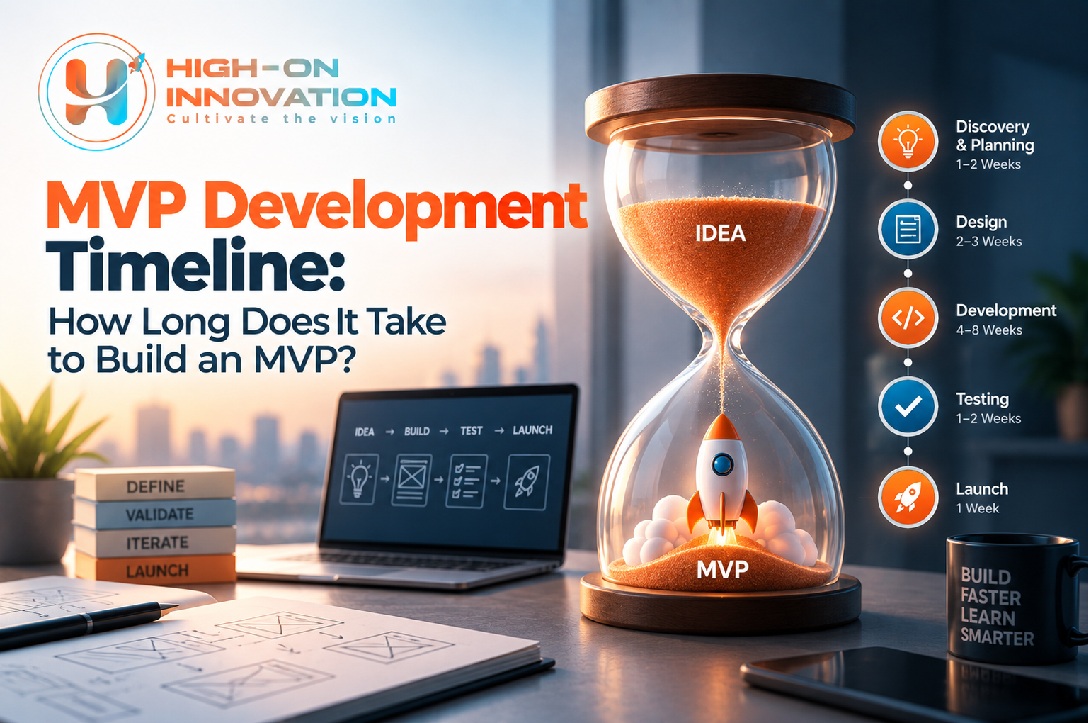
MVP Development Timeline: How Long Does It Take to Build an MVP?
For a startup, knowing how long MVP development takes is critical for planning investment, coordinating teams, preparing a launch strategy, and setting realistic expectations with stakeholders.
There is no universal MVP development timeline. A simple MVP with a limited number of features can be launched in a matter of weeks, while a complex SaaS platform, marketplace, fintech product, or AI-powered application may take several months.