Startup CRM Software Solution: A Complete Guide for Startups around the world are building products
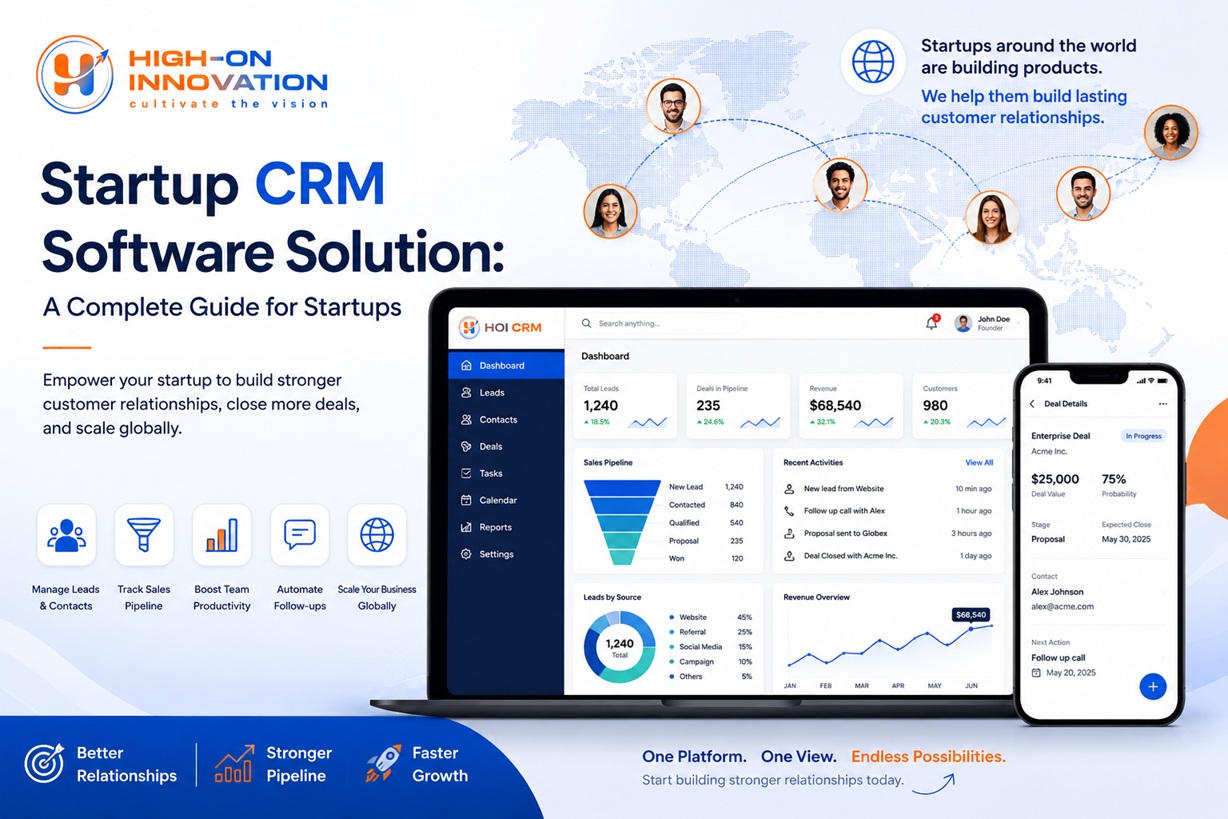
Startups around the world are building products, entering new markets, and scaling teams faster than ever. As a company grows, managing leads, customers, sales conversations, follow-ups, and business relationships through spreadsheets, email, and messaging apps becomes increasingly difficult.
This is where a startup CRM software solution can become an important part of a company's growth infrastructure.
Modern CRM software for startups helps founders and sales teams centralize customer information, automate repetitive activities, track sales pipelines, and make better decisions using real-time data.
What Is Startup CRM Software?
Startup CRM software is a customer relationship management platform designed to help early-stage and growing businesses manage sales and customer relationships efficiently.
Unlike complex enterprise CRM systems, a good CRM software for startups should be simple to implement, affordable, scalable, and easy for a small team to use.
It can help startups:
Capture and manage leads
Organize customer information
Track sales opportunities
Manage sales pipelines
Schedule follow-ups
Automate repetitive tasks
Monitor sales performance
Manage customer communication
Generate business reports
Depending on the target market, CRM platforms can also integrate with communication channels such as WhatsApp, email, telephony, website forms, social media, and other customer engagement tools.
Why Do Startups Need CRM Software?
Many startups initially manage customers using Google Sheets, Excel, email, messaging apps, and individual sales representatives' contact lists. This may work when the business has only a few prospects, but it becomes difficult to maintain as the customer base grows.
1. Centralize Customer Data
A startup CRM solution stores customer information in one centralized system.
Sales teams can access:
Customer details
Lead source
Previous conversations
Sales activity
Deal value
Follow-up history
Purchase information
Customer status
This reduces dependency on spreadsheets and individual employees' records.
2. Improve Lead Management
A CRM helps startups capture leads from websites, landing pages, marketing campaigns, social media, referrals, events, and other channels.
Leads can then be assigned to sales representatives based on predefined rules, territories, industries, lead scores, or team availability.
3. Never Miss a Follow-Up
Missed follow-ups can result in lost opportunities.
A CRM for startups can provide automated reminders and workflows for calls, meetings, emails, and follow-ups, helping sales teams maintain consistent communication across time zones and markets.
4. Build a Predictable Sales Pipeline
Instead of asking salespeople for manual updates, founders and managers can view the sales pipeline directly inside the CRM.
Typical stages include:
New Lead → Contacted → Qualified → Proposal → Negotiation → Won/Lost
This provides management with better visibility into potential revenue, sales velocity, conversion rates, and pipeline health.
Essential Features of CRM Software for Startups
When selecting or developing a CRM software solution for startups, businesses should focus on features that directly support growth.
Lead and Contact Management
The CRM should provide a centralized database for leads, prospects, customers, partners, and business contacts.
Sales Pipeline Management
Visual pipelines make it easier for sales teams to understand where each opportunity stands and what action is required next.
Workflow Automation
CRM automation can automatically:
Assign leads
Create follow-up tasks
Send notifications
Update lead status
Trigger emails
Move opportunities between stages
Notify managers about stalled deals
Create records from website submissions
Communication Integration
Customer communication may take place through email, phone calls, WhatsApp, SMS, video meetings, social media, or live chat. Integrating these channels into CRM workflows helps sales teams maintain conversation history and respond more efficiently.
Analytics and Reporting
Founders and sales managers should be able to monitor:
Lead volume
Conversion rate
Sales pipeline
Revenue
Sales representative performance
Lead sources
Customer acquisition trends
Sales cycle length
Customer retention
Forecast accuracy
Mobile CRM
A mobile-friendly CRM allows founders, remote teams, and field sales representatives to manage leads and customer information from anywhere.
CRM for Different Types of Startups
A CRM solution should reflect the startup's business model, sales process, customer journey, and growth objectives.
SaaS Startups
SaaS companies can use CRM software to manage demos, trials, subscriptions, sales opportunities, renewals, upgrades, and customer expansion.
Fintech Startups
Fintech businesses can use CRM systems to manage leads, customer onboarding, communication, service workflows, and account management while integrating appropriate security and compliance processes.
EdTech Startups
CRM automation can help manage student inquiries, counseling, admissions, follow-ups, enrollment, and parent communication.
D2C Startups
D2C businesses can use CRM platforms to manage customer interactions, repeat purchases, support requests, retention activities, and personalized marketing campaigns.
B2B Startups
A B2B startup CRM can help sales teams manage multiple decision-makers, proposals, meetings, negotiations, account relationships, and longer sales cycles.
Professional Services Startups
Consulting firms, agencies, legal practices, financial services companies, and other professional services businesses can use CRM software to manage inquiries, proposals, client relationships, projects, and renewals.
Custom CRM vs. Ready-Made CRM for Startups
Startups generally have two options: adopt an existing CRM platform or build a custom CRM software solution.
Ready-Made CRM
A ready-made CRM can be suitable when the startup has standard sales requirements and wants to deploy quickly.
It may offer:
Faster implementation
Predictable subscription pricing
Standard sales features
Prebuilt integrations
Regular product updates
Technical support
Custom CRM
A custom CRM for startups can be useful when the company's sales process is unique or when the business needs specific integrations, workflows, reporting, or automation.
Custom development can provide:
Custom sales pipelines
Industry-specific workflows
Custom dashboards
Website integration
Communication integrations
ERP integration
Payment integration
AI-powered automation
Custom user roles
Business-specific reporting
Multi-region and multi-currency support
Custom security and access controls
The right choice depends on the startup's business model, sales process, budget, growth plans, technical requirements, and integration needs.
How AI Can Improve Startup CRM Software
The next generation of CRM software for startups is increasingly moving beyond simple contact management.
AI can help startups with:
Lead scoring
Sales forecasting
Customer segmentation
Automated follow-ups
Conversation analysis
Lead prioritization
Recommended next actions
Customer churn prediction
Automated data entry
AI-generated sales summaries
Email and message drafting
Opportunity risk detection
Customer sentiment analysis
The objective should not be to add AI simply as a feature. AI should automate repetitive work, improve data quality, and help sales teams spend more time engaging with high-value prospects and customers.
How to Choose the Best CRM for a Startup
Before selecting a CRM, founders should evaluate:
Ease of use – Will the sales team actually use it every day?
Scalability – Can it support the company as the team, customer base, and markets grow?
Automation – Can repetitive sales and customer management activities be automated?
Integrations – Can it connect with existing business tools?
Mobile accessibility – Can teams use it remotely and across devices?
Reporting – Does it provide useful business insights?
Security – Is customer data appropriately protected?
Customization – Can the platform adapt to the company's processes?
International support – Can it support multiple regions, currencies, languages, and time zones if needed?
Total cost – What will the platform cost as users, data, and requirements increase?
The key principle is simple: the best CRM for a startup is not necessarily the CRM with the most features; it is the one that fits the startup's workflow and gets adopted by the team.
How High-On Innovation Helps Startups
High-On Innovation (HOI) helps startups design and develop technology solutions that support sales, customer management, automation, and business growth.
Our startup CRM software solutions can be customized around the way your business operates, whether you are launching in one market or scaling across multiple regions.
HOI can help startups build:
Custom CRM platforms
Lead management systems
Sales pipeline management
CRM automation
Customer databases
AI-powered lead management
Communication integrations
Custom dashboards
CRM and website integration
CRM and ERP integration
Mobile CRM applications
AI-powered sales automation
Multi-region CRM systems
Multi-currency sales and reporting workflows
Custom customer portals
Instead of forcing a startup to change its business process to fit generic software, a custom CRM can be designed around the startup's existing workflow and future growth requirements.
Conclusion
A CRM is more than a database of customer contacts. For a growing startup, it can become the central system for managing leads, sales activities, customer relationships, and revenue opportunities.
Whether you choose a ready-made platform or invest in a custom CRM software solution, the objective should be the same: create a simple, scalable, secure, and data-driven sales process.
High-On Innovation helps startups build custom CRM and business automation solutions that connect customer data, sales processes, communication channels, and intelligent automation in one scalable platform.
Harsit Gupta is the Founder of High-On Innovation and is responsible for shaping the company's vision, business model, growth strategy, and market expansion initiatives. He specializes in identifying emerging opportunities, driving innovation, and helping businesses navigate digital transformation in a rapidly evolving technology landscape. His expertise includes business strategy, digital innovation, startup growth, market positioning, and future-focused technology adoption.
Comments
Loading comments…
Latest Market Trends
Sep 9, 2026
MVP Development Cost for Australian Businesses in 2026
A simple customer portal, booking application, SaaS dashboard, marketplace, AI-powered platform, fintech product, healthcare application, or enterprise workflow system can all be described as an "MVP", but their development requirements can be dramatically different.

Sep 3, 2026
How to Choose an MVP Development Company for Your Startup
Choosing the right MVP development company can have a major impact on your startup's first product launch. The right development partner does more than write code. They help translate your business idea into a focused product, identify technical risks, prioritize features, and create an MVP that can be tested with real users.

Sep 8, 2026
MVP Development Cost for Canadian Businesses in 2026: Complete Guide to Pricing, Features and Process
Discover MVP development cost Canada in 2026, including startup MVP cost, development factors, timelines, features, technology, compliance, and how to choose the right MVP development company.
Popular Post
MVP Development Cost for Australian Businesses in 2026
A simple customer portal, booking application, SaaS dashboard, marketplace, AI-powered platform, fintech product, healthcare application, or enterprise workflow system can all be described as an "MVP", but their development requirements can be dramatically different.
How to Choose an MVP Development Company for Your Startup
Choosing the right MVP development company can have a major impact on your startup's first product launch. The right development partner does more than write code. They help translate your business idea into a focused product, identify technical risks, prioritize features, and create an MVP that can be tested with real users.
MVP Development Cost for Canadian Businesses in 2026: Complete Guide to Pricing, Features and Process
Discover MVP development cost Canada in 2026, including startup MVP cost, development factors, timelines, features, technology, compliance, and how to choose the right MVP development company.
MVP Development Cost for USA Startups in 2026
An MVP, or Minimum Viable Product, gives founders a way to turn an idea into a usable product, launch it with real users, collect feedback, and understand whether the market actually wants the solution.