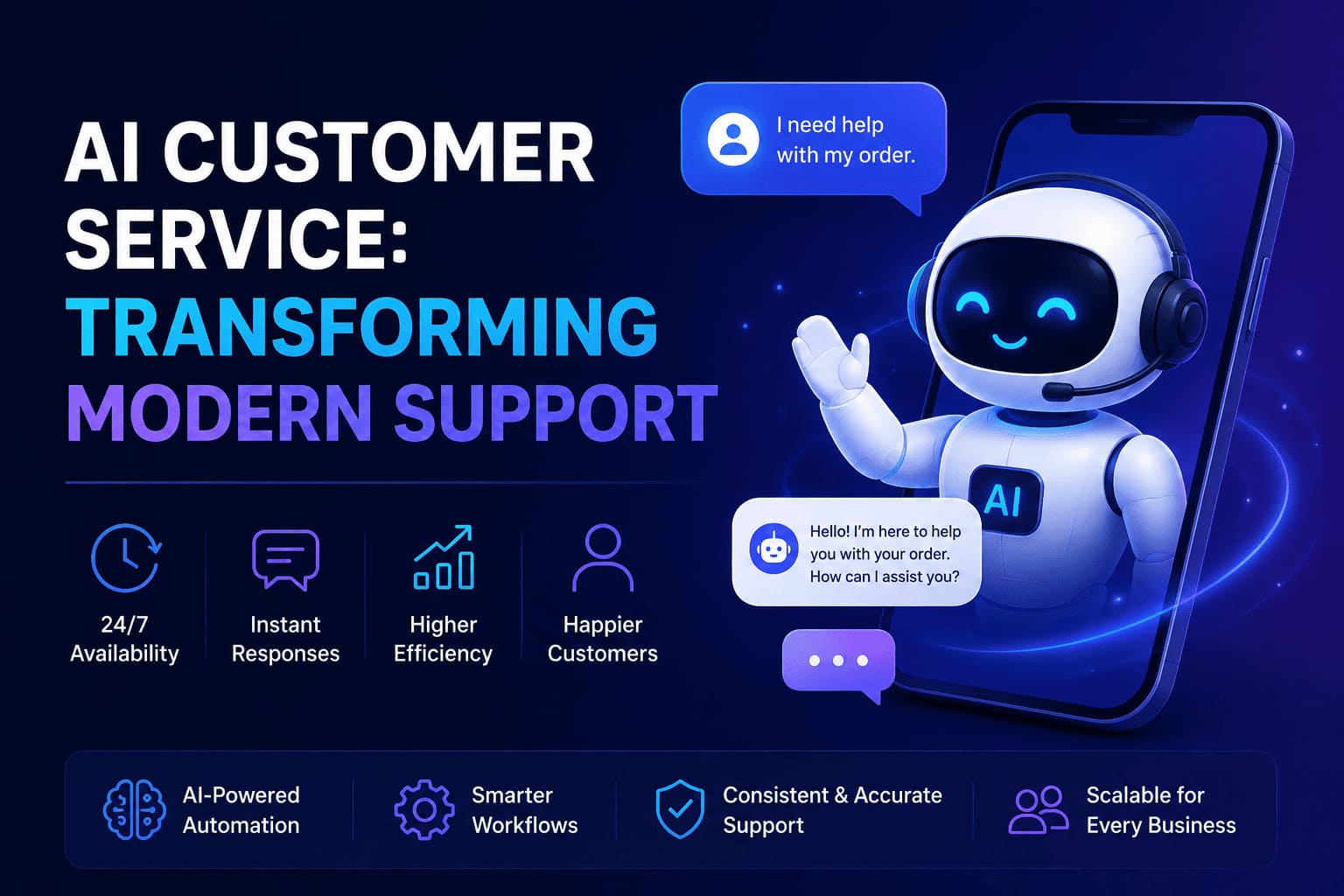
AI Customer Service: Transforming Modern Support
Introduction: The Support Problem That Kills Growth
You hired three more support agents. Response times barely improved. Customer complaints kept climbing. Sound familiar?
Scaling customer support the traditional way is one of the most expensive and least sustainable growth strategies a business can pursue. As your product gets traction, inbound volume grows exponentially, customer expectations become increasingly demanding, and your support team hits a ceiling. A ticket backlog is not a support problem; it is an operations problem, and it compounds.
Customers today expect responses in under five minutes. They want support across every channel: live chat, email, WhatsApp, social DMs, and phone. They expect agents to already know their history. One bad experience and 61% of customers will move to a competitor, according to Microsoft's Global State of Customer Service report.
This is where AI automation services change the operational equation entirely. AI customer service platforms are no longer an experimental investment reserved for enterprise budgets. They are the fastest-growing category in business technology, and the gap between companies deploying them and those that are not is widening every quarter.
This article breaks down everything founders, operations leaders, and growth-stage companies need to understand about AI customer service platforms, including how they work, why adoption is accelerating, which industries are seeing the highest ROI, and how to build a real implementation strategy around intelligent automation solutions.
What is an AI Customer Service Platform?
Definition: An AI customer service platform is a software system that uses artificial intelligence, natural language processing (NLP), and machine learning to automate, augment, and optimize customer-facing support operations across communication channels.
It is not a chatbot. That distinction matters.
Traditional chatbots follow decision trees. If a customer says something outside the predefined script, the chatbot breaks. An AI customer service platform is fundamentally different. It uses conversational AI to understand intent, not just keywords. It learns from interactions over time. It integrates into your CRM, ticketing system, and communication stack. It can take actions, not just generate responses.
Here is how the core components stack together:
Natural Language Processing (NLP): The engine that lets the system understand what a customer is actually asking, regardless of how they phrase it. NLP allows the platform to classify intent, extract entities (like order numbers or dates), and generate contextually accurate responses.
Conversational AI: This is the layer that manages multi-turn conversations, maintains context across a session, and responds in a human-like, coherent way. Modern conversational AI can manage complex queries that span multiple topics within a single interaction.
AI Agents vs. Chatbots: Chatbots respond. AI agents act. An AI agent can look up a customer's order, check inventory, initiate a refund, update a CRM record, send a follow-up email, and close a ticket without any human involvement. The functional difference is dramatic.
AI Workflow Automation: Behind the customer-facing interface is a pipeline of automated actions. When a customer submits a complaint, AI workflow automation can simultaneously log the ticket, assign a priority level, route it to the right team, pull the customer's purchase history, and trigger a follow-up sequence - all in under two seconds.
Omnichannel Support: A modern AI platform does not operate on one channel. It unifies conversations from live chat, email, SMS, WhatsApp, Instagram DMs, and voice into a single intelligent interface. Context carries across channels, so a customer who started a conversation on chat and moved to email does not have to repeat themselves.
Human + AI Hybrid Systems: The best implementations do not replace human agents. They make human agents dramatically more effective. AI handles the high-volume, repetitive queries (password resets, shipping status, FAQ responses) while routing complex, high-value, or emotionally sensitive cases to human agents with full context already populated.
For a SaaS founder managing a 500-user base, this means your two-person support team can handle the volume of twelve. For an enterprise operations director, it means a 40% reduction in cost per resolution while improving CSAT scores simultaneously.
Why Businesses Are Rapidly Adopting AI Customer Service
The numbers behind AI adoption in customer service are significant, and they reflect a structural shift rather than a trend.
The global AI in customer service market was valued at approximately $11.5 billion in 2023 and is projected to grow at a compound annual growth rate (CAGR) of 23.7% through 2030, according to Grand View Research. By 2025, Gartner projected that 80% of customer interactions would be managed without a human agent. That projection is already materializing faster than anticipated.
From an adoption standpoint, Salesforce's State of Service Report found that 83% of service decision-makers say AI will be transformative for customer service over the next two years. IBM data shows that companies deploying AI in customer support reduce handling time by up to 40% and support costs by 30% within the first year of full deployment.
McKinsey's research on AI in business operations found that automation of customer-facing workflows generates the fastest and most measurable ROI of any AI investment category. The payback period for a well-implemented AI customer service platform averages between three and nine months depending on support volume.
Key data points shaping the market right now:
69% of customers prefer chatbots for quick queries over waiting for a human agent (Salesforce, 2024)
Businesses using AI customer service see a 35% average reduction in first response time
Support cost per ticket drops from an average of $8.01 with human agents to $0.10 with full AI resolution (IBM Institute for Business Value)
AI-powered support teams show a 14% improvement in agent productivity, according to a Stanford and MIT joint study
Voice AI in customer service is projected to grow at 28% CAGR through 2028, driven by smart assistant adoption and IVR modernization
The strategic reality is this: the cost of not implementing AI business automation in your support operations is no longer just operational inefficiency. It is customer churn, declining NPS, and losing competitive ground to businesses that have already made the transition.
Looking at the trajectory, three trends define the near-term future of AI customer service:
AI-first support ecosystems: Within two years, leading SaaS and ecommerce brands will run support organizations where AI handles 80% or more of volume autonomously.
Predictive customer service: AI platforms will move from reactive (responding to issues) to predictive (identifying and resolving issues before the customer contacts support).
Voice AI growth: AI voice agents are replacing legacy IVR systems. Businesses are deploying voice AI that can handle inbound calls end-to-end without human escalation for a majority of use cases.
Core Features of Modern AI Customer Service Platforms
Understanding individual features in isolation is less useful than understanding how they work together to transform support operations. Here is a detailed breakdown of what a mature AI customer support system looks like in practice.
AI Chatbots
AI chatbots serve as the front-line of automated customer interaction. Unlike legacy rule-based chatbots, modern AI chatbots are trained on your product documentation, past conversation data, and knowledge base. They handle FAQs, process requests, guide users through troubleshooting, and collect information needed for escalation. For an ecommerce brand processing 3,000 inbound messages per day, an AI chatbot can deflect 65-75% of that volume without human involvement.
AI Voice Agents
Voice AI is maturing rapidly. AI voice agents can now handle inbound calls, conduct outbound follow-up calls, manage appointment reminders, and qualify leads over the phone. For industries like healthcare, real estate, and financial services, where the phone is still the primary support channel, deploying AI voice automation is one of the highest-leverage investments available.
Intelligent Ticket Routing
AI routing systems analyze the content, tone, language, and urgency of incoming support requests and automatically assign them to the right team or agent. A billing dispute gets routed to finance. A technical bug report routes to tier-two engineering support. A complaint from a high-value customer gets flagged and escalated immediately. Routing accuracy from AI systems typically exceeds 90%, versus 60-70% for manual triage.
CRM Integration
An AI platform without CRM integration is operating blind. When a customer contacts support, the AI should instantly pull their full history: purchase records, past tickets, subscription tier, renewal date, and communication preferences. CRM integration closes the loop between marketing, sales, and support, ensuring continuity of relationship data across every touchpoint.
Workflow Automation
This is where AI workflow automation creates compounding operational leverage. Every support interaction triggers a workflow: tag the ticket, log the interaction, update the CRM, send an acknowledgment, assign follow-up tasks, notify the account manager if the customer is enterprise tier. These workflows run in the background, invisibly, and they eliminate the administrative overhead that accounts for roughly 30% of agent time in manual support environments.
AI Knowledge Base
A self-updating knowledge base that AI can query in real time to generate accurate, contextually relevant answers. The knowledge base learns from resolutions, updates itself when product documentation changes, and surfaces the right content for each query. For support teams, this reduces answer-searching time by up to 60%.
Sentiment Analysis
Sentiment analysis identifies emotional tone in customer messages in real time. When a customer's language signals frustration, urgency, or distress, the system flags the conversation for immediate human escalation. This prevents churn-risk situations from falling through the cracks and ensures high-emotion interactions receive the human response they require.
Multilingual Support
AI platforms can deliver support in 50+ languages without additional staffing. For SaaS companies with global user bases or ecommerce brands expanding into new markets, multilingual AI support removes a significant operational barrier to international growth.
Omnichannel Communication
Customers move across channels without thinking about it. A unified AI platform tracks conversations across chat, email, SMS, WhatsApp, and social platforms, maintaining context throughout. This eliminates the frustrating experience of repeating information that drives one of the highest churn risk scenarios in customer support.
Predictive Customer Support
Advanced AI platforms identify customers who are likely to encounter issues based on behavioral signals before those customers ever reach out. For SaaS companies, this might mean proactively messaging a user who has not completed onboarding after five days. For ecommerce, it means flagging an order likely to be delayed before the customer discovers it themselves.
AI Analytics and Reporting
Real-time dashboards that surface ticket volume trends, resolution rates, sentiment scores, agent performance, and channel effectiveness. For operations leaders, AI analytics replace the manual reporting that typically consumes 4-6 hours per week and delivers insights in real time.
Lead Qualification Automation
AI can qualify inbound leads through support interactions without human sales involvement. A prospect who contacts support asking about enterprise pricing can be automatically scored, tagged, and routed to sales with full context. This bridges the gap between support and revenue generation.
AI Appointment Scheduling
AI scheduling agents integrate with calendars to handle appointment booking, rescheduling, and reminders autonomously. For service businesses, healthcare providers, and sales teams running demos, this removes an entire category of coordination overhead.
Customer Journey Automation
AI platforms can orchestrate the entire post-sale customer journey, from onboarding email sequences to in-app guidance triggers to renewal reminders, all driven by customer behavior data. This is AI driven business process automation operating at its highest level of sophistication.
How AI Workflow Automation Improves Customer Operations
The difference between an AI customer service tool and an intelligent automation solution is the automation pipeline behind the interface. Here is how this plays out across real business contexts.
The Automation Pipeline: Every customer action triggers a sequence. A new ecommerce order is placed, AI confirms the order, updates inventory, generates a shipping notification workflow, and sets a delivery follow-up trigger. If the delivery is delayed, AI identifies the affected orders at 2 AM, sends proactive notifications, and logs the resolution without anyone on the team touching it.
Ecommerce: Returns processing, order tracking, product availability queries, and promotional campaign support all run through automated workflows. A mid-size ecommerce brand processing 10,000 orders per month can handle 80% of support volume without human intervention, reducing support headcount costs by 50-60%.
SaaS Onboarding: When a new user signs up, AI triggers an onboarding workflow: welcome sequence, setup guide, check-in on day three if key product actions are not completed, escalation to a customer success manager if engagement drops. This workflow runs for every user without CSM involvement unless escalation triggers fire.
Healthcare Support: Patient appointment scheduling, insurance verification inquiries, prescription refill reminders, and post-visit follow-ups can all operate through automated workflows. AI voice agents handle inbound calls for common requests, dramatically reducing hold times and administrative burden on front desk staff.
Real Estate Lead Management: AI captures inbound leads from listing sites, qualifies them based on property interest and budget signals, books property viewings, and routes warm leads to agents with full context. Response time for inbound real estate leads goes from hours to under two minutes.
Agency Client Onboarding: When an agency wins a new client, AI triggers the onboarding workflow: contract delivery, kickoff scheduling, briefing document collection, and task assignment to internal teams. The administrative overhead of onboarding drops by 70%.
Appointment Booking Automation: For any service business, AI scheduling eliminates the back-and-forth of manual booking coordination. The system checks availability, sends calendar invites, confirms appointments, and handles rescheduling requests without staff involvement.
The cumulative impact of these workflows is operational scalability that is genuinely disconnected from headcount. A company can grow from 1,000 to 100,000 customers without proportional growth in support staff.
Industries Benefiting from AI Customer Service Platforms
SaaS
SaaS companies face a specific support challenge: high volume, technical complexity, and global user bases with 24/7 expectations. AI customer service platforms handle tier-one technical support, onboarding, in-app guidance, and renewal management. ROI is measurable in churn reduction: a 1% decrease in monthly churn in a SaaS business with $5M ARR is worth $600,000 in annual retained revenue.
Healthcare
Healthcare providers use AI platforms to manage appointment scheduling, patient communication, pre-visit instructions, insurance verification, and post-discharge follow-up. With strict regulatory constraints, AI implementations in healthcare focus on workflow automation rather than clinical decision support. The operational efficiency gains are significant: administrative costs, which account for 34% of US healthcare spending, have measurable reduction potential through AI automation.
E-commerce
E-commerce is one of the highest-density AI adoption sectors. Order tracking, returns, product questions, and promotional support represent the bulk of customer queries - all highly automatable. Leading ecommerce brands are achieving 70%+ AI resolution rates, cutting support costs in half while improving response times from hours to seconds.
Education
EdTech platforms and universities use AI to manage student inquiries, enrollment support, fee processing queries, and academic guidance at scale. During peak enrollment periods, AI platforms handle volume spikes that would require significant temporary staffing under manual models.
Real Estate
AI lead management and communication automation are transforming real estate operations. Inbound lead qualification, property matching, viewing scheduling, and buyer communication workflows reduce the time agents spend on administrative tasks, freeing capacity for high-value relationship activities.
Finance
Financial services firms deploy AI for account inquiry support, fraud alert communication, loan application status updates, and regulatory compliance-driven communication workflows. Given the sensitivity of financial data, deployments in this sector require enterprise-grade security architecture, which modern AI platforms are built to support.
Hospitality
Hotels and travel businesses use AI to handle booking inquiries, reservation modifications, local experience recommendations, and loyalty program support across chat, email, and voice channels. Guest satisfaction scores improve when response times drop from 30 minutes to under 60 seconds.
Agencies
Marketing and growth agencies use AI to automate client communication, project status updates, reporting delivery, and onboarding workflows. The operational leverage is particularly high for agencies that have traditionally been resource-constrained as they scale accounts.
Challenges Businesses Face Without AI Automation Services
The cost of maintaining manual support operations at scale is not just a budget line item. It is a structural disadvantage.
High Support Costs: The average cost to resolve a customer query with a human agent ranges from $6 to $12 depending on channel and complexity. At 50,000 monthly tickets, that is $300,000 to $600,000 per year in support operations alone. AI resolution costs a fraction of that.
Slow Response Times: Manual support operations average 12 hours or more for email response and 8 minutes for live chat, during business hours only. These numbers fall well short of customer expectations, and slow response is directly correlated with churn risk.
Human Error: Manual ticket handling, data entry, and routing introduce error rates of 5-10% in most operations. Misdirected tickets, missed follow-ups, and inconsistent responses damage customer experience and create legal and compliance exposure in regulated industries.
Scaling Issues: Human support operations scale linearly with volume. Each increment of customer growth requires proportional headcount growth. This model breaks down as customer bases expand and is unsustainable for growth-stage companies.
Agent Burnout: High-volume, repetitive support work is one of the most reliably burnout-inducing roles in any business. Turnover in customer support roles averages 30-45% annually, creating constant recruiting, onboarding, and training costs that compound on top of base salary expense.
Customer Churn: Customers who experience poor support interactions churn at significantly higher rates. For SaaS companies, support experience is one of the three most cited reasons for subscription cancellation. For ecommerce brands, a single unresolved support issue leads 33% of affected customers to never purchase again.
Lost Revenue Opportunities: Without lead qualification automation and proactive engagement workflows, high-intent inbound inquiries that come through support channels are frequently lost. Support teams are not built to identify and route sales opportunities.
Inconsistent Customer Experience: When eight agents handle the same query eight different ways, brand experience becomes unpredictable. AI delivers consistent, on-brand responses at every interaction, regardless of volume.
How HOI Helps Businesses Implement Intelligent Automation Solutions
Most companies know they need AI automation. Few have a clear implementation roadmap, and that gap is where most deployments fail or underperform.
HOI approaches intelligent automation consulting as an operational strategy engagement, not a technology sales exercise. The methodology is built around four phases.
Discovery and Workflow Audit: Before any platform is selected or any workflow is built, HOI maps existing support operations in detail. Where does volume concentrate? What percentage of tickets are repetitive? Where are the escalation breakpoints? Where does revenue leak through support gaps? This audit produces a clear picture of automation potential and prioritization logic.
Automation Roadmap: Based on the audit, HOI builds a sequenced automation roadmap that identifies quick wins (typically deployable within 30 days), medium-term workflow builds (90 days), and long-term AI business automation infrastructure (6-12 months). The roadmap is tied to business outcomes: cost per resolution, first-response time, CSAT, and ticket deflection rate.
Platform Selection and Integration: HOI is platform-agnostic, which means the recommendation is always based on what fits the business, not what carries the highest margin. Platform selection criteria include existing tech stack compatibility, support volume, channel mix, and budget. CRM automation integration is a core component of every implementation, ensuring support data flows into sales and marketing pipelines.
Deployment and Optimization: HOI handles the technical implementation of AI chatbot deployment, voice agent configuration, workflow automation builds, and CRM integration. Post-deployment, the optimization process uses real performance data to refine routing logic, expand knowledge base coverage, and improve resolution rates over the first 90 days.
For companies earlier in the automation journey, HOI offers AI automation consulting engagements that produce a clear-eyed assessment of where AI applies, what it will cost, and what the realistic ROI timeline looks like. For founders who have heard the pitch from six vendors and are not sure what to believe, that independent analysis is often the most valuable first step.
The operational improvements that well-implemented AI automation for business operations deliver are not speculative. They are measurable, documented, and achievable within a defined timeline when the implementation is built correctly from the start.
The Future of AI Customer Service Platforms
The AI customer service platforms available today are early-stage versions of what the category will look like in three years.
Autonomous AI Agents: Current AI platforms automate responses and workflows. The next generation will deploy fully autonomous AI agents capable of managing complex, multi-step customer issues end-to-end, including negotiation, policy exceptions, and cross-department coordination, without human involvement.
Hyper-Personalization: AI platforms will move beyond customer segment personalization to individual-level personalization. Every interaction will be tailored to the specific customer's history, communication style, product usage patterns, and predicted needs.
Emotion-Aware AI: Sentiment analysis is already deployed. Emotion-aware AI goes further, detecting frustration, confusion, excitement, or urgency in real time and dynamically adjusting response strategy, tone, and escalation logic accordingly.
Predictive Support Systems: AI will anticipate customer issues before they surface. For SaaS companies, this means identifying users at risk of churning due to support friction before they decide to leave. For ecommerce, it means resolving fulfillment issues before customers discover them.
AI Copilots for Support Teams: For complex queries that still require human judgment, AI copilots will provide agents with real-time suggested responses, relevant knowledge base content, sentiment guidance, and CRM context on a single interface. Agent efficiency will increase by 40-60% even without full automation.
Voice-First Customer Support: As voice AI matures, inbound call handling will shift almost entirely to AI voice agents. Human agents will handle only the cases that require empathy, judgment, or authority at a level current AI cannot match.
AI Operating Systems for Business: The most forward-looking framing is the AI-native business, where support, sales, marketing, and operations all run through a unified AI layer that orchestrates workflows, surfaces insights, and executes tasks across functions. Companies building this architecture now will have operational structures that competitors cannot replicate quickly.
By 2028, the AI customer service market is forecast to reach $47 billion, driven by autonomous agent deployment, voice AI adoption, and the expansion of AI into mid-market and SME segments that are only beginning to implement at scale.
Conclusion: The Competitive Moat Is Being Built Right Now
AI customer service is no longer a future state. It is a present reality, and the gap between companies operating AI-native support functions and those still scaling headcount manually is widening every month.
AI workflow automation in customer operations delivers compounding returns. Each workflow built reduces cost per resolution, speeds response time, and frees your team to focus on the work that actually requires human judgment. Over 12 to 24 months, the operational efficiency gap between AI-adopting businesses and their competitors becomes structurally difficult to close.
The businesses that will dominate their categories in three years are the ones building intelligent automation solutions into their operations now: not at the experimental stage, but at the infrastructure level. AI customer service is not a productivity tool. It is the operational foundation of the next generation of scalable business.
If you are evaluating AI automation for your support operations and want a realistic, implementation-focused assessment of what it would take to build this in your business, HOI can start with a workflow audit. No pitch. Just a clear map of where you are, where the automation opportunity is, and what it would realistically cost and return.
That is the starting point worth having.
FAQs
What is an AI customer service platform?
An AI customer service platform is a system that uses artificial intelligence, natural language processing, and automation to handle, route, and resolve customer support interactions across channels including chat, email, voice, and social messaging. Unlike traditional chatbots, AI customer service platforms understand intent, take actions within integrated systems, learn from past interactions, and can operate autonomously across complex, multi-step support workflows.
How much does AI customer support cost?
AI customer service platform costs vary by vendor, deployment complexity, and support volume. Entry-level platforms with chatbot and basic workflow automation start at $300 to $1,500 per month. Enterprise-grade platforms with voice AI, CRM integration, and custom workflows typically range from $2,000 to $15,000 per month. The more relevant financial metric is cost per resolution: AI-resolved tickets average $0.10 to $0.50, compared to $6 to $12 for human-agent resolution, which means ROI on AI investment at scale is typically achieved within 3 to 9 months.
Can AI replace customer service agents?
AI can fully replace human agents for high-volume, repetitive query categories, which typically account for 60-75% of support volume in most businesses. It cannot fully replace human agents for emotionally complex interactions, high-stakes escalations, or situations requiring empathy, judgment, or decision-making authority. The most effective model is a human-AI hybrid where AI handles volume and humans handle complexity, with AI augmenting human agent productivity through real-time suggestions and context surfacing.
What industries benefit most from AI automation in customer service?
E-commerce, SaaS, healthcare, real estate, financial services, education, and hospitality show the highest measurable ROI from AI customer service automation. E-commerce benefits from order management and returns automation. SaaS benefits from onboarding and tier-one technical support automation. Healthcare benefits from appointment scheduling and patient communication automation. The unifying factor across industries is high support volume with a significant proportion of repetitive, structurally similar queries.
How does AI workflow automation work in customer support?
AI workflow automation works by triggering predefined or AI-configured action sequences based on specific events or conditions. When a customer submits a support request, AI classifies the intent, routes the ticket to the correct team or agent, pulls relevant CRM and order data, sends an acknowledgment to the customer, logs all actions, and triggers follow-up sequences based on resolution status. These workflows execute in seconds without human initiation. More sophisticated implementations chain workflows across systems: a single inbound query can simultaneously update a CRM record, assign an internal task, notify a billing system, and initiate a customer communication sequence.
Comments
Loading comments…
Latest Market Trends

Sep 9, 2026
MVP Development Cost for Australian Businesses in 2026
A simple customer portal, booking application, SaaS dashboard, marketplace, AI-powered platform, fintech product, healthcare application, or enterprise workflow system can all be described as an "MVP", but their development requirements can be dramatically different.

Sep 3, 2026
How to Choose an MVP Development Company for Your Startup
Choosing the right MVP development company can have a major impact on your startup's first product launch. The right development partner does more than write code. They help translate your business idea into a focused product, identify technical risks, prioritize features, and create an MVP that can be tested with real users.

Sep 8, 2026
MVP Development Cost for Canadian Businesses in 2026: Complete Guide to Pricing, Features and Process
Discover MVP development cost Canada in 2026, including startup MVP cost, development factors, timelines, features, technology, compliance, and how to choose the right MVP development company.
Popular Post
MVP Development Cost for Australian Businesses in 2026
A simple customer portal, booking application, SaaS dashboard, marketplace, AI-powered platform, fintech product, healthcare application, or enterprise workflow system can all be described as an "MVP", but their development requirements can be dramatically different.
How to Choose an MVP Development Company for Your Startup
Choosing the right MVP development company can have a major impact on your startup's first product launch. The right development partner does more than write code. They help translate your business idea into a focused product, identify technical risks, prioritize features, and create an MVP that can be tested with real users.
MVP Development Cost for Canadian Businesses in 2026: Complete Guide to Pricing, Features and Process
Discover MVP development cost Canada in 2026, including startup MVP cost, development factors, timelines, features, technology, compliance, and how to choose the right MVP development company.
MVP Development Cost for USA Startups in 2026
An MVP, or Minimum Viable Product, gives founders a way to turn an idea into a usable product, launch it with real users, collect feedback, and understand whether the market actually wants the solution.