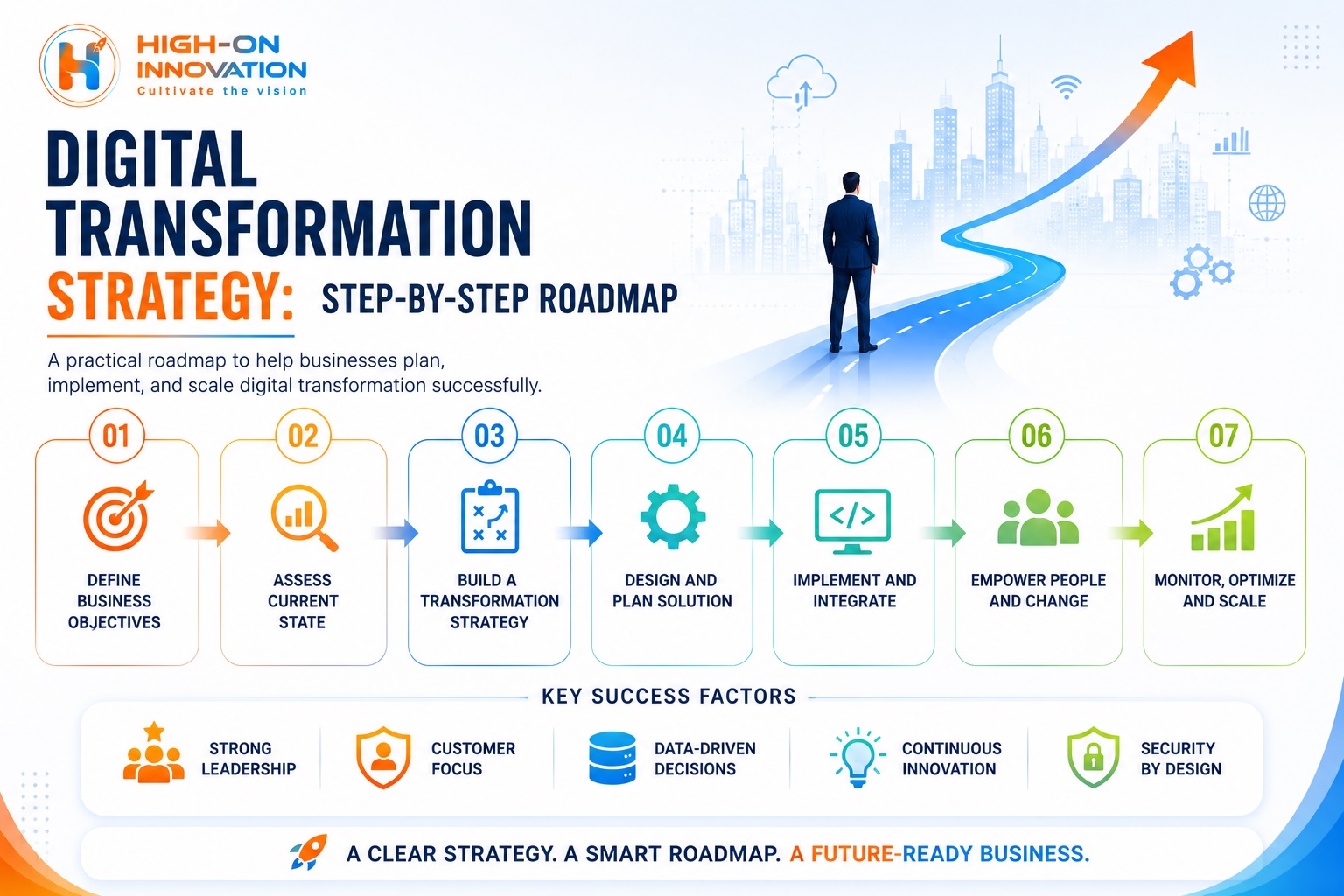
Digital Transformation Strategy: Step-by-Step Roadmap
Key Takeaways
A digital transformation strategy aligns technology initiatives with business goals.
Successful transformation requires planning, prioritization, and employee adoption.
Cloud computing, AI, analytics, and automation are core transformation technologies.
Customer experience should remain central to transformation efforts.
Continuous optimization and performance monitoring are essential for long-term success.
Businesses with structured transformation roadmaps adapt faster to market changes.
Introduction
Digital transformation has become one of the most important business priorities for organizations looking to remain competitive, scalable, and future-ready. Companies across industries are investing in technologies like artificial intelligence, cloud computing, automation, analytics, and intelligent business systems to improve efficiency and customer experiences.
However, successful digital transformation is not simply about adopting new technologies.
Many businesses fail because they implement digital tools without a clear strategy, defined objectives, employee alignment, or long-term transformation planning.
A successful digital transformation strategy requires a structured roadmap that aligns technology initiatives with business goals, operational improvements, customer needs, and future scalability.
This guide explains how businesses can create a practical and effective digital transformation roadmap step by step.
What Is a Digital Transformation Strategy?
A digital transformation strategy is a structured plan that helps businesses integrate digital technologies into operations, customer experiences, workflows, and decision-making systems.
The strategy defines:
Business goals
Technology adoption plans
Operational improvements
Customer experience initiatives
Data and analytics implementation
Employee enablement
Transformation timelines
A strong digital transformation strategy ensures that technology investments create measurable business value instead of becoming isolated IT projects.
Why Businesses Need a Digital Transformation Strategy
Without a proper roadmap, digital transformation projects often face:
Budget overruns
Poor adoption
Technology inefficiencies
Employee resistance
Security risks
Failed implementation
A clear strategy helps businesses:
Align digital initiatives with business objectives
Prioritize investments effectively
Improve operational efficiency
Reduce transformation risks
Accelerate innovation
Improve customer experiences
Measure ROI more accurately
Digital transformation should be treated as a business growth strategy, not just a technology upgrade.
Step-by-Step Digital Transformation Roadmap
Step 1: Define Business Goals and Vision
Every successful transformation begins with clear business objectives.
Before adopting technologies, organizations should identify:
Current operational challenges
Customer experience gaps
Growth limitations
Productivity bottlenecks
Competitive disadvantages
Key Questions to Ask
What problems are we trying to solve?
What outcomes do we want to achieve?
How will digital transformation improve our business?
What customer expectations must we address?
Common Business Goals
Improve operational efficiency
Increase scalability
Reduce costs
Improve customer engagement
Accelerate innovation
Enhance remote collaboration
Defining measurable goals creates a strong foundation for the transformation process.
Step 2: Assess Existing Infrastructure and Processes
Businesses must evaluate their current systems, workflows, and digital maturity before implementing new technologies.
This assessment should include:
Existing software systems
IT infrastructure
Data management processes
Customer experience workflows
Employee productivity systems
Security protocols
Why This Step Matters
Many businesses operate on outdated legacy systems that limit flexibility, integration, and scalability.
A detailed assessment helps identify:
Technology gaps
Operational inefficiencies
Security vulnerabilities
Integration challenges
This ensures smarter transformation planning and technology selection.
Step 3: Understand Customer Expectations
Modern digital transformation strategies should be customer-focused.
Today’s customers expect:
Faster services
Personalized experiences
Omnichannel communication
Mobile accessibility
Real-time support
Businesses should analyze:
Customer feedback
User behavior
Digital interaction patterns
Customer pain points
Customer-Centric Transformation Examples
AI chatbots for instant support
Personalized recommendations
Mobile-first platforms
Self-service customer portals
Improving customer experience often becomes one of the biggest drivers of digital transformation success.
Step 4: Build a Technology Roadmap
After identifying business goals and operational challenges, organizations should define which technologies support their transformation objectives.
Core Technologies Often Include
Cloud Computing
Supports scalability, remote access, and infrastructure flexibility.
Artificial Intelligence (AI)
Enables automation, predictive analytics, and intelligent decision-making.
Automation Tools
Reduce repetitive manual tasks and improve operational efficiency.
Data Analytics Platforms
Provide business intelligence and real-time performance insights.
Cybersecurity Solutions
Protect digital infrastructure and customer data.
Important Consideration
Technology adoption should align with business priorities rather than following trends blindly.
Step 5: Prioritize High-Impact Areas
Digital transformation can become overwhelming if businesses try to modernize everything at once.
Organizations should prioritize areas that generate the highest impact.
Common High-Impact Areas
Customer support automation
Sales and CRM systems
Cloud migration
Employee collaboration tools
Analytics and reporting
Ecommerce systems
Benefits of Prioritization
Faster implementation
Reduced risk
Better ROI
Easier adoption
More measurable outcomes
Starting with manageable projects helps build momentum and organizational confidence.
Step 6: Create a Change Management Strategy
One of the biggest digital transformation challenges is employee resistance.
People often resist change due to:
Fear of automation
Lack of technical knowledge
Uncertainty about new systems
Businesses must focus on change management by:
Communicating transformation goals clearly
Involving employees early
Providing training programs
Encouraging collaboration
Building a digital-first culture
Why Employee Adoption Matters
Technology alone cannot drive transformation success. Employees must understand and
Step 7: Implement Cloud and Scalable Infrastructure
Modern digital transformation requires scalable infrastructure that supports growth, flexibility, and remote accessibility.
Cloud transformation helps businesses:
Scale operations efficiently
Reduce infrastructure complexity
Improve collaboration
Support AI and analytics systems
Enable remote work environments
Cloud-native infrastructure creates a strong foundation for future innovation.
Step 8: Use Data and Analytics for Decision-Making
Data-driven decision-making is a core part of successful digital transformation.
Businesses should implement analytics systems that track:
Customer behavior
Operational performance
Marketing effectiveness
Financial metrics
Productivity KPIs
Benefits of Analytics
Smarter strategic decisions
Real-time insights
Better forecasting
Faster problem-solving
Improved business optimization
Organizations using analytics effectively become more agile and competitive.
Step 9: Strengthen Cybersecurity and Compliance
As businesses become more digital, cybersecurity risks increase significantly.
A digital transformation roadmap should include:
Data protection policies
Access control systems
Threat monitoring
Security audits
Compliance management
Why Cybersecurity Matters
Businesses handle sensitive:
Customer data
Financial information
Internal operations
Intellectual property
Strong cybersecurity builds trust and reduces operational risks.
Step 10: Monitor, Optimize, and Scale
Digital transformation is not a one-time project. It is an ongoing business evolution process.
Organizations should continuously:
Measure KPIs
Monitor performance
Optimize workflows
Improve user experiences
Upgrade technologies
Adapt strategies
Important KPIs to Track
Operational efficiency
Customer satisfaction
Revenue growth
Automation performance
Employee productivity
ROI metrics
Continuous optimization ensures long-term transformation success.
Common Digital Transformation Challenges
Legacy System Limitations
Older systems often create integration and scalability issues.
Budget Constraints
Large-scale transformation projects require careful financial planning.
Employee Resistance
Teams may hesitate to adopt new technologies and workflows.
Skill Gaps
Organizations may require digital expertise and employee training.
Cybersecurity Risks
Digital systems increase exposure to cyber threats.
Businesses should address these challenges proactively through proper planning and leadership alignment.
Best Practices for Successful Digital Transformation
Focus on Business Goals
Technology should solve business problems and improve outcomes.
Start Small and Scale Gradually
Pilot projects reduce risks and improve adoption.
Build a Digital Culture
Encourage innovation, collaboration, and continuous learning.
Prioritize Customer Experience
Customer-centric transformation creates stronger business growth.
Invest in Employee Training
Digital skills are essential for successful transformation adoption.
Partner With Digital Experts
Experienced transformation partners help businesses avoid costly mistakes.
Industries Successfully Using Digital Transformation Strategies
Healthcare
Hospitals use AI, telemedicine, and digital records to improve patient care.
Finance
Banks implement mobile banking, AI fraud detection, and automated financial systems.
Retail
Retailers use analytics, automation, and personalized ecommerce experiences.
Manufacturing
Manufacturers adopt IoT monitoring, predictive maintenance, and smart automation.
Education
Educational institutions implement virtual learning and digital collaboration platforms.
The Future of Digital Transformation Strategies
Future digital transformation strategies will increasingly focus on:
AI-powered automation
Generative AI
Intelligent business ecosystems
Hyper-personalized customer experiences
Advanced analytics
Cloud-native operations
Businesses that continuously evolve digitally will be better positioned for long-term innovation and competitive growth.
Conclusion
A successful digital transformation strategy requires more than technology adoption. It demands a clear roadmap, strong leadership, customer-focused thinking, employee alignment, and continuous optimization.
From AI and cloud computing to analytics and automation, digital transformation helps businesses become more agile, scalable, efficient, and future-ready.
Organizations that approach digital transformation strategically can improve operational performance, accelerate innovation, and create sustainable long-term business growth.
Digital transformation is not simply about modernizing systems. It is about transforming how businesses operate and deliver value in a digital-first world.
Frequently Asked Questions
What is a digital transformation strategy?
A digital transformation strategy is a roadmap that helps businesses adopt digital technologies to improve operations, customer experiences, and business performance.
Why is digital transformation important?
Digital transformation helps businesses improve efficiency, scalability, innovation, and customer engagement while remaining competitive.
What technologies are used in digital transformation?
Common technologies include AI, cloud computing, automation, analytics, cybersecurity, and IoT systems.
How long does digital transformation take?
The timeline depends on business size, infrastructure complexity, and transformation goals. Digital transformation is usually an ongoing process.
Author Bio
Harsit Gupta – Founder, High-On Innovation
Harsit Gupta is the Founder of High-On Innovation and is responsible for shaping the company's vision, business model, growth strategy, and market expansion initiatives. He specializes in digital transformation strategy, AI-driven business solutions, cloud modernization, and intelligent automation systems. His expertise includes business strategy, digital innovation, startup growth, market positioning, and future-focused technology adoption.
Comments
Loading comments…
Latest Market Trends

Sep 9, 2026
MVP Development Cost for Australian Businesses in 2026
A simple customer portal, booking application, SaaS dashboard, marketplace, AI-powered platform, fintech product, healthcare application, or enterprise workflow system can all be described as an "MVP", but their development requirements can be dramatically different.

Sep 3, 2026
How to Choose an MVP Development Company for Your Startup
Choosing the right MVP development company can have a major impact on your startup's first product launch. The right development partner does more than write code. They help translate your business idea into a focused product, identify technical risks, prioritize features, and create an MVP that can be tested with real users.

Sep 8, 2026
MVP Development Cost for Canadian Businesses in 2026: Complete Guide to Pricing, Features and Process
Discover MVP development cost Canada in 2026, including startup MVP cost, development factors, timelines, features, technology, compliance, and how to choose the right MVP development company.
Popular Post
MVP Development Cost for Australian Businesses in 2026
A simple customer portal, booking application, SaaS dashboard, marketplace, AI-powered platform, fintech product, healthcare application, or enterprise workflow system can all be described as an "MVP", but their development requirements can be dramatically different.
How to Choose an MVP Development Company for Your Startup
Choosing the right MVP development company can have a major impact on your startup's first product launch. The right development partner does more than write code. They help translate your business idea into a focused product, identify technical risks, prioritize features, and create an MVP that can be tested with real users.
MVP Development Cost for Canadian Businesses in 2026: Complete Guide to Pricing, Features and Process
Discover MVP development cost Canada in 2026, including startup MVP cost, development factors, timelines, features, technology, compliance, and how to choose the right MVP development company.

MVP Development Cost for USA Startups in 2026
An MVP, or Minimum Viable Product, gives founders a way to turn an idea into a usable product, launch it with real users, collect feedback, and understand whether the market actually wants the solution.