Smart Factory Solutions for Automotive Manufacturers: Building the Future of Intelligent Manufacturing
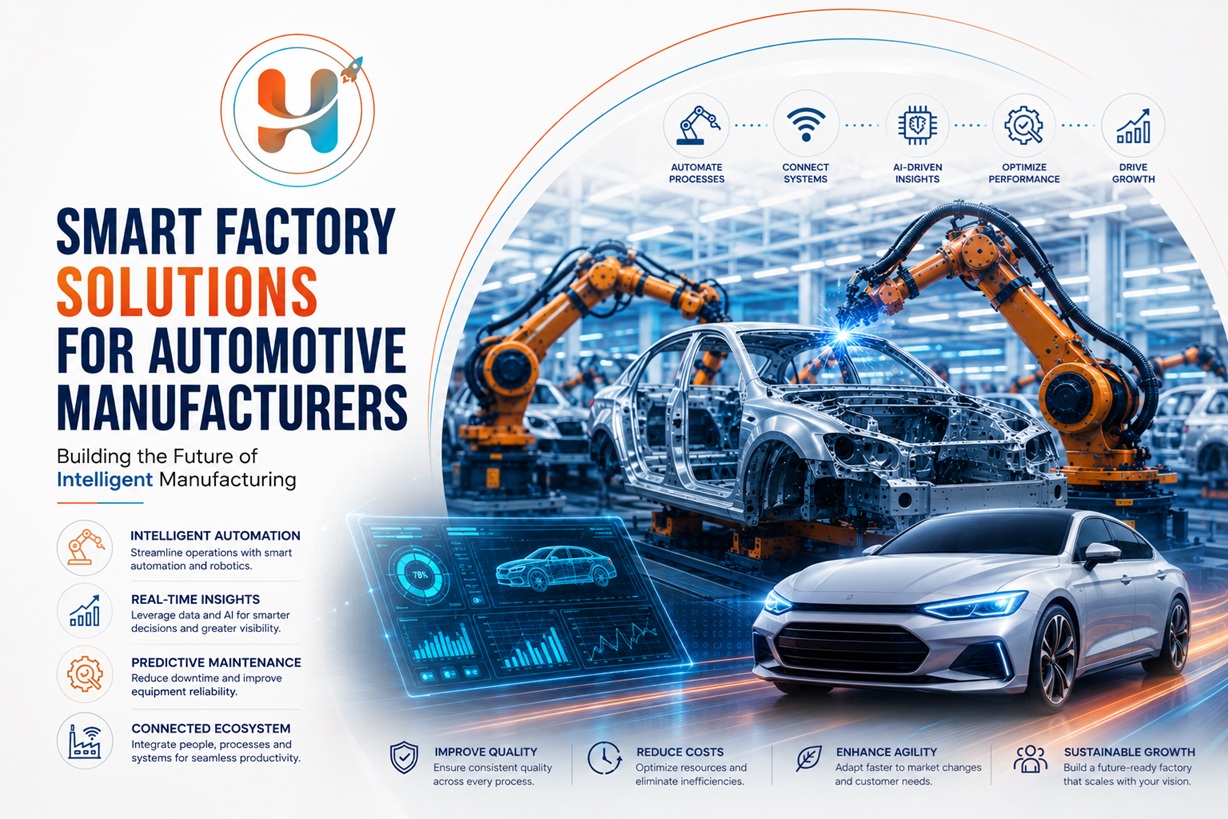
The automotive industry is under increasing pressure to produce high-quality vehicles faster, reduce operational costs, improve sustainability, and adapt to rapidly changing customer demands. Traditional manufacturing methods, while effective for mass production, often struggle to provide the flexibility and real-time visibility required in today's competitive landscape.
This is where smart factory solutions are transforming automotive manufacturing.
A smart factory leverages technologies such as Artificial Intelligence (AI), Industrial Internet of Things (IIoT), robotics, cloud computing, edge computing, digital twins, and advanced analytics to create an intelligent production environment where machines, systems, and people communicate seamlessly. These technologies enable manufacturers to monitor operations in real time, automate repetitive tasks, optimize production, and make data-driven decisions that improve efficiency and product quality.
Whether manufacturing internal combustion engine (ICE) vehicles, electric vehicles (EVs), or autonomous mobility platforms, automotive companies are investing in smart factories to enhance productivity and future-proof their operations.
In this article, we'll explore what a smart factory is, its core technologies, business benefits, implementation challenges, and best practices for automotive manufacturers.
What Is a Smart Factory?
A smart factory is a digitally connected manufacturing environment where machines, production systems, and enterprise applications exchange real-time data to automate processes, optimize operations, and support intelligent decision-making.
Unlike traditional factories, where production systems often operate independently, smart factories integrate operational technology (OT) with information technology (IT) to create a unified ecosystem.
Key Characteristics of a Smart Factory
Connected Production Systems
Machines, robots, sensors, and production lines continuously communicate using Industrial IoT technologies, enabling real-time monitoring and operational visibility.
Data-Driven Decision Making
Instead of relying on historical reports, manufacturers use live production data to optimize scheduling, quality, maintenance, and resource utilization.
Intelligent Automation
AI-powered systems automate repetitive tasks while helping engineers and operators make faster, more informed decisions.
Continuous Optimization
Production processes are continuously analyzed and refined based on operational data, enabling ongoing improvements in efficiency and quality.
Related Reading: The Complete Guide to Digital Transformation in the Automotive Industry (Pillar Blog)
Core Technologies Powering Smart Factories
A smart factory combines multiple Industry 4.0 technologies to create a connected and intelligent manufacturing ecosystem.
Artificial Intelligence (AI)
AI enables manufacturers to analyze production data, detect anomalies, optimize scheduling, and improve quality inspection.
Common AI Applications
Predictive maintenance
Defect detection
Production planning
Demand forecasting
Energy optimization
Related Blog: How AI Is Transforming the Automotive Industry
Industrial Internet of Things (IIoT)
IIoT connects equipment, sensors, and enterprise systems to provide real-time operational visibility.
IIoT Enables
Equipment monitoring
Asset tracking
Production analytics
Energy management
Machine health monitoring
Related Blog: Industrial IoT Applications in Automotive Manufacturing
Robotics and Automation
Industrial robots and collaborative robots (cobots) perform repetitive, hazardous, and precision-intensive tasks with high accuracy.
Typical Applications
Welding
Painting
Material handling
Assembly
Packaging
Inspection
Automation improves consistency while reducing manual effort and production variability.
Digital Twins
Digital twins create virtual representations of production assets, allowing engineers to simulate manufacturing scenarios before implementing physical changes.
Applications include:
Factory layout optimization
Process simulation
Capacity planning
Predictive maintenance
Equipment performance analysis
Related Blog: Digital Twins in Automotive Product Development and Manufacturing
Cloud and Edge Computing
Cloud platforms centralize manufacturing data across facilities, while edge computing processes time-sensitive information directly at production equipment.
Together they support:
Real-time analytics
AI model deployment
Remote monitoring
Enterprise collaboration
Scalable manufacturing intelligence
Benefits of Smart Factory Solutions
Smart factories improve nearly every aspect of automotive manufacturing.
Increased Production Efficiency
Connected production systems automatically identify bottlenecks, optimize workflows, and improve equipment utilization.
Benefits include:
Higher throughput
Shorter production cycles
Better resource allocation
Reduced idle time
Improved Product Quality
AI-powered inspection systems continuously monitor production quality and detect defects before products move further along the assembly line.
This leads to:
Higher first-pass yield
Lower scrap rates
Reduced rework
Improved customer satisfaction
Reduced Downtime
Smart factories use predictive maintenance to identify equipment issues before failures occur.
Maintenance teams receive alerts based on real-time machine health, reducing unexpected production interruptions.
Greater Manufacturing Flexibility
Modern automotive plants often produce multiple vehicle models on the same production line.
Smart factories make it easier to:
Adjust production schedules
Introduce new vehicle variants
Support EV manufacturing
Respond to changing market demand
Enhanced Sustainability
Smart factories continuously monitor energy consumption, water usage, and material waste.
Manufacturers can:
Reduce carbon emissions
Improve energy efficiency
Optimize resource utilization
Support sustainability goals
Smart Factory Applications in Automotive Manufacturing
Automotive manufacturers use smart factory technologies across multiple production processes.
Intelligent Assembly Lines
Connected assembly systems monitor cycle times, machine utilization, and workstation performance in real time.
Production managers gain visibility into bottlenecks and can optimize workflows without disrupting operations.
Automated Quality Inspection
Computer vision systems inspect:
Weld quality
Paint finishes
Component alignment
Battery modules
Surface defects
AI improves inspection accuracy while reducing manual effort.
Connected Logistics
IIoT-enabled logistics systems provide real-time visibility into:
Inventory levels
Material movement
Warehouse operations
Supplier deliveries
This improves supply chain efficiency and reduces production delays.
Energy Management
Smart factories optimize energy usage by monitoring equipment consumption and identifying inefficiencies.
This helps manufacturers lower operating costs while supporting environmental initiatives.
Business Impact of Smart Factories
Traditional Factory
Smart Factory
Manual monitoring
Real-time operational visibility
Scheduled maintenance
Predictive maintenance
Manual quality inspection
AI-powered inspection
Isolated production systems
Connected manufacturing ecosystem
Static scheduling
Dynamic production optimization
Limited analytics
Data-driven decision-making
Challenges of Smart Factory Implementation
Although smart factories offer significant advantages, organizations must address several implementation challenges.
Legacy Equipment Integration
Many manufacturing facilities still rely on older machines with limited connectivity.
Retrofitting equipment using IIoT sensors and edge gateways allows manufacturers to modernize without replacing entire production lines.
Data Integration
A smart factory depends on seamless communication between MES, ERP, PLM, quality management systems, and production equipment.
Building an integrated data architecture is essential for effective decision-making.
Cybersecurity
Connected production systems require strong cybersecurity practices.
Manufacturers should implement:
Zero Trust Architecture
Multi-factor authentication
Secure network segmentation
Continuous monitoring
Industrial cybersecurity standards
Workforce Development
Employees need training in:
Data analytics
Robotics
AI-assisted operations
Industrial IoT
Smart manufacturing platforms
Upskilling ensures successful adoption of new technologies.
Best Practices for Building a Smart Factory
To maximize business value, automotive manufacturers should follow a structured implementation strategy.
Start with High-Impact Use Cases
Focus on initiatives such as predictive maintenance, quality inspection, or production monitoring that deliver measurable improvements quickly.
Build an Integrated Digital Ecosystem
Connect:
Manufacturing Execution Systems (MES)
Enterprise Resource Planning (ERP)
Product Lifecycle Management (PLM)
Industrial IoT platforms
AI analytics solutions
A unified ecosystem improves visibility and operational efficiency.
Measure Performance
Track KPIs such as:
Overall Equipment Effectiveness (OEE)
Downtime
First-pass yield
Production throughput
Energy consumption
Asset utilization
Continuous monitoring supports ongoing optimization.
Future Trends in Smart Automotive Manufacturing
Smart factories continue to evolve alongside emerging technologies.
Key trends include:
AI-powered autonomous factories
Generative AI for production planning
Digital thread integration
5G-enabled manufacturing
Edge AI for real-time decision-making
Sustainable intelligent factories
Human-robot collaboration using advanced cobots
These innovations will enable automotive manufacturers to become more agile, resilient, and efficient.
Key Takeaways
Smart factories integrate AI, IIoT, robotics, cloud computing, and digital twins to create intelligent manufacturing environments.
Automotive manufacturers benefit from improved productivity, quality, flexibility, and sustainability.
Predictive maintenance and AI-powered inspection reduce downtime and improve operational efficiency.
Successful implementation requires integrated data systems, cybersecurity, and workforce development.
Smart factories form the operational foundation of Industry 4.0 and future automotive manufacturing.
Frequently Asked Questions
What is a smart factory?
A smart factory is a digitally connected manufacturing environment that uses AI, IIoT, robotics, cloud computing, and real-time analytics to optimize production and automate decision-making.
How do smart factories improve automotive manufacturing?
They improve efficiency, product quality, predictive maintenance, operational visibility, energy management, and production flexibility.
Which technologies power a smart factory?
Core technologies include Artificial Intelligence, Industrial IoT, robotics, digital twins, cloud computing, edge computing, computer vision, and advanced analytics.
Are smart factories only suitable for large manufacturers?
No. Manufacturers of all sizes can begin with focused digital initiatives and gradually expand their smart factory capabilities based on business priorities.
How do smart factories support electric vehicle manufacturing?
They enable flexible production, advanced quality inspection, battery manufacturing optimization, predictive maintenance, and real-time production monitoring required for EV manufacturing.
Conclusion
Smart factory solutions are reshaping automotive manufacturing by transforming traditional production facilities into intelligent, connected ecosystems. Through the integration of AI, IIoT, robotics, digital twins, and cloud technologies, manufacturers gain the visibility and agility needed to improve quality, reduce downtime, optimize resources, and respond quickly to changing market demands.
As vehicle technology becomes increasingly software-driven and customer expectations continue to evolve, smart factories will play a central role in enabling efficient, sustainable, and future-ready manufacturing operations. Organizations that invest in these capabilities today will be better positioned to lead the next generation of automotive innovation.
How High On Innovation Can Help
High On Innovation partners with automotive manufacturers to design and implement scalable smart factory solutions that improve operational efficiency, production quality, and digital maturity. Our expertise spans AI, Industrial IoT, predictive maintenance, digital twins, cloud engineering, robotics, and manufacturing analytics, helping organizations accelerate their Industry 4.0 transformation.
Bhuwan Vohra is the Co-Founder of High-On Innovation and oversees technology operations, administrative management, infrastructure planning, and resource optimization. He plays a key role in building scalable technology frameworks and ensuring efficient delivery of digital solutions across projects. His expertise includes cloud infrastructure, technology management, system architecture, operational efficiency, resource planning, and enterprise technology implementation.
Comments
Loading comments…
Latest Market Trends
Sep 4, 2026
MVP Development for Early-Stage Startups: From Product Idea to Market Validation
Learn how MVP development for early-stage startups works, what to include in an MVP, development costs, technology, testing, launch, and how to validate your startup idea.
Sep 3, 2026
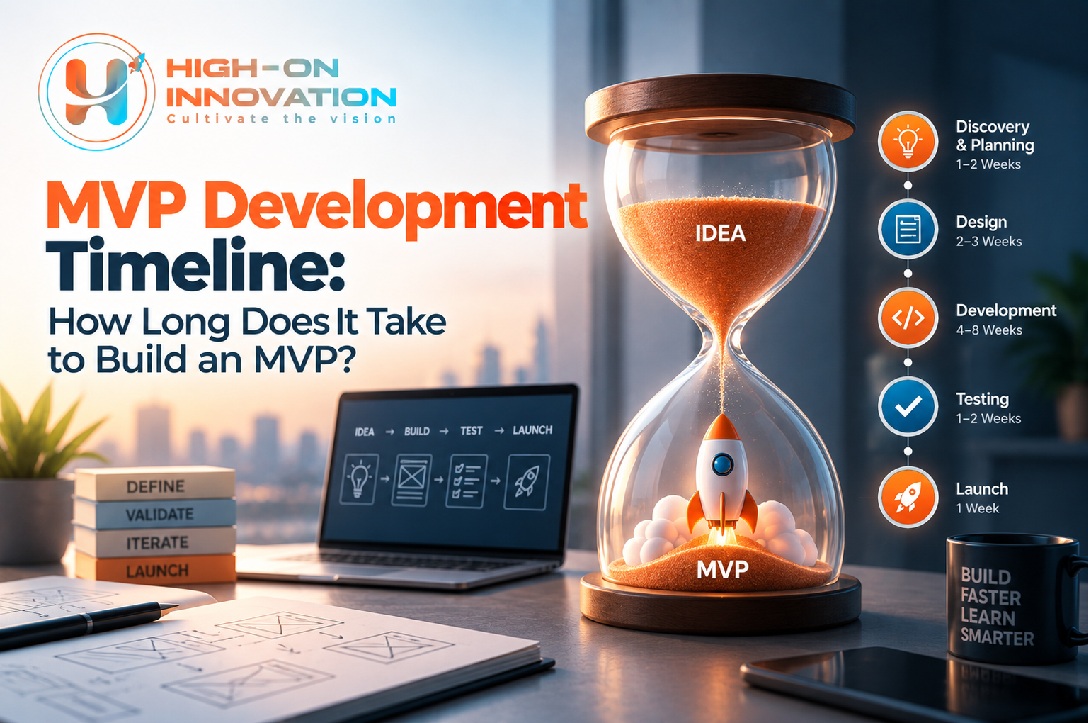
MVP Development Timeline: How Long Does It Take to Build an MVP?
For a startup, knowing how long MVP development takes is critical for planning investment, coordinating teams, preparing a launch strategy, and setting realistic expectations with stakeholders.
There is no universal MVP development timeline. A simple MVP with a limited number of features can be launched in a matter of weeks, while a complex SaaS platform, marketplace, fintech product, or AI-powered application may take several months.
Sep 3, 2026
MVP Development Process: From Startup Idea to Product Launch
A great startup idea is only the beginning. Turning that idea into a functional product requires a structured MVP development process that validates assumptions, prioritizes essential features, controls development costs, and gets the product in front of real users quickly.
A Minimum Viable Product (MVP) is not simply a smaller version of a finished product. It is a focused product built around the core problem your startup wants to solve. The goal is to launch with enough functionality to attract early users, collect feedback, and determine whether the product has genuine market potential.
Popular Post
MVP Development for Early-Stage Startups: From Product Idea to Market Validation
Learn how MVP development for early-stage startups works, what to include in an MVP, development costs, technology, testing, launch, and how to validate your startup idea.
MVP Development Timeline: How Long Does It Take to Build an MVP?
For a startup, knowing how long MVP development takes is critical for planning investment, coordinating teams, preparing a launch strategy, and setting realistic expectations with stakeholders.
There is no universal MVP development timeline. A simple MVP with a limited number of features can be launched in a matter of weeks, while a complex SaaS platform, marketplace, fintech product, or AI-powered application may take several months.
MVP Development Process: From Startup Idea to Product Launch
A great startup idea is only the beginning. Turning that idea into a functional product requires a structured MVP development process that validates assumptions, prioritizes essential features, controls development costs, and gets the product in front of real users quickly.
A Minimum Viable Product (MVP) is not simply a smaller version of a finished product. It is a focused product built around the core problem your startup wants to solve. The goal is to launch with enough functionality to attract early users, collect feedback, and determine whether the product has genuine market potential.
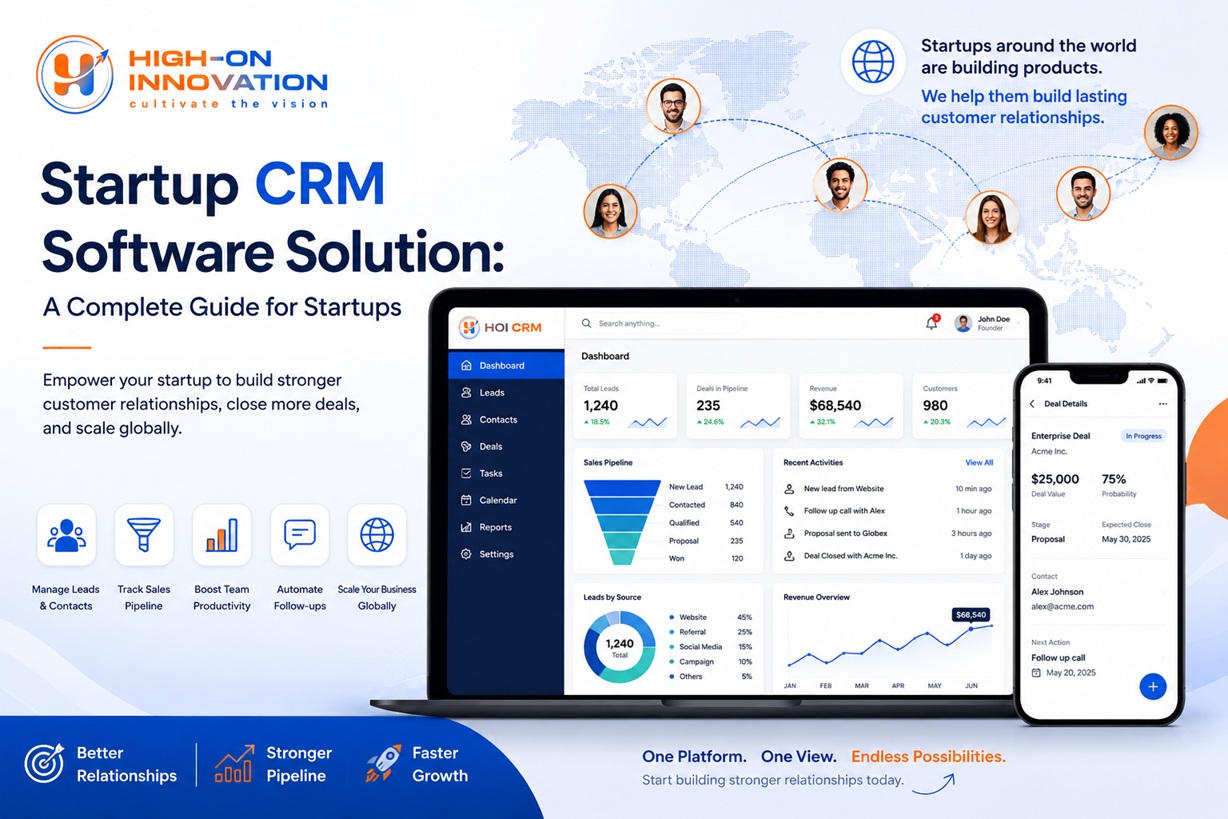
Startup CRM Software Solution: A Complete Guide for Startups around the world are building products
Startups around the world are building products, entering new markets, and scaling teams faster than ever. As a company grows, managing leads, customers, sales conversations, follow-ups, and business relationships through spreadsheets, email, and messaging apps becomes increasingly difficult. This is where a startup CRM software solution can become an important part of a company's growth infrastructure.